
Got a photo? Identify mushrooms instantly with the Mushby app
Open the appDescription
Strobilurus tenacellus, commonly known as the Conifer Cone Cap, is a small, delicate agaric mushroom that is saprobic on buried conifer cones, primarily spruce and pine. It is characterized by its small, often umbonate cap, white gills, and a slender, tough stem that arises directly from a buried cone. This species is one of several 'cone-dwelling' mushrooms, distinguished by its specific microscopic features and host preference.
How to Identify
- Cap
- 1-3 cm in diameter, convex to broadly convex, often with a central umbo (a small, nipple-like bump). The surface is smooth, sometimes slightly radially striate when moist, and can be whitish, pale yellowish-brown, or grayish-brown, often darker towards the center. It becomes paler with age and when dry.
- Gills
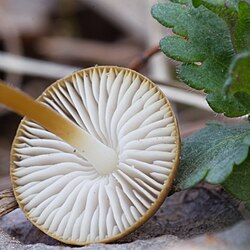
- Adnexed to almost free, crowded, narrow, and white to cream-colored. They may develop a slightly yellowish tint with age.
- Stem
- 3-8 cm long and 1-3 mm thick, slender, cylindrical, and often slightly tapering towards the apex. It is tough, cartilaginous, and typically whitish to pale brownish, often darker towards the base. The base is usually deeply rooted in the substrate, attaching to a buried conifer cone. It lacks a ring.
- Flesh
- Thin, whitish, and rather tough in the stem.
- Fruiting body
- Small, delicate agaric, typically growing solitary or in small groups directly from buried conifer cones.
- Habitat
- Saprobic, growing exclusively on buried or partially buried conifer cones, primarily spruce (Picea spp.) and pine (Pinus spp.). It is found in coniferous and mixed forests.
Key Facts
- Cap surfaces: Smooth, sometimes radially striate when moist.
- Growth Form: Solitary to gregarious.
- Spore Print: White.
- Body color: Cap whitish to pale yellowish-brown; gills white; stem whitish to pale brownish.
- Odor: Mild, indistinct.
- Flesh bruises: Does not bruise.
- Height: 3-8 cm
- Cap Diameter: 1-3 cm
- Nutrient gathering: Saprobic on conifer cones.
Safe
SafeStrobilurus tenacellus is generally considered edible, though its small size makes it of little culinary interest. There are no known toxic compounds. However, always exercise caution and ensure positive identification before consumption. Misidentification with other small, potentially inedible or toxic species is a risk for inexperienced foragers.
Quick Check
- Odor: Mild, indistinct, sometimes slightly radish-like.
- Fruiting: Spring to early summer, sometimes autumn.
- Substrate: Buried conifer cones (spruce, pine).
Where to Find
Coniferous Forests
Common in coniferous forests across Europe and North America where spruce and pine trees are prevalent. Look for it under the needle litter.
Mixed Forests
Can also be found in mixed forests, provided there is a significant presence of conifer trees and their cones.
Finding Tips
Look for Cones
The most crucial tip is to actively search for buried conifer cones. The mushroom's stem will be directly attached to one.
Check Under Litter
Gently rake away needle litter and duff in areas with conifers, especially around the base of trees.
Timing
This species fruits early in the spring, often appearing shortly after snowmelt, and can continue into late spring or early summer. A second flush may occur in autumn.
Similar Species
Spruce Cone Cap
mushroom
Also known as: Strobilurus esculentus
Pine Cone Cap
mushroom
Also known as: Strobilurus stephanocystis
Oak Cone Cap
mushroom
Also known as: Strobilurus kühneri
Scientific Classification
- Phylum
- Basidiomycota
- Class
- Agaricomycetes
- Order
- Agaricales
- Family
- Physalacriaceae
- Genus
- Strobilurus
Storage Information
- Max Temperature: 4°C
- Freezing duration: 6 months
- Min Temperature: 1°C
- Refrigeration: 3 days
How to Clean
Due to its small size and delicate nature, cleaning is minimal. Gently brush off any debris with a soft brush. Avoid washing with water as they can become waterlogged and lose texture.
Explore Conifer Cone Cap
Identify mushrooms anywhere
Free on iOS, Android, and Web. Photo identification, full database, and your personal collection.