
How to identify Old-man-of-the-woods
Strobilomyces strobilaceus
Got a photo? Identify mushrooms instantly with the Mushby app
Open the appTo correctly identify Old-man-of-the-woods (Strobilomyces strobilaceus), check each of these features in order. Misidentification is the most common cause of mushroom poisoning, so cross-reference multiple sources.
Step-by-step identification
- 1
Cap
Shape, color, surface texture, and diameter.
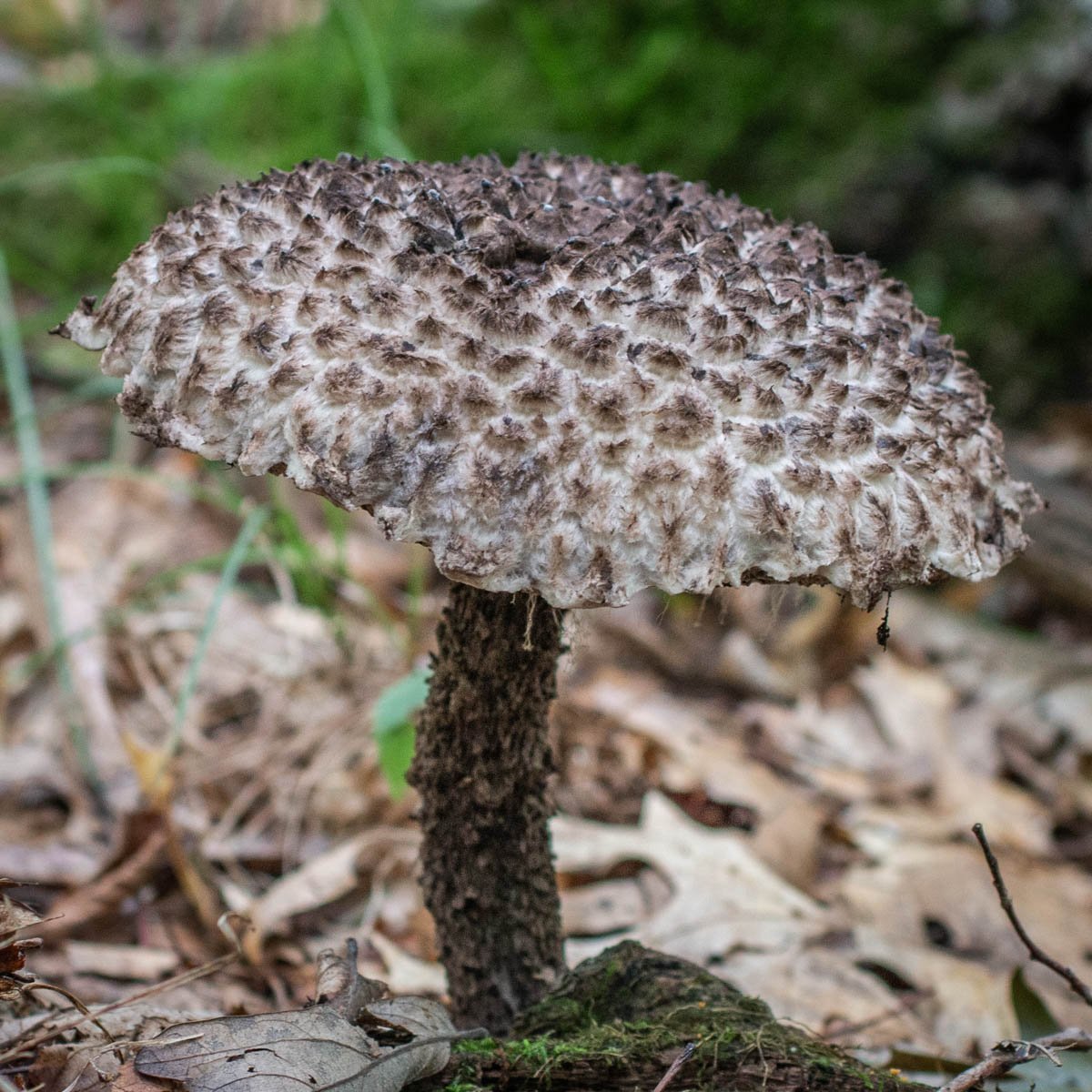
The cap is convex, becoming flattened with age, and covered in coarse, dark grey to black scales. The scales give it a rough, almost pine cone-like texture.
- 2
Gills
Attachment to stem, color, and spacing.
This mushroom has pores instead of gills. The pores are angular and greyish-white, darkening with age and bruising.
- 3
Stem
Length, shape, surface, and any ring.
The stem is stout, shaggy, and similar in color to the cap, covered in scales or coarse hairs. It lacks a ring.
- 4
Flesh
Color, texture, and bruising reaction.
The flesh is thick and white, bruising reddish and eventually black when cut or exposed to air.
- 5
Fruiting body
Overall growth pattern.
The fruiting body is large and fleshy, with a distinctive shaggy appearance.
- 6
Habitat
Where it grows and on what substrate.
It grows in deciduous and coniferous woods, often in sandy soil, during summer and fall. 주로 여름과 가을에 걸쳐 활엽수림과 침엽수림에서 발견됩니다.
Key Facts
- Cap surfaces
- Shaggy scales
- Growth Form
- Solitary or scattered
- Spore Print
- Black
- Body color
- Dark grey to black
- Odor
- Mild
- Flesh bruises
- Reddish then black
- Height
- 5-20 cm
- Cap Diameter
- 5-20 cm
Fruit body characteristics
- Gill attachment: Pores
- Stem shape: Cylindrical
- Stem surface: Shaggy
- Ring: Absent
- Stem cross-section: Solid
Explore Old-man-of-the-woods
Identify mushrooms anywhere
Free on iOS, Android, and Web. Photo identification, full database, and your personal collection.