
Got a photo? Identify mushrooms instantly with the Mushby app
Open the appDescription
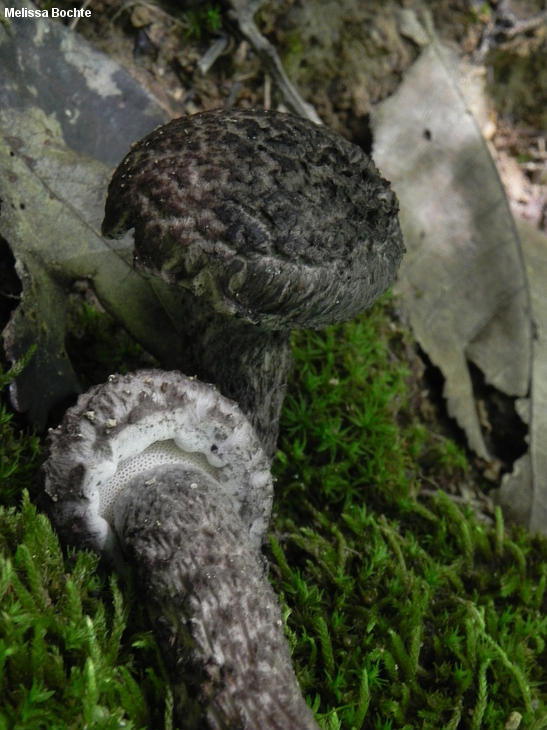
Strobilomyces floccopus, commonly known as Old-man-of-the-woods, is a striking and distinctive mushroom species. It is characterized by its shaggy, dark-scaled cap and stem, giving it a somewhat prehistoric or 'old' appearance. This mushroom is found in deciduous and coniferous forests, often in association with oak and pine trees. While it is considered edible, its texture can be coarse, and it is not highly sought after by all mushroom hunters.
How to Identify
- Cap
- The cap is initially globose or oval, later becoming convex to flattened with age. The surface is covered in coarse, dark grey to black scales or tufts, giving it a rough and shaggy texture. The flesh is thick and white, bruising reddish and then blackish when cut or damaged.
- Gills
- The gills are free to slightly decurrent, meaning they do not directly attach to the stem or run slightly down it. They are whitish to greyish, darkening with age and bruising. The pores are angular and relatively large.
- Stem
- The stem is typically stout and sturdy, measuring 5 to 15 cm in length and 1 to 3 cm in diameter. It is covered in shaggy scales similar to those on the cap, and its color ranges from grey to black. The stem lacks a ring or volva.
- Flesh
- The flesh of Strobilomyces floccopus is thick and white, but it undergoes a color change when cut or bruised, turning reddish and eventually blackish. This bruising reaction is a key characteristic of the species.
- Fruiting body
- The fruiting body of Strobilomyces floccopus is typically medium to large in size, with a cap diameter ranging from 5 to 20 cm. The overall appearance is shaggy and dark, with prominent scales covering both the cap and stem.
- Habitat
- Strobilomyces floccopus is found in both deciduous and coniferous forests, often in association with oak and pine trees. It is a mycorrhizal fungus, forming symbiotic relationships with the roots of trees. It typically fruits in summer and autumn.
Key Facts
- Cap surfaces: Dry, shaggy with dark scales
- Growth Form: Mycorrhizal
- Spore Print: Black
- Body color: Dark grey to black
- Odor: Mild and earthy
- Flesh bruises: Reddish then blackish
- Height: 5-15 cm
- Cap Diameter: 5-20 cm
- Nutrient gathering: Mycorrhizal
Safe
SafeStrobilomyces floccopus is generally considered edible, but it is not highly regarded due to its coarse texture. Some individuals may experience gastrointestinal upset if it is not cooked thoroughly. It is important to properly identify this mushroom to avoid confusion with any potentially toxic look-alikes.
Quick Check
- Odor: Mild and earthy
- Fruiting: Solitary or in small groups
- Substrate: Soil in deciduous and coniferous forests
Where to Find
North America
Eastern North America, particularly in deciduous forests with oak and pine.
Europe
Various regions in Europe, often in mixed forests.
Finding Tips
Look Near Host Trees
Search around the base of oak and pine trees in late summer and autumn.
Check Shaded Areas
Focus on shaded, moist areas within the forest.
Similar Species
Strobilomyces confusus
Mushroom
Also known as: Confusing Old Man of the Woods
Scientific Classification
- Phylum
- Basidiomycota
- Class
- Agaricomycetes
- Order
- Boletales
- Family
- Boletaceae
- Genus
- Strobilomyces
Storage Information
- Max Temperature: N/A
- Freezing duration: N/A
- Min Temperature: 2-4°C (35-40°F)
- Refrigeration: 3-5 days
How to Clean
To clean Strobilomyces floccopus, gently brush off any dirt or debris from the cap and stem. Avoid soaking the mushroom in water, as it can become waterlogged. A soft brush or damp cloth can be used to remove stubborn dirt. Trim any damaged or discolored parts before cooking.
Explore Old-man-of-the-woods
Identify mushrooms anywhere
Free on iOS, Android, and Web. Photo identification, full database, and your personal collection.