
Got a photo? Identify mushrooms instantly with the Mushby app
Open the appDescription
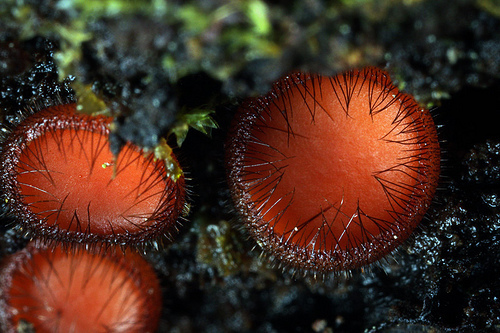
The Eyelash Cup (Scutellinia scutellata) is a small, bright red fungus that belongs to the cup fungi family. It is characterized by its tiny, cup-like shape and the presence of dark, eyelash-like hairs around the rim of the cup. These hairs are technically called setae and are a key feature for identification. The fungus is saprobic, meaning it obtains nutrients from decaying organic matter, and is commonly found on damp wood, bark, and plant debris in woodland areas. It is not considered edible due to its small size and lack of substantial flesh.
How to Identify
- Cap
- The 'cap' is cup-shaped, typically 2-10 mm in diameter. The inner surface is bright red to orange-red, while the outer surface is paler and may be slightly hairy.
- Gills
- Absent, as it is a cup fungus.
- Stem
- Absent; the fungus is sessile (attaches directly to the substrate).
- Flesh
- The flesh is very thin and reddish.
- Fruiting body
- Small, cup-shaped fungus with bright red inner surface and dark, eyelash-like hairs (setae) around the rim.
- Habitat
- Found on decaying wood, bark, and plant debris in damp woodland areas.
Key Facts
- Cap surfaces: Smooth inner surface, slightly hairy outer surface
- Growth Form: Cup-shaped
- Spore Print: White to pale yellow
- Body color: Bright red to orange-red
- Odor: Not distinctive
- Flesh bruises: No bruising reaction
- Height: 1-3 mm
- Cap Diameter: 2-10 mm
- Nutrient gathering: Saprobic
Safe
SafeScutellinia scutellata is not considered toxic, but it is also not typically consumed due to its small size and lack of culinary value.
Quick Check
- Odor: Not distinctive
- Fruiting: Cup-shaped, bright red with eyelash-like hairs
- Substrate: Decaying wood, bark, plant debris
Where to Find
Decaying Wood
Eyelash Cups are commonly found on decaying wood, bark, and plant debris in woodland areas. They thrive in damp environments.
Forest Floor
Look for these fungi on fallen branches, logs, and other woody debris on the forest floor.
Tree Bark
Eyelash Cups can also be found on the bark of trees, especially in areas with high moisture levels.
Finding Tips
Look for Bright Red Color
Eyelash Cups are most easily spotted due to their bright red color against the darker background of decaying wood and leaf litter.
Check Damp Areas
Check damp and shaded areas in woodlands, as these fungi prefer moist environments.
Use a Magnifying Glass
Use a magnifying glass to observe the eyelash-like hairs (setae) around the rim of the cup, which are a key identifying feature.
Similar Species
Other Scutellinia species
cup fungus
Also known as: N/A
Scientific Classification
- Phylum
- Ascomycota
- Class
- Pezizomycetes
- Order
- Pezizales
- Family
- Pyronemataceae
- Genus
- Scutellinia
Storage Information
- Max Temperature: N/A (not typically stored)
- Freezing duration: N/A (not typically stored)
- Min Temperature: N/A (not typically stored)
- Refrigeration: N/A (not typically stored)
How to Clean
Eyelash Cups are not typically cleaned as they are very small and not consumed. If necessary, gently brush off any debris with a soft brush.
Explore Eyelash Cup
Identify mushrooms anywhere
Free on iOS, Android, and Web. Photo identification, full database, and your personal collection.