
Got a photo? Identify mushrooms instantly with the Mushby app
Open the appDescription
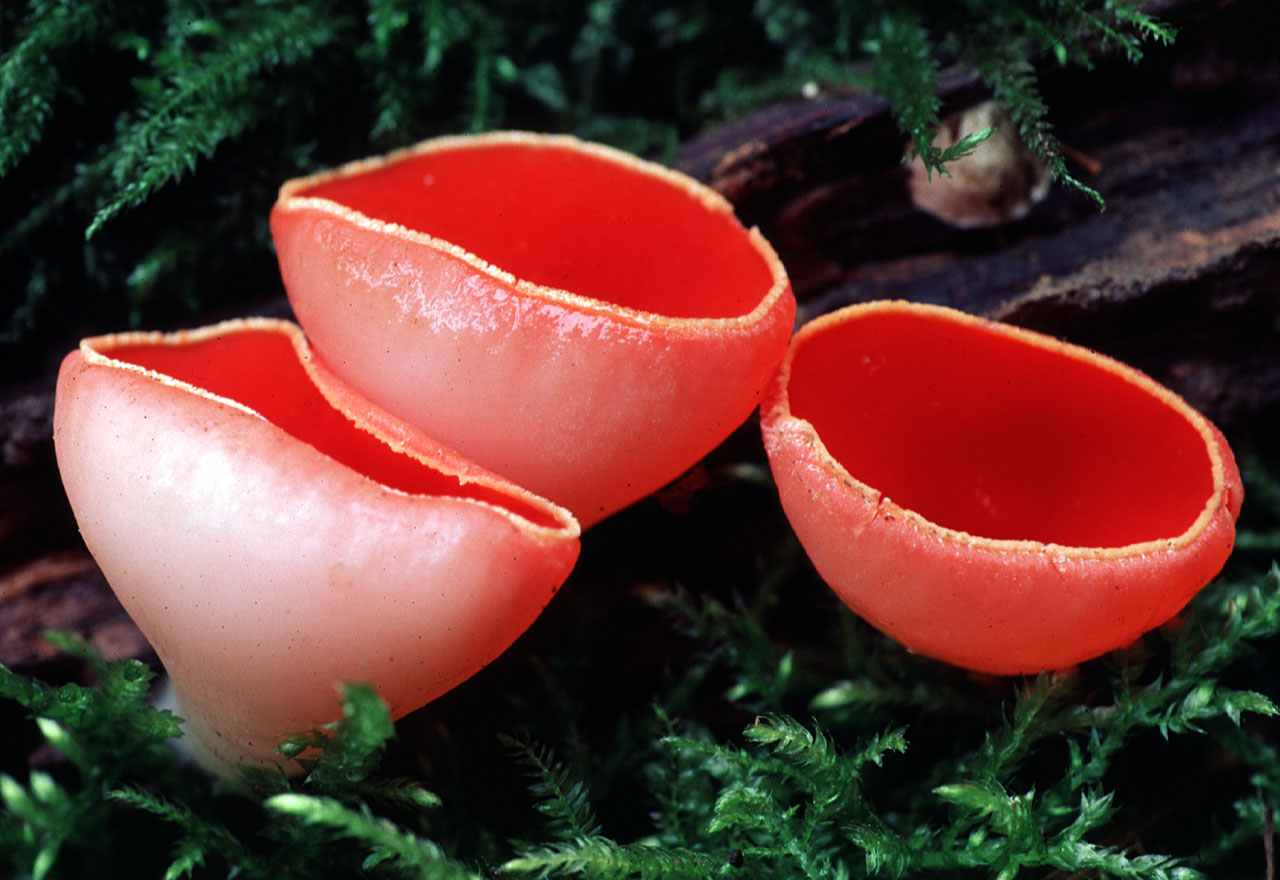
Sarcoscypha coccinea, commonly known as the Scarlet Elfcup, is a striking and easily recognizable ascomycete fungus. It is characterized by its vibrant scarlet-red, cup-shaped fruiting bodies that typically appear in late winter and early spring. This species is saprobic, growing on decaying hardwood branches and twigs, often partially buried in leaf litter. Its vivid coloration makes it a popular subject for nature photographers and a welcome sight in the often-drab winter woodland.
How to Identify
- Cap
- Not a true cap in the sense of a gilled mushroom. The 'cap' refers to the apothecium, which is cup-shaped, 1-5 cm (0.4-2 inches) in diameter, and 1-3 cm (0.4-1.2 inches) deep. The color is brilliant scarlet to crimson on the inner surface, and whitish to pale pinkish on the outer surface.
- Gills
- Not applicable, as Sarcoscypha coccinea is an ascomycete and does not produce gills. Spores are produced on the inner surface of the cup.
- Stem
- A short, rudimentary stem (stipe) is often present, typically 0.5-3 cm (0.2-1.2 inches) long and 0.2-0.8 cm (0.08-0.3 inches) thick. It is usually paler than the cup, whitish to pinkish, and often buried in the substrate or leaf litter. It can be eccentric or central.
- Flesh
- Thin, brittle, and reddish.
- Fruiting body
- The fruiting body (apothecium) is cup-shaped, becoming more saucer-shaped or flattened with age. The inner surface (hymenium) is bright scarlet to crimson red, smooth. The outer surface is paler, whitish to pinkish, and finely felted or downy. The margin is often slightly inrolled when young, becoming erect or wavy.
- Habitat
- Saprobic, growing on decaying hardwood branches and twigs, particularly those of willow (Salix), hazel (Corylus), alder (Alnus), and beech (Fagus). It prefers damp, shaded locations, often partially buried in moss or leaf litter.
Key Facts
- Cap surfaces: Inner surface smooth, bright scarlet; outer surface whitish to pinkish, finely felted.
- Growth Form: Solitary to gregarious, often in clusters.
- Spore Print: White
- Body color: Bright scarlet red (inner surface), whitish to pinkish (outer surface)
- Odor: Indistinct
- Flesh bruises: Does not bruise significantly
- Height: 1-5 cm (0.4-2 inches) for the cup, stem up to 3 cm (1.2 inches)
- Cap Diameter: 1-5 cm (0.4-2 inches)
- Nutrient gathering: Saprobic
Safe
SafeSarcoscypha coccinea is generally considered edible, though its edibility is often described as 'mediocre' or 'insignificant' due to its thin flesh and lack of distinct flavor. It is not known to be toxic. However, as with all wild mushrooms, proper identification is crucial to avoid confusion with potentially toxic look-alikes. Always cook wild mushrooms thoroughly.
Quick Check
- Odor: Indistinct or slightly earthy
- Fruiting: Late winter to early spring
- Substrate: Decaying hardwood branches and twigs
Where to Find
Deciduous Woodlands
Commonly found in deciduous forests, especially where there is an abundance of fallen hardwood branches and twigs.
Riverbanks and Stream Sides
Moist environments near water bodies are ideal, as these areas often have decaying wood and high humidity.
Shaded Areas
Prefers shaded, damp spots, often under leaf litter or moss, which helps retain moisture.
Finding Tips
Timing is Key
Look for Scarlet Elfcups in late winter and early spring (December to April in the Northern Hemisphere), as they are one of the first fungi to appear after the cold season.
Search on Decaying Wood
Focus your search on fallen branches and twigs of hardwoods, particularly those that are well-rotted and partially buried. They rarely grow directly on the ground.
Look for Bright Colors
Their vibrant red color makes them stand out against the drab winter landscape, so keep an eye out for splashes of red.
Check Undersides of Logs
They often grow on the underside or sides of decaying logs and branches, so be sure to inspect all surfaces.
Similar Species
Ruby Elfcup
fungus
Also known as: Sarcoscypha austriaca
Pink Elfcup
fungus
Also known as: Sarcoscypha dudleyi
Orange Peel Fungus
fungus
Also known as: Aleuria aurantia
Scientific Classification
- Phylum
- Ascomycota
- Class
- Pezizomycetes
- Order
- Pezizales
- Family
- Sarcoscyphaceae
- Genus
- Sarcoscypha
Storage Information
- Max Temperature: 4°C
- Freezing duration: 6 months
- Min Temperature: 0°C
- Refrigeration: 3-5 days
How to Clean
Gently brush off any debris, soil, or leaf litter with a soft brush or damp cloth. Avoid washing them under running water, as they can become waterlogged and lose their texture. If necessary, a quick rinse and immediate drying on paper towels can be done.
Explore Scarlet Elfcup
Identify mushrooms anywhere
Free on iOS, Android, and Web. Photo identification, full database, and your personal collection.