
Got a photo? Identify mushrooms instantly with the Mushby app
Open the appDescription
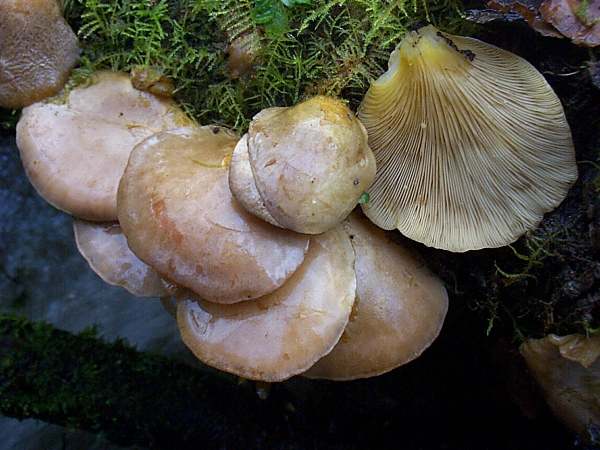
Sarcomyxa serotina, commonly known as the Olive Oysterling, is a late-fruiting, edible mushroom. It is characterized by its olive-brown to yellowish-brown cap, decurrent gills, and a short, stubby stem. The mushroom often appears in clusters on decaying wood, particularly of deciduous trees. While edible, it is not highly regarded due to its sometimes slimy texture and variable flavor.
How to Identify
- Cap
- The cap is olive-brown to yellowish-brown, often with a slimy or gelatinous surface, especially when wet. The shape is variable, ranging from kidney-shaped to fan-shaped or semicircular. The margin is often wavy or lobed.
- Gills
- The gills are decurrent, meaning they run down the stem. They are closely spaced and yellowish-brown in color, often becoming darker with age.
- Stem
- The stem is short, stubby, and often lateral or absent. It is typically the same color as the cap or slightly lighter.
- Flesh
- The flesh is yellowish-brown and somewhat gelatinous, especially in wet conditions.
- Fruiting body
- The fruiting body of Sarcomyxa serotina is typically medium-sized, with a cap that ranges from 3 to 10 cm in diameter. It often grows in clusters, with individual caps overlapping.
- Habitat
- Sarcomyxa serotina grows on decaying wood, particularly of deciduous trees such as beech, birch, and willow. It is typically found in late autumn to early winter.
Key Facts
- Cap surfaces: Slimy or gelatinous when wet
- Growth Form: Clustered
- Spore Print: Yellowish-brown
- Body color: Olive-brown to yellowish-brown
- Odor: Mild
- Flesh bruises: No bruising
- Height: 2-5 cm
- Cap Diameter: 3-10 cm
- Nutrient gathering: Saprophytic
Safe
SafeSarcomyxa serotina is generally considered edible, but it can cause gastrointestinal upset in some individuals. It is important to cook it thoroughly before consumption.
Quick Check
- Odor: Mild and fungal
- Fruiting: Late autumn to early winter
- Substrate: Decaying wood of deciduous trees
Where to Find
Deciduous Forests
Prefers decaying wood in deciduous forests.
Northern Hemisphere
Common in North America and Europe.
Finding Tips
Late Season
Look for it in late autumn to early winter.
Decaying Wood
Check fallen logs and branches of deciduous trees.
Similar Species
Crepidotus mollis
a species of bracket fungus
Also known as: Peeling Oysterling
Scientific Classification
- Phylum
- Basidiomycota
- Class
- Agaricomycetes
- Order
- Agaricales
- Family
- Lyophyllaceae
- Genus
- Sarcomyxa
Storage Information
- Max Temperature: 4°C
- Freezing duration: 3 months
- Min Temperature: 2°C
- Refrigeration: 3-5 days
How to Clean
Clean by gently wiping the cap with a damp cloth to remove debris. Avoid soaking, as the mushroom can become waterlogged.
Explore Olive Oysterling
Identify mushrooms anywhere
Free on iOS, Android, and Web. Photo identification, full database, and your personal collection.