
Got a photo? Identify mushrooms instantly with the Mushby app
Open the appDescription
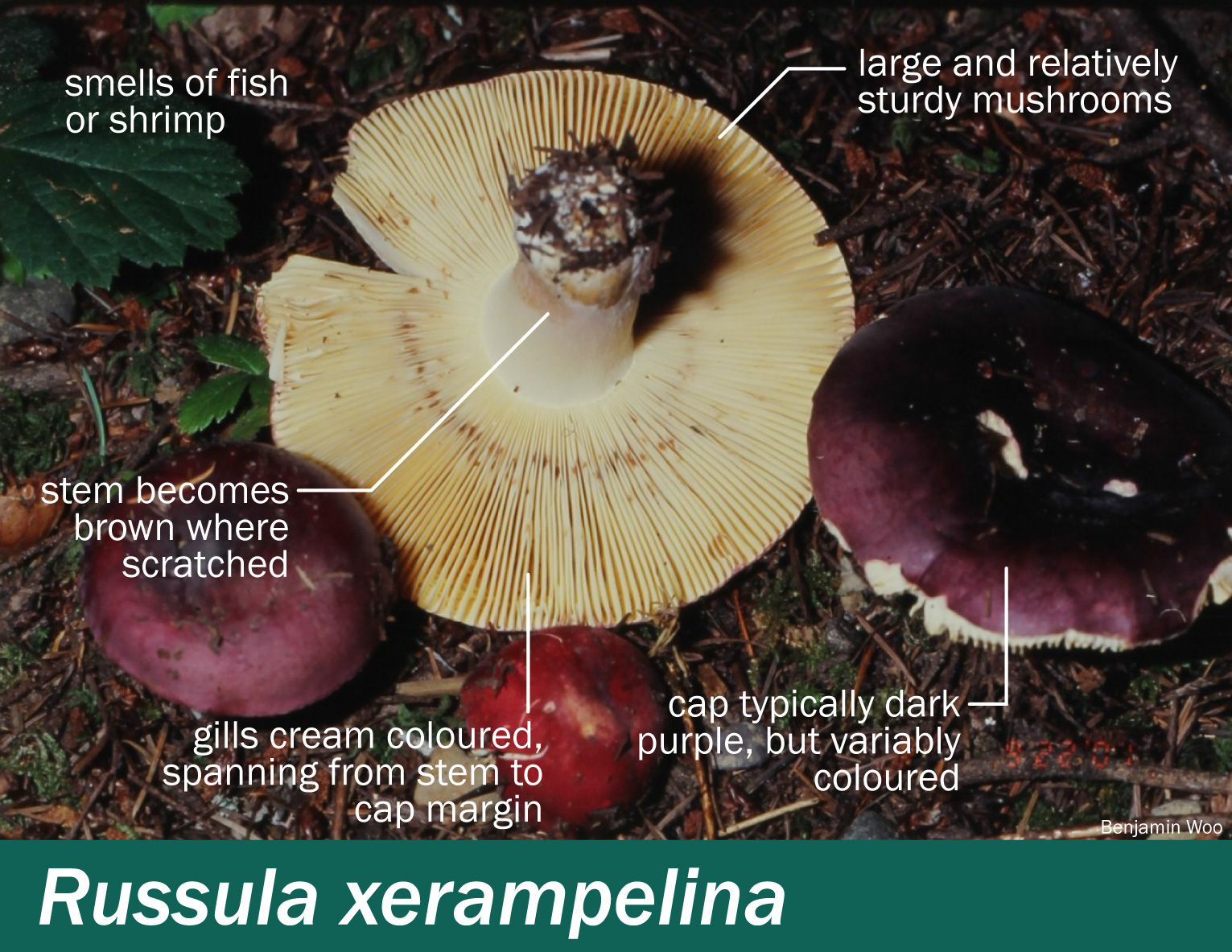
Russula xerampelina, also known as the crab brittlegill, is a common, edible mushroom, found in coniferous woodlands. Its cap is reddish, and up to 10 cm in diameter. The gills are white to pale cream, and the stalk is white, flushed with red. The flesh smells of shellfish, hence the common name.
How to Identify
- Cap
- The cap is convex when young, flattening with age, and often develops a shallow depression. The color is typically reddish, ranging from deep red to pinkish-red, and may have yellowish or brownish tints. The surface is smooth and slightly sticky when moist, becoming dry with age. The margin is often slightly wrinkled or furrowed.
- Gills
- The gills are white to pale cream, close together, and slightly brittle. They are adnexed to free, meaning they are narrowly attached to the stem or not attached at all.
- Stem
- The stem is white, flushed with red, and cylindrical to club-shaped. The surface is dry and smooth. It is solid, not hollow.
- Flesh
- The flesh is white, sometimes with a reddish tint, and firm. It has a distinctive shellfish-like odor, especially when cut or crushed.
- Fruiting body
- Medium to large size, with a reddish cap, white to pale cream gills, and a white stalk flushed with red. The shellfish-like odor is a key identifying feature.
- Habitat
- Found in coniferous woodlands, typically under pine and spruce trees. It fruits in late summer and autumn.
Key Facts
- Cap surfaces: Smooth, slightly sticky when moist
- Growth Form: Solitary or scattered
- Spore Print: White to pale cream
- Body color: White, flushed with red
- Odor: Shellfish-like
- Flesh bruises: Not applicable
- Height: 5-8 cm
- Cap Diameter: 5-10 cm
- Nutrient gathering: Mycorrhizal
Safe
SafeRussula xerampelina is considered edible, but some similar species can cause gastrointestinal upset. It is important to properly identify the mushroom before consumption.
Quick Check
- Odor: Shellfish-like
- Fruiting: Late summer and autumn
- Substrate: Coniferous woodlands, under pine and spruce trees
Where to Find
Europe
Coniferous woodlands
North America
Under pine and spruce trees
Finding Tips
Season
Look for them in late summer and autumn.
Habitat
Check areas with moist soil and plenty of leaf litter.
Similar Species
Russula nobilis
Russula
Also known as: Beechwood Sickener
Russula faginea
Russula
Also known as: Geranium-scented Russula
Scientific Classification
- Phylum
- Basidiomycota
- Class
- Agaricomycetes
- Order
- Russulales
- Family
- Russulaceae
- Genus
- Russula
Storage Information
- Max Temperature: 4
- Freezing duration: 3
- Min Temperature: 2
- Refrigeration: 2
How to Clean
Gently brush off any dirt or debris from the cap and stem. A soft, damp cloth can be used to wipe away stubborn dirt. Avoid soaking the mushroom in water, as it can become waterlogged.
Explore Crab brittlegill
Identify mushrooms anywhere
Free on iOS, Android, and Web. Photo identification, full database, and your personal collection.