
Got a photo? Identify mushrooms instantly with the Mushby app
Open the appDescription
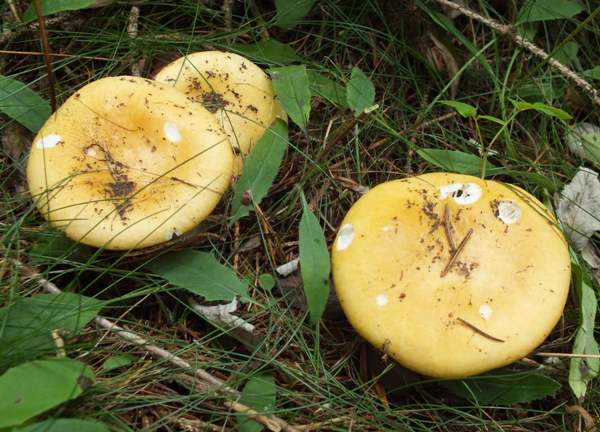
Russula ochroleuca, commonly known as the Yellow-gilled Russula or Ochre Brittlegill, is a widespread and common mushroom found in coniferous and deciduous woodlands across the Northern Hemisphere. It is characterized by its dull yellow to ochre cap, pale yellow gills, and white stem. While generally considered edible, its taste is often described as mild to slightly acrid, and it is not highly regarded as a culinary mushroom. It belongs to the Russulaceae family, known for its brittle flesh and lack of a milky latex (unlike Lactarius species).
How to Identify
- Cap
- The cap is typically 5-12 cm in diameter, initially convex, becoming plano-convex to depressed with age. The color ranges from dull yellow, ochre, or straw-yellow to pale brownish-yellow, often darker towards the center. The margin is often striate in older specimens. The cuticle is viscid when wet, but soon dry, and peels about one-third to halfway to the center.
- Gills
- The gills are adnexed to almost free, crowded to subdistant, and brittle. They are initially pale cream, becoming distinctly pale yellow to ochre-yellow with age. They are often forked near the stem.
- Stem
- The stem is 4-10 cm long and 1-2.5 cm thick, cylindrical or slightly tapering towards the base, solid when young, becoming somewhat spongy or hollow with age. It is white, sometimes with a yellowish tinge, and smooth or finely pruinose. It does not have a ring or volva.
- Flesh
- The flesh is white, firm, and brittle, not changing color when cut or bruised. It has a mild to slightly acrid taste, especially in the gills.
- Fruiting body
- The fruiting body is a typical agaric (gilled mushroom) with a cap, gills, and a central stem. It is robust and brittle.
- Habitat
- Russula ochroleuca is a mycorrhizal fungus, forming symbiotic relationships with the roots of various trees. It is commonly found in both coniferous and deciduous forests, particularly under oak, beech, birch, and pine trees. It prefers acidic to neutral soils.
Key Facts
- Cap surfaces: Smooth, viscid when wet, dry otherwise, peels partially.
- Growth Form: Solitary to scattered.
- Spore Print: Pale cream to pale yellow (IIb-IIIa).
- Body color: Cap: dull yellow, ochre; Gills: pale yellow; Stem: white.
- Odor: Faint, indistinct.
- Flesh bruises: Does not bruise or change color.
- Height: 4-10 cm
- Cap Diameter: 5-12 cm
- Nutrient gathering: Mycorrhizal
Safe
SafeRussula ochroleuca is generally considered edible, but its taste is often described as mild to slightly acrid, making it less desirable than other edible Russula species. It is not known to be toxic, but like all wild mushrooms, individual sensitivities can occur. It is crucial to cook it thoroughly. Raw consumption of any Russula is not recommended due to potential gastrointestinal upset.
Quick Check
- Odor: Faint, indistinct, sometimes slightly fruity or earthy.
- Fruiting: Late summer to autumn.
- Substrate: Terrestrial, mycorrhizal with various broadleaf and coniferous trees.
Where to Find
Europe
Widespread and common across most of Europe, from Scandinavia to the Mediterranean.
North America
Common throughout temperate regions of North America, particularly in the eastern and western forests.
Asia
Reported from parts of Asia, though its distribution may be less well-documented than in Europe and North America.
Finding Tips
Seasonality
Typically fruits from late summer through autumn (August to November in the Northern Hemisphere), with peak abundance often in September and October.
Habitat Preference
Look for it in mixed woodlands, especially where oak, beech, birch, or pine trees are present. It can be found growing solitarily or in scattered groups on the forest floor.
Spore Print
A spore print is essential for accurate identification of Russula species. Russula ochroleuca produces a pale cream to pale yellow spore print (spore print color IIb-IIIa on the Romagnesi scale).
Taste Test (Caution Advised)
For experienced foragers, a small taste of the raw flesh (and then spitting it out) can help differentiate Russula species. R. ochroleuca has a mild to slightly acrid taste. Any Russula with a strongly peppery or acrid taste should be avoided for consumption.
Similar Species
Common Yellow Russula
Russula
Also known as: Russula claroflava
Geranium Scented Russula
Russula
Also known as: Russula fellea
Beechwood Sickener
Russula
Also known as: Russula nobilis (formerly R. mairei)
Charcoal Burner
Russula
Also known as: Russula cyanoxantha
Scientific Classification
- Phylum
- Basidiomycota
- Class
- Agaricomycetes
- Order
- Russulales
- Family
- Russulaceae
- Genus
- Russula
Storage Information
- Max Temperature: 4°C
- Freezing duration: 6 months
- Min Temperature: 0°C
- Refrigeration: 5 days
How to Clean
Brush off any dirt or debris with a soft brush or damp cloth. Avoid washing under running water, as mushrooms can absorb water and become soggy. Trim off any damaged or insect-eaten parts.
Explore Yellow-gilled Russula
Identify mushrooms anywhere
Free on iOS, Android, and Web. Photo identification, full database, and your personal collection.