
Got a photo? Identify mushrooms instantly with the Mushby app
Open the appDescription
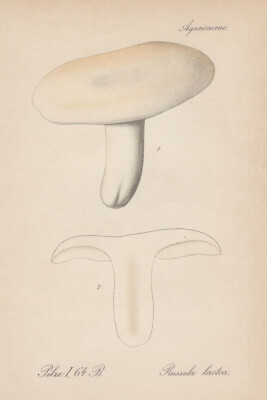
Russula lactea, commonly known as the Milk-white Russula, is a medium-sized, entirely white mushroom belonging to the Russulaceae family. It is characterized by its chalk-white cap, gills, and stem, and its mild taste. It is a mycorrhizal fungus, forming symbiotic relationships with various deciduous and coniferous trees.
How to Identify
- Cap
- The cap is 5-15 cm in diameter, initially convex, becoming broadly convex to flat, often with a depressed center. The margin is usually inrolled when young, expanding with age. The surface is dry, smooth, and unpolished, chalk-white to cream-white, sometimes developing yellowish or brownish stains with age or handling. The cuticle is not easily peelable.
- Gills
- The gills are adnate to slightly decurrent, crowded, broad, and brittle. They are pure white, sometimes developing a creamy tint with age. There are numerous lamellulae (short gills).
- Stem
- The stem is 3-8 cm long and 1-3 cm thick, central, cylindrical or slightly tapering towards the base, solid, and firm. The surface is dry, smooth, and chalk-white, often staining yellowish or brownish with age or handling. It lacks a ring or volva.
- Flesh
- The flesh is thick, firm, brittle, and white throughout. It does not change color when cut or bruised. The taste is mild, and the odor is indistinct.
- Fruiting body
- The fruiting body is entirely white, robust, and typically grows solitarily or scattered.
- Habitat
- Russula lactea is a mycorrhizal species, typically found growing on the ground in deciduous and coniferous forests, often associated with oak (Quercus), beech (Fagus), and pine (Pinus). It prefers well-drained, often calcareous soils.
Key Facts
- Cap surfaces: Dry, smooth, unpolished
- Growth Form: Solitary to scattered
- Spore Print: White to cream
- Body color: Chalk-white throughout
- Odor: Indistinct
- Flesh bruises: No color change
- Height: 3-8 cm
- Cap Diameter: 5-15 cm
- Nutrient gathering: Mycorrhizal
Safe
SafeRussula lactea is considered edible with a mild taste. However, it is crucial to correctly identify it, as several white Russula and Lactarius species exist, some of which can be acrid or mildly toxic if consumed raw. Always cook mushrooms thoroughly. Never consume wild mushrooms unless positively identified by an expert. If in doubt, discard it.
Quick Check
- Odor: Indistinct
- Fruiting: Late summer to autumn
- Substrate: Ground, mycorrhizal with deciduous and coniferous trees
Where to Find
Europe
Widespread across temperate regions of Europe, particularly common in broadleaf and mixed woodlands.
North America
Reported from various regions in North America, though its distribution might be less common or more localized than in Europe. Often found in association with oak and pine.
Asia
Occasional reports from parts of Asia, particularly in regions with similar forest ecosystems.
Finding Tips
Seasonality
Fruiting bodies typically appear from late summer to autumn (August to October) in temperate climates.
Habitat Preference
Look for it on the ground in mature forests, especially under oak, beech, and pine trees. It often prefers mossy or leaf-littered areas.
Soil Type
While not exclusive, it often shows a preference for calcareous (lime-rich) soils.
Similar Species
Russula delica
Russula
Also known as: Short-stemmed Russula
Russula brevipes
Russula
Also known as: Short-stemmed White Russula
Lactarius piperatus
Lactarius
Also known as: Peppery Milkcap
Lactarius vellereus
Lactarius
Also known as: Fleecy Milkcap
Scientific Classification
- Phylum
- Basidiomycota
- Class
- Agaricomycetes
- Order
- Russulales
- Family
- Russulaceae
- Genus
- Russula
Storage Information
- Max Temperature: 4°C
- Freezing duration: 6 months
- Min Temperature: 1°C
- Refrigeration: 5 days
How to Clean
Gently brush off any dirt or debris with a soft brush or damp cloth. Avoid washing under running water as mushrooms can absorb excess moisture. Trim off any damaged or insect-ridden parts.
Explore Milk-white Russula
Identify mushrooms anywhere
Free on iOS, Android, and Web. Photo identification, full database, and your personal collection.