
Got a photo? Identify mushrooms instantly with the Mushby app
Open the appDescription
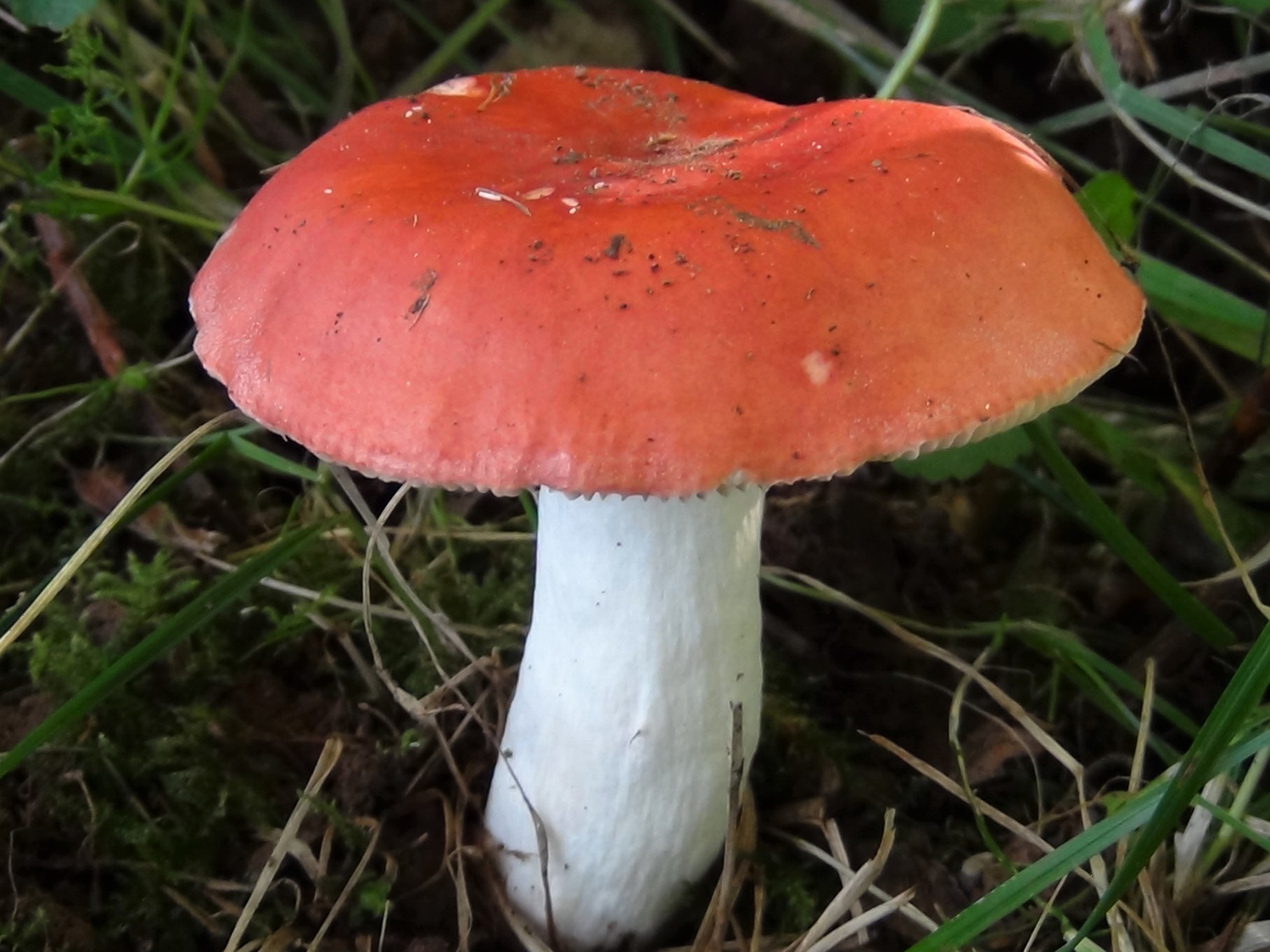
Russula emetica, commonly known as the sickener, is a basidiomycete mushroom, and the type species of the genus Russula. It has a red, convex to flat cap, pure white gills, and a white stipe that is equal in length to the cap diameter. It is commonly found in deciduous and coniferous forests and is moderately toxic, causing gastrointestinal upset when consumed raw or undercooked.
How to Identify
- Cap
- The cap is typically 5–10 cm (2–4 in) in diameter, convex when young, then flattening out with age, sometimes with a shallow depression. The cap surface is smooth and viscid when moist, and the color is typically bright red, fading to pink or even white in the center. The cap cuticle can be peeled off almost entirely from the cap.
- Gills
- The gills are adnexed to almost free, close together, and pure white. They are brittle and often forked near the stipe.
- Stem
- The stipe is 4.5–10.5 cm (1.8–4.1 in) long and 0.7–2.4 cm (0.3–0.9 in) thick, white, cylindrical or slightly club-shaped, and dry. It is smooth or slightly roughened, and brittle.
- Flesh
- The flesh is white, brittle, and has a hot, acrid taste.
- Fruiting body
- The fruiting body of Russula emetica is a mushroom with a cap and a stipe. The cap is typically 5–10 cm (2–4 in) in diameter, convex when young, then flattening out with age, sometimes with a shallow depression. The cap surface is smooth and viscid when moist, and the color is typically bright red, fading to pink or even white in the center. The cap cuticle can be peeled off almost entirely from the cap.
- Habitat
- Russula emetica is commonly found in deciduous and coniferous forests, often near birch, beech, or pine trees. It fruits from summer to autumn.
Key Facts
- Cap surfaces: Smooth, viscid when moist
- Growth Form: Solitary or scattered
- Spore Print: White
- Body color: Red, pink, or white
- Odor: Mild or indistinct
- Flesh bruises: Does not typically bruise
- Height: 4.5–10.5 cm (1.8–4.1 in)
- Cap Diameter: 5–10 cm (2–4 in)
- Nutrient gathering: Mycorrhizal
Toxic
Moderate ToxicityRussula emetica is moderately toxic and can cause gastrointestinal upset if consumed raw or undercooked. Symptoms include nausea, vomiting, diarrhea, and abdominal cramps. These symptoms typically appear within 30 minutes to 3 hours after ingestion and usually resolve within a few hours.
Quick Check
- Odor: Mild or indistinct
- Fruiting: Summer to autumn
- Substrate: Soil in deciduous and coniferous forests
Where to Find
Europe
Common throughout Europe.
North America
Found in North America, particularly in coniferous forests.
Finding Tips
Habitat
Look for Russula emetica in moist areas of deciduous and coniferous forests, especially near birch, beech, or pine trees.
Season
The mushroom fruits from summer to autumn.
Similar Species
Russula nobilis
mushroom
Also known as: Beechwood Sickener
Russula mairei
mushroom
Also known as: beech russula
Scientific Classification
- Phylum
- Basidiomycota
- Class
- Agaricomycetes
- Order
- Russulales
- Family
- Russulaceae
- Genus
- Russula
Explore Sickener
Identify mushrooms anywhere
Free on iOS, Android, and Web. Photo identification, full database, and your personal collection.