
Got a photo? Identify mushrooms instantly with the Mushby app
Open the appDescription
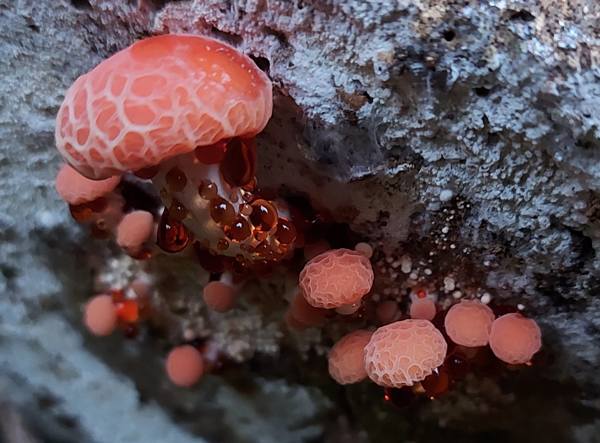
Rhodotus palmatus, commonly known as the Wrinkled Peach, Netted Rhodotus, or Rosy Veincap, is a distinctive and beautiful mushroom belonging to the Physalacriaceae family. It is characterized by its unique, deeply wrinkled or reticulated (net-like) cap surface, often displaying shades of pink, orange, or peach. This saprobic fungus grows on decaying hardwood, particularly elm, and is known for its striking appearance, making it a favorite among mycologists and nature enthusiasts. Its unusual texture and color make it relatively easy to identify in the field, though its occurrence can be sporadic.
How to Identify
- Cap
- The cap is 2-10 cm (0.8-4 inches) in diameter, convex to broadly convex, becoming flattened with age, often with a depressed center. Its most striking feature is the deeply wrinkled, reticulated, or veined surface, resembling a network of ridges and grooves. The color ranges from pale pink to peach, apricot, or reddish-orange, often fading with age or exposure to light. The margin is typically inrolled when young, becoming wavy or lobed with maturity.
- Gills
- The gills are adnate to adnexed, sometimes nearly free, moderately crowded, and relatively broad. They are initially pale pinkish, becoming more salmon-pink or orange-pink with age. They often exude small droplets of reddish liquid when young and fresh, especially in humid conditions.
- Stem
- The stem is 2-6 cm (0.8-2.4 inches) long and 0.5-1.5 cm (0.2-0.6 inches) thick, central or slightly eccentric, often curved. It is typically concolorous with the cap or slightly paler, sometimes with a finely hairy or pruinose (powdery) surface, especially towards the apex. The base is often slightly swollen. There is no ring or volva.
- Flesh
- The flesh is firm, elastic, and somewhat rubbery, whitish to pale pinkish, and does not change color when bruised or cut.
- Fruiting body
- The fruiting body is agaricoid (mushroom-shaped), typically solitary or in small clusters.
- Habitat
- Saprobic, growing on decaying hardwood logs, stumps, and branches, particularly elm (Ulmus spp.), but also occasionally on maple (Acer spp.), basswood (Tilia spp.), and other hardwoods. It prefers moist, shaded environments.
Key Facts
- Cap surfaces: Deeply wrinkled, reticulated, or veined; often slimy or sticky when moist, becoming dry with age.
- Growth Form: Solitary to gregarious (in small clusters).
- Spore Print: Pinkish to salmon-pink.
- Body color: Pale pink, peach, apricot, reddish-orange.
- Odor: Mild, sometimes fruity.
- Flesh bruises: Does not bruise.
- Height: 2-6 cm (0.8-2.4 inches)
- Cap Diameter: 2-10 cm (0.8-4 inches)
- Nutrient gathering: Saprobic (decomposer of dead wood).
Safe
SafeRhodotus palmatus is generally considered inedible due to its tough, rubbery texture and lack of culinary appeal. While not reported as toxic, it is not consumed. There are no known toxins associated with this species, but it is not recommended for consumption.
Quick Check
- Odor: Mild, sometimes described as fruity or indistinct.
- Fruiting: Late spring to autumn, especially late summer and fall.
- Substrate: Decaying hardwood logs and stumps, primarily elm.
Where to Find
North America
Widely distributed across eastern North America, particularly in the Great Lakes region and northeastern United States, extending south to the Appalachian Mountains.
Europe
Found throughout temperate Europe, though considered rare or endangered in many countries due to the decline of elm trees from Dutch elm disease.
Asia
Reported from parts of Asia, including Japan and Korea.
Finding Tips
Look for Elm Trees
Focus your search on areas with decaying elm logs and stumps. While it can grow on other hardwoods, elm is its most common host.
Check Moist, Shaded Areas
Rhodotus palmatus prefers humid, shaded environments, often near streams or in dense forest undergrowth.
Seasonal Timing
Typically fruits from late spring through autumn, with peak occurrences often in late summer and early fall, especially after periods of rain.
Distinctive Appearance
Its unique wrinkled, netted cap and peach-pink coloration make it quite distinctive. Once you've seen it, it's hard to mistake for anything else.
Similar Species
None
fungus
Also known as: No truly similar species due to its unique reticulated cap and color
Scientific Classification
- Phylum
- Basidiomycota
- Class
- Agaricomycetes
- Order
- Agaricales
- Family
- Physalacriaceae
- Genus
- Rhodotus
Storage Information
- Max Temperature: Not applicable
- Freezing duration: Not applicable
- Min Temperature: Not applicable
- Refrigeration: Not applicable
How to Clean
Due to its inedibility and rarity, cleaning instructions are not typically relevant. If handled for identification, a soft brush can remove debris. Avoid washing as it can damage the delicate surface features.
Explore Wrinkled Peach
Identify mushrooms anywhere
Free on iOS, Android, and Web. Photo identification, full database, and your personal collection.