
Got a photo? Identify mushrooms instantly with the Mushby app
Open the appDescription
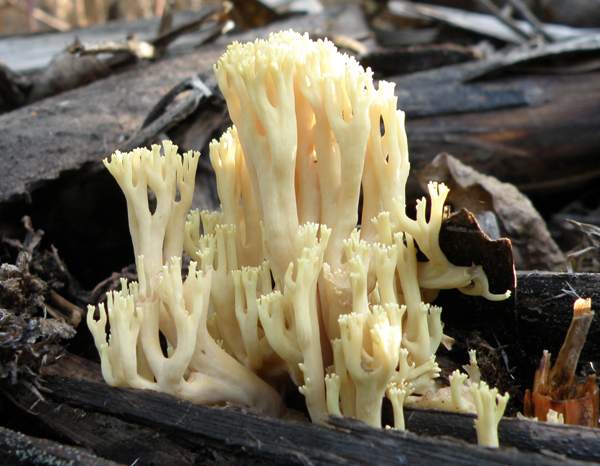
Ramaria stricta, commonly known as Spruce Coral, is a distinctive coral fungus characterized by its upright, densely branched, and often yellowish to brownish fruiting bodies. It typically grows on decaying wood, particularly conifers, and is known for its tough, fibrous texture. The branches are usually parallel and terminate in blunt tips, often becoming darker with age or handling. It is a saprobic species, playing an important role in wood decomposition.
How to Identify
- Cap
- Not applicable, as Ramaria stricta is a coral fungus and does not possess a cap.
- Gills
- Not applicable, as Ramaria stricta is a coral fungus and does not possess gills.
- Stem
- The stem (or base) is stout, whitish to yellowish, and often fused with other fruiting bodies at the base, forming a common, thick stipe-like structure. It is typically 1-3 cm thick and deeply embedded in the substrate.
- Flesh
- The flesh is whitish, tough, and fibrous, especially in the stem. It does not change color significantly when cut or bruised, though the surface of the branches may darken.
- Fruiting body
- The fruiting body is coral-like, erect, and densely branched, typically 5-15 cm tall and 3-10 cm wide. The branches are usually parallel, ascending, and somewhat brittle when fresh, becoming tougher with age. Color ranges from yellowish-buff to ochre, often with pinkish or purplish tints, especially towards the tips when young. The tips often darken to brownish or purplish-brown with age or bruising.
- Habitat
- Saprobic, growing on decaying wood, particularly conifer logs and stumps, but occasionally on hardwoods. It can be found solitary or in clusters.
Key Facts
- Cap surfaces: Not applicable (coral fungus)
- Growth Form: Branched, coral-like, upright
- Spore Print: Ochre-yellow to brownish-yellow
- Body color: Yellowish-buff to ochre, often with pinkish or purplish tints, tips darkening to brownish-purple with age/bruising.
- Odor: Mild, earthy, or slightly radish-like.
- Flesh bruises: Does not bruise significantly, but branch tips may darken.
- Height: 5-15 cm
- Cap Diameter: Not applicable (coral fungus)
- Nutrient gathering: Saprobic
Safe
SafeRamaria stricta is generally considered inedible due to its tough, fibrous texture and often bitter taste. While not reported as toxic, consumption is not recommended. Some coral fungi can cause gastrointestinal upset in sensitive individuals. It is crucial to distinguish it from other coral fungi, some of which can be mildly toxic or cause digestive issues.
Quick Check
- Odor: Mild, sometimes described as earthy or slightly radish-like.
- Fruiting: Late summer to late autumn.
- Substrate: Decaying conifer wood (primarily), occasionally hardwoods.
Where to Find
Coniferous Forests
Commonly found in coniferous and mixed forests across temperate regions of North America, Europe, and Asia. Look for it on well-rotted conifer logs, stumps, and woody debris.
Deciduous Forests
Less frequently, it can also be found on decaying hardwood logs and stumps in deciduous forests.
Finding Tips
Substrate Focus
Always check decaying wood, especially conifer logs and stumps. It rarely grows directly on soil.
Seasonal Timing
Look for it from late summer through autumn, particularly after periods of rain.
Color Variation
Be aware of the color variations, from pale yellow to ochre, and the tendency for tips to darken with age or handling.
Similar Species
Yellow-tipped Coral
Coral Fungi
Also known as: Ramaria flava
Crested Coral
Coral Fungi
Also known as: Clavulina cristata
Crown-tipped Coral
Coral Fungi
Also known as: Clavicorona pyxidata
Scientific Classification
- Phylum
- Basidiomycota
- Class
- Agaricomycetes
- Order
- Gomphales
- Family
- Gomphaceae
- Genus
- Ramaria
Storage Information
- Max Temperature: 4°C
- Freezing duration: 6 months
- Min Temperature: 0°C
- Refrigeration: 3 days
How to Clean
Due to its growth habit on wood and often in damp environments, Ramaria stricta can accumulate debris. Gently brush off any attached soil, leaves, or wood fragments. A soft brush or damp cloth can be used. Avoid washing under running water as it can become waterlogged and lose texture.
Explore Spruce Coral
Identify mushrooms anywhere
Free on iOS, Android, and Web. Photo identification, full database, and your personal collection.