
Got a photo? Identify mushrooms instantly with the Mushby app
Open the appDescription
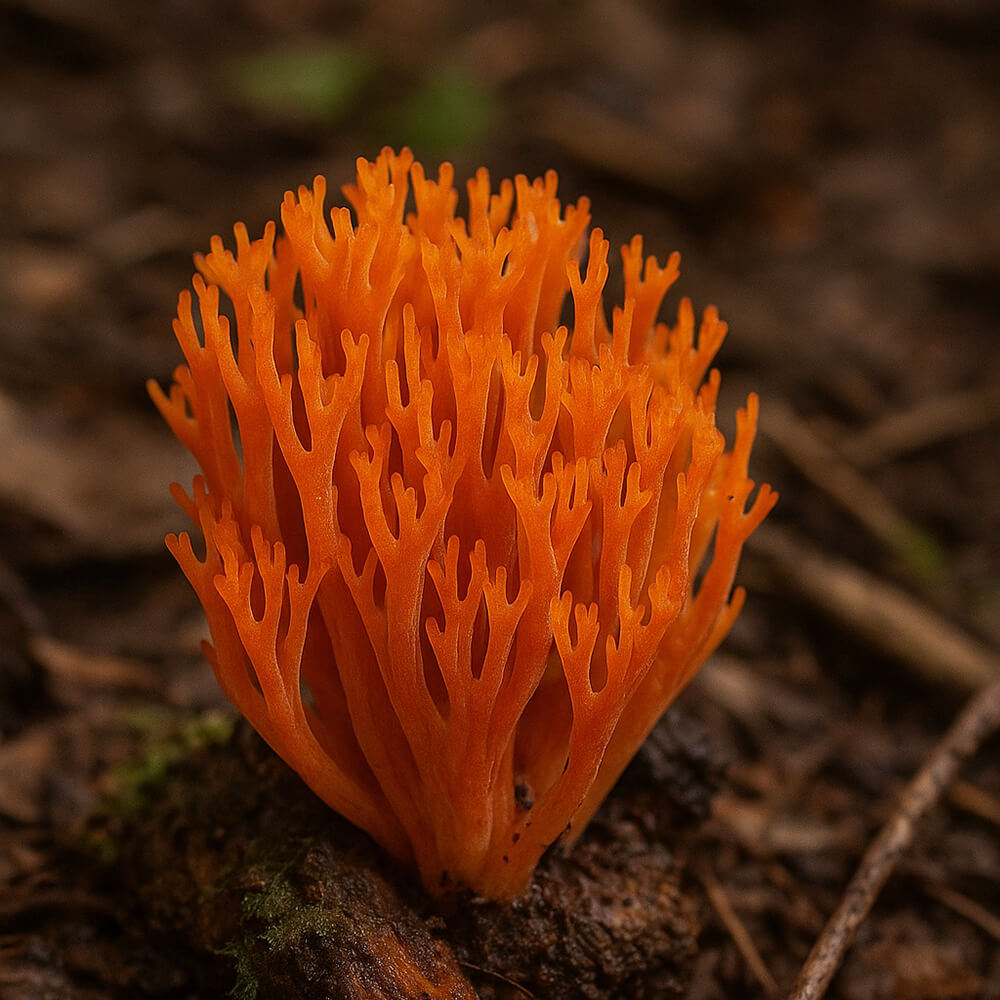
Ramaria aurantiaca, commonly known as the Orange Coral Mushroom, is a striking and easily recognizable species of coral fungus. It is characterized by its vibrant orange to apricot-colored, highly branched fruiting body that resembles an underwater coral. This species is saprobic, playing an important role in the decomposition of organic matter in forest ecosystems. While some coral fungi are edible, Ramaria aurantiaca is generally considered inedible due to its bitter taste and potential to cause gastrointestinal upset in some individuals. It is a beautiful addition to the forest floor, often found growing on decaying wood or leaf litter.
How to Identify
- Cap
- Not applicable, as this mushroom does not have a distinct cap. The entire structure is a branched fruiting body.
- Gills
- Not applicable, as this mushroom does not have gills. Spores are produced on the surface of the branches.
- Stem
- The stem (or base) is short, stout, and whitish to pale orange, typically 1-3 cm tall and 1-2 cm thick. It is often somewhat fuzzy or finely tomentose at the base where it attaches to the substrate. It quickly branches out into the coral-like structure.
- Flesh
- The flesh is brittle, watery, and whitish to pale orange. It has a mild to slightly bitter taste and no distinctive odor.
- Fruiting body
- The fruiting body is erect, highly branched, and coral-like, typically 5-15 cm tall and 4-10 cm wide. It arises from a single, stout base that quickly divides into numerous, densely packed branches. The branches are cylindrical, often flattened or grooved, and repeatedly dichotomously or polychotomously branched, with blunt or rounded tips. The color is a vibrant orange, apricot-orange, or golden-orange, often fading slightly with age or in dry conditions. The surface is smooth and dry.
- Habitat
- Saprobic, growing on decaying hardwood or conifer logs, stumps, buried wood, or leaf litter. It can be found solitary or in scattered groups.
Key Facts
- Cap surfaces: Not applicable (branched fruiting body)
- Growth Form: Coral-like, branched
- Spore Print: Ochre-yellow to brownish-yellow
- Body color: Vibrant orange, apricot-orange, golden-orange
- Odor: Mild to indistinct
- Flesh bruises: Does not bruise significantly
- Height: 5-15 cm
- Cap Diameter: Not applicable (width 4-10 cm)
- Nutrient gathering: Saprobic
Toxic
Mild ToxicityRamaria aurantiaca is generally considered inedible due to its bitter taste and potential to cause gastrointestinal upset, including nausea, vomiting, and diarrhea, in some individuals. While not considered deadly poisonous, it is best avoided for consumption.
Quick Check
- Odor: Mild to indistinct
- Fruiting: Late summer to autumn
- Substrate: Decaying wood (hardwood or conifer) or leaf litter
Where to Find
Deciduous Forests
Commonly found in deciduous forests, particularly under oak, beech, and maple trees, where it decomposes fallen wood and leaf litter.
Coniferous Forests
Also occurs in coniferous forests, often associated with decaying conifer logs and needles.
Mixed Forests
Can be found in mixed forest environments, thriving on the abundant organic debris.
Finding Tips
Look for Decaying Wood
Focus your search on areas with abundant decaying logs, stumps, and woody debris, as Ramaria aurantiaca is a saprobic species.
Check Forest Floor Litter
It can also emerge from thick layers of leaf litter, so gently sift through the duff in promising locations.
Seasonal Timing
Typically fruits from late summer through autumn, with peak abundance often after periods of rain.
Similar Species
Yellow Coral
Coral Fungi
Also known as: Golden Spindles
Crested Coral
Coral Fungi
Also known as: White Coral
Elegant Coral
Coral Fungi
Also known as: Pink-tipped Coral
Scientific Classification
- Phylum
- Basidiomycota
- Class
- Agaricomycetes
- Order
- Gomphales
- Family
- Gomphaceae
- Genus
- Ramaria
Explore Orange Coral Mushroom
Identify mushrooms anywhere
Free on iOS, Android, and Web. Photo identification, full database, and your personal collection.