
Got a photo? Identify mushrooms instantly with the Mushby app
Open the appDescription
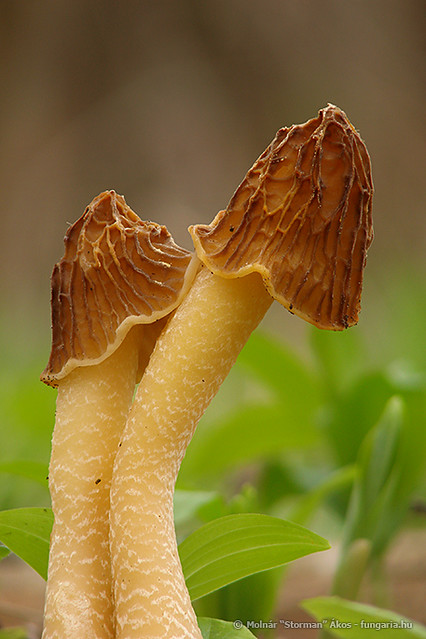
Ptychoverpa bohemica, commonly known as the Wrinkled Thimble-cap or Early Morel, is an ascomycete fungus characterized by its early spring fruiting and thimble-shaped cap with wrinkled or brain-like folds. It is considered edible by some, instructions on how to prepare this mushroom for consumption are listed below.
How to Identify
- Cap
- The cap is thimble-shaped, typically 2-5 cm tall and 1.5-4 cm wide. Its surface is characterized by irregular wrinkles, folds, or brain-like convolutions rather than the distinct pits found in true morels. The color ranges from yellowish-brown to dark brown. The cap is attached to the stipe only at the apex.
- Gills
- Ptychoverpa bohemica is an ascomycete and therefore does not possess gills. The spores are produced within asci on the inner surface of the pits and wrinkles of the cap
- Stem
- The stipe ranges from 3-8 cm long and 1-2.5 cm thick, and is typically cylindrical or slightly enlarged at the base. The stipe surface can be smooth to slightly wrinkled, and its color ranges from whitish to pale yellowish-brown. The stem is hollow.
- Flesh
- The fruit body's flesh is thin, brittle, and whitish to pale brownish.
- Fruiting body
- The fruiting body of Ptychoverpa bohemica typically measures 3-10 cm in height. It is composed of a cap and a stipe (stem).
- Habitat
- Ptychoverpa bohemica is found in early spring, often in disturbed ground, along riverbanks, and in deciduous woods, particularly under cottonwood and aspen. It is often associated with moist habitats.
Key Facts
- Cap surfaces: Wrinkled, folded
- Growth Form: Solitary or scattered
- Spore Print: Yellowish
- Body color: Yellowish-brown to dark brown
- Odor: Indistinct to earthy
- Flesh bruises: Does not bruise
- Height: 3-10 cm
- Cap Diameter: 1.5-4 cm
- Nutrient gathering: Saprobic/Mycorrhizal
Toxic
Severe ToxicityPtychoverpa bohemica contains monomethylhydrazine (MMH), a toxic compound also found in Gyromitra esculenta (False Morel). MMH can cause gastrointestinal distress and neurological symptoms. Proper cooking reduces the MMH content; however, individual sensitivity varies, and complete removal of the toxin is never guaranteed.
Quick Check
- Odor: Indistinct or slightly earthy
- Fruiting: Early spring
- Substrate: Disturbed soil, riverbanks, deciduous woods
Where to Find
Disturbed Ground
Look for this mushroom in areas that have been recently disturbed, such as construction sites or areas cleared for development.
Riverbanks
Search along the banks of rivers and streams, where the soil is often moist and rich in organic matter.
Deciduous Woods
Focus on deciduous forests, especially those with cottonwood and aspen trees. These trees often have a symbiotic relationship with Ptychoverpa bohemica.
Moist Habitats
Areas with consistently moist soil, such as marshy areas or damp woodlands, are ideal locations for this mushroom.
Finding Tips
Timing
Search for Ptychoverpa bohemica in early spring, shortly after the snow melts and temperatures begin to rise. The exact timing will vary depending on your geographic location and the specific weather conditions.
Look for Indicator Trees
Pay attention to the presence of cottonwood and aspen trees, as they are often associated with this mushroom. Search the ground around the base of these trees and in the immediate vicinity.
Focus on Edges
Concentrate your search along the edges of forests, roadsides, and other transitional areas. These areas often provide the right combination of sunlight and moisture for mushroom growth.
Check Disturbed Areas
Don't overlook areas that have been disturbed by human activity, such as construction sites or logging operations. These areas can provide the ideal conditions for Ptychoverpa bohemica to fruit.
Use a Guidebook
Always carry a reliable mushroom guidebook with you when foraging, and carefully compare any mushrooms you find to the descriptions and photos in the book. If you are unsure of the identification, it is best to err on the side of caution and not consume the mushroom.
Similar Species
True Morels
edible mushroom
Also known as: Morchella spp.
Poisonous False Morel
poisonous mushroom
Also known as: Gyromitra esculenta
Scientific Classification
- Phylum
- Ascomycota
- Class
- Ascomycetes
- Order
- Pezizales
- Family
- Morchellaceae
- Genus
- Ptychoverpa
Explore Wrinkled Thimble-cap
Identify mushrooms anywhere
Free on iOS, Android, and Web. Photo identification, full database, and your personal collection.