
Got a photo? Identify mushrooms instantly with the Mushby app
Open the appDescription
Psilocybe fimetaria is a species of psychedelic mushroom in the family Hymenogastraceae. It is known for its psychoactive properties due to the presence of psilocybin and psilocin. This species is typically found growing on dung, particularly horse or cow dung, in grasslands and pastures.
How to Identify
- Cap
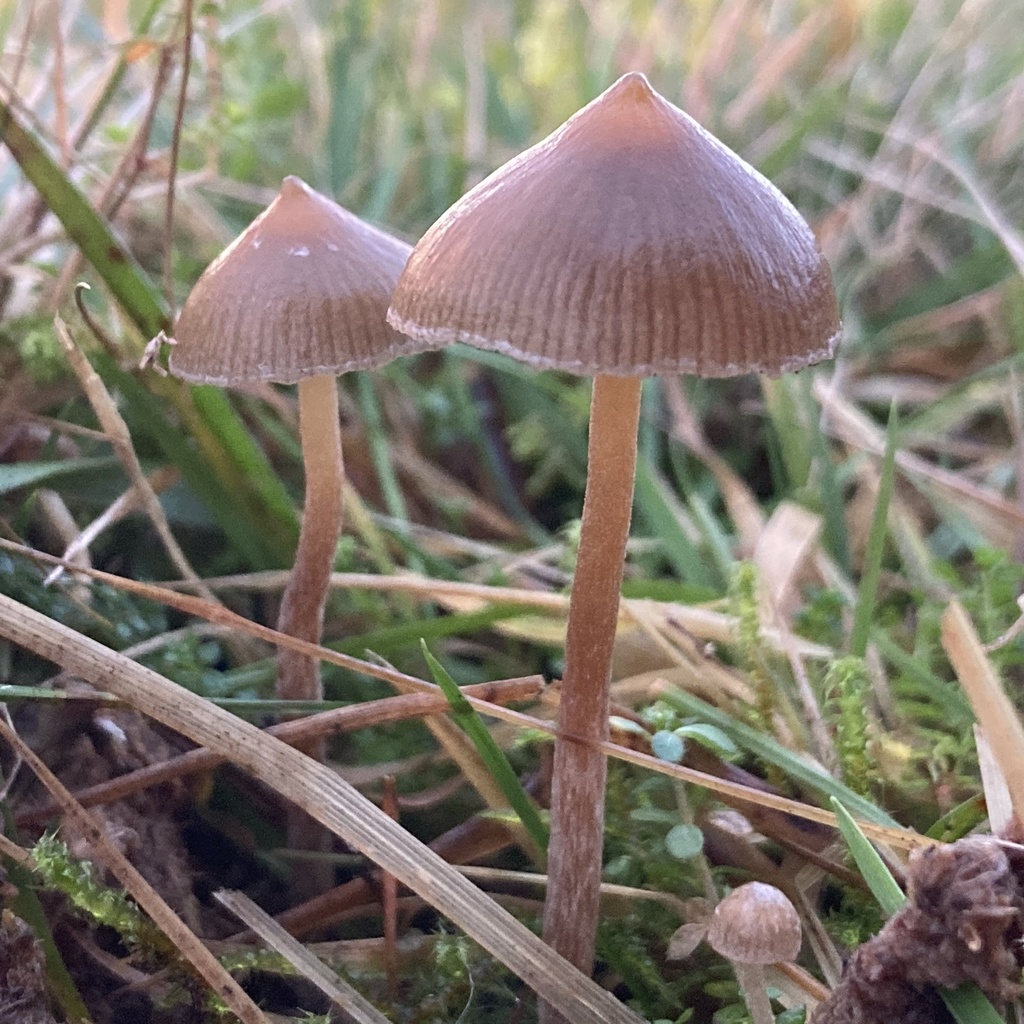
- 1-3 cm in diameter, conical to campanulate, expanding to convex with age, often with a papilla. Color varies from yellowish-brown to reddish-brown when moist, fading to pale yellow or buff when dry (hygrophanous). Surface is smooth and viscid when moist, becoming dry and shiny. Margin is often striate when moist.
- Gills
- Adnate to adnexed, close, initially pale brown, becoming dark purplish-brown with white edges as spores mature.
- Stem
- 3-10 cm long, 1-3 mm thick, slender, cylindrical, often slightly thicker at the base. Whitish to yellowish-brown, often darkening towards the base. Smooth, sometimes with fine fibrils. A partial veil is present in young specimens, leaving a faint, ephemeral annular zone or no ring at all. Bruises blue, particularly towards the base.
- Flesh
- Thin, whitish, bruising blue, especially at the base of the stem.
- Fruiting body
- Small to medium-sized agaric with a conical to campanulate cap, slender stem, and dark spore print. Bruises blue when handled.
- Habitat
- Saprobic, growing gregariously or scattered on dung (especially horse and cow dung) in pastures, meadows, and grasslands.
Key Facts
- Cap surfaces: Smooth, viscid when moist, shiny when dry
- Growth Form: Gregarious or scattered
- Spore Print: Dark purplish-brown
- Body color: Yellowish-brown to reddish-brown (moist), pale yellow to buff (dry)
- Odor: Farinaceous or indistinct
- Flesh bruises: Blue, especially at the stem base
- Height: 3-10 cm
- Cap Diameter: 1-3 cm
- Nutrient gathering: Saprobic
Toxic
Severe ToxicityPsilocybe fimetaria contains the psychoactive compounds psilocybin and psilocin. Consumption leads to hallucinogenic effects. While not acutely toxic in terms of organ damage, the psychological effects can be profound and potentially distressing, especially for individuals with pre-existing mental health conditions or those who are unprepared for the experience. Misidentification with truly toxic species is a significant risk.
Quick Check
- Odor: Farinaceous (mealy) or indistinct
- Fruiting: Late summer to late autumn
- Substrate: Dung (equine or bovine)
Where to Find
Europe
Widespread across many European countries, particularly in temperate regions.
North America
Reported in various parts of North America, though less common than Psilocybe semilanceata.
Other Temperate Regions
May occur in other temperate regions globally where suitable dung substrates are present.
Finding Tips
Substrate Preference
Focus searches on pastures and fields where horses or cattle graze, as it exclusively grows on their dung.
Moisture Conditions
Look for them after periods of rain, as they prefer moist conditions for fruiting.
Seasonal Timing
Typically fruits from late summer through autumn, depending on local climate.
Blue Bruising
Gently handle suspected specimens to check for the characteristic blue bruising, a key indicator of psilocybin-containing species.
Similar Species
Liberty Cap
Psilocybe
Also known as: Psilocybe semilanceata
Panaeolus cyanescens
Panaeolus
Also known as: Blue Meanie
Conocybe filaris
Conocybe
Also known as: Deadly Conocybe
Scientific Classification
- Phylum
- Basidiomycota
- Class
- Agaricomycetes
- Order
- Agaricales
- Family
- Hymenogastraceae
- Genus
- Psilocybe
Explore Dung-loving Psilocybe
Identify mushrooms anywhere
Free on iOS, Android, and Web. Photo identification, full database, and your personal collection.