
Got a photo? Identify mushrooms instantly with the Mushby app
Open the appDescription
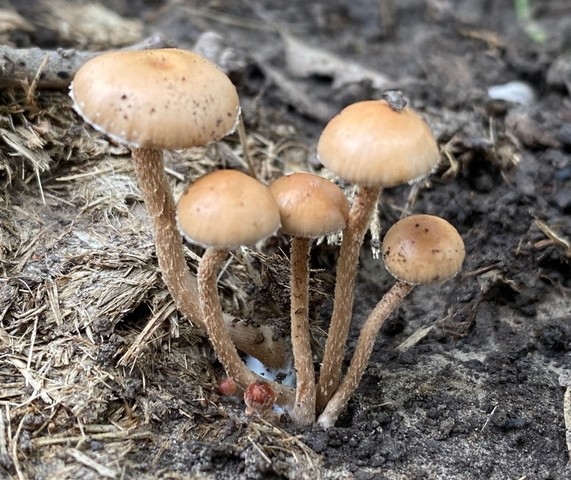
Psilocybe coprophila is a small, saprobic mushroom belonging to the family Hymenogastraceae. It is characterized by its convex to plano-convex cap, dark brown to reddish-brown color, and preference for growing directly on dung. Unlike many other Psilocybe species, P. coprophila does not contain psilocybin or psilocin and is not psychoactive. It is a common species found globally in suitable habitats.
How to Identify
- Cap
- 1-3 cm in diameter, convex to plano-convex, sometimes with a slight umbo. Surface is smooth, viscid when moist, becoming dry. Color ranges from dark brown to reddish-brown, fading to yellowish-brown or ochraceous when dry (hygrophanous). Margin is often striate when moist.
- Gills
- Adnate to adnexed, close, broad. Initially pallid to grayish, becoming dark purplish-brown to blackish with age due to spore maturation. Edges are often paler.
- Stem
- 2-6 cm long, 2-4 mm thick, cylindrical, often slightly tapering upwards. Color is whitish to brownish, often darker towards the base. Surface is smooth or finely pruinose at the apex. No annulus (ring) is present. Stems are typically solid or stuffed, becoming hollow with age. Does not bruise blue.
- Flesh
- Thin, pallid to brownish, not bruising blue.
- Fruiting body
- Small, agaricoid mushroom, typically growing gregariously or scattered.
- Habitat
- Saprobic, growing directly on dung (especially horse, cow, and sheep dung) in pastures, fields, and grassy areas.
Key Facts
- Cap surfaces: Smooth, viscid when moist, hygrophanous
- Growth Form: Gregarious or scattered
- Spore Print: Dark purplish-brown to blackish
- Body color: Dark brown to reddish-brown (moist), yellowish-brown to ochraceous (dry)
- Odor: Mild, fungoid
- Flesh bruises: No blue bruising
- Height: 2-6 cm
- Cap Diameter: 1-3 cm
- Nutrient gathering: Saprobic
Safe
SafePsilocybe coprophila is considered non-toxic and non-psychoactive. It does not contain psilocybin or psilocin. However, due to its small size and lack of culinary value, it is not recommended for consumption. Misidentification with other dung-inhabiting species, some of which can be psychoactive or mildly toxic, is a significant risk.
Quick Check
- Odor: Mild, fungoid
- Fruiting: Spring to autumn
- Substrate: Dung (coprophilous)
Where to Find
Pastures
Commonly found in pastures where livestock graze, providing ample dung.
Fields
Can be found in agricultural fields, especially those used for grazing.
Grassy areas
Occasionally found in other grassy areas where dung is present.
Global distribution
Widespread and common throughout temperate and subtropical regions worldwide.
Finding Tips
Look for dung
Focus your search on areas with fresh or aged animal dung, particularly from herbivores.
Seasonal timing
Typically fruits from spring through autumn, depending on local climate and moisture availability. Often appears after rainfall.
Examine closely
These are small mushrooms, so a careful examination of dung piles is necessary.
Similar Species
Panaeolus papilionaceus
Panaeolus
Also known as: Panaeolus campanulatus
Protostropharia semiglobata
Protostropharia
Also known as: Half-globe Stropharia
Psilocybe fimetaria
Psilocybe
Also known as: Dung Psilocybe
Scientific Classification
- Phylum
- Basidiomycota
- Class
- Agaricomycetes
- Order
- Agaricales
- Family
- Hymenogastraceae
- Genus
- Psilocybe
Storage Information
- Max Temperature: Not applicable
- Freezing duration: Not applicable
- Min Temperature: Not applicable
- Refrigeration: Not applicable
How to Clean
Not applicable, as this mushroom is not consumed.
Explore Dung-loving Psilocybe
Identify mushrooms anywhere
Free on iOS, Android, and Web. Photo identification, full database, and your personal collection.