
Got a photo? Identify mushrooms instantly with the Mushby app
Open the appDescription
Psilocybe caerulipes, commonly known as the Blue-foot Psilocybe, is a psychoactive mushroom belonging to the family Hymenogastraceae. It is characterized by its distinctive blue staining reactions, particularly on the stem, and its preference for growing on decaying hardwood. This species is known for containing the psychedelic compounds psilocybin and psilocin.
How to Identify
- Cap
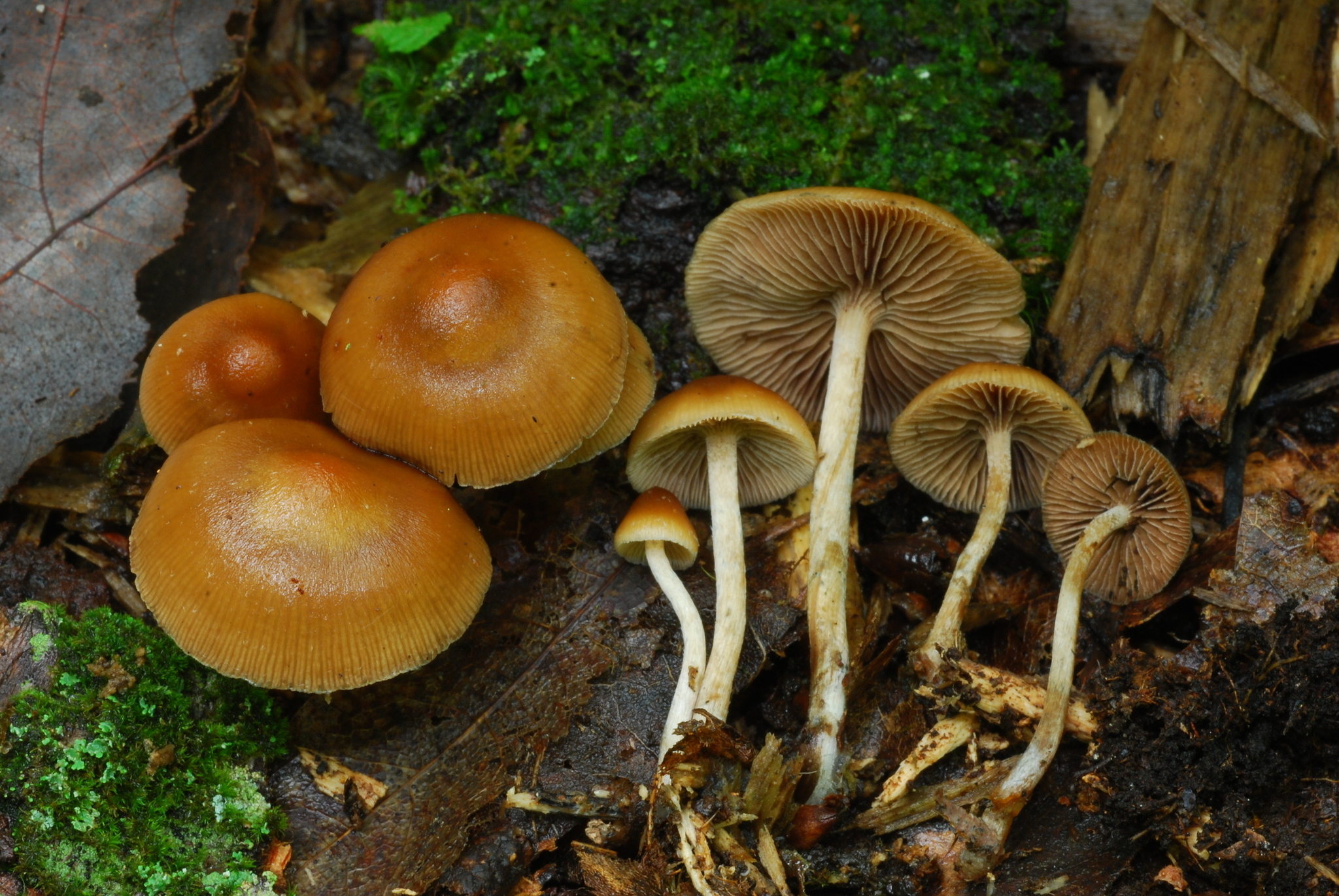
- 1-3.5 cm (0.4-1.4 inches) in diameter, convex to subumbonate, becoming broadly convex to plane with age, often with a slight papilla. Surface is smooth, viscid when moist, becoming dry. Color ranges from dark chestnut brown to reddish-brown when moist, fading to buff or yellowish-brown when dry (hygrophanous). Margins are striate when moist and often incurved when young. Bruises blue, especially at the margin.
- Gills
- Adnate to adnexed, close, narrow to moderately broad. Color is pallid to grayish-brown when young, becoming purplish-brown to dark purplish-brown with age due to spore maturation. Edges are often lighter.
- Stem
- 2-6 cm (0.8-2.4 inches) long, 2-5 mm (0.08-0.2 inches) thick, equal or slightly tapering upwards, sometimes slightly enlarged at the base. Surface is smooth, whitish to brownish, often covered with fine fibrils when young. Characteristically stains dark blue to bluish-black, especially towards the base and where handled. No annulus (ring) is present. The stem is typically solid when young, becoming hollow with age.
- Flesh
- Whitish to brownish, thin, bruising blue, particularly in the stem and cap margin.
- Fruiting body
- Small to medium-sized agaric mushroom, typically solitary to scattered, sometimes gregarious.
- Habitat
- Saprobic, growing on decaying hardwood logs, stumps, and woody debris, particularly oak, maple, and birch. Rarely found on conifer wood. Prefers moist, shaded environments in deciduous or mixed forests.
Key Facts
- Cap surfaces: Smooth, viscid when moist, hygrophanous.
- Growth Form: Solitary to scattered, sometimes gregarious.
- Spore Print: Dark purplish-brown.
- Body color: Cap: Chestnut brown to reddish-brown (moist), buff to yellowish-brown (dry). Stem: Whitish to brownish, strongly blue-staining.
- Odor: Farinaceous or indistinct.
- Flesh bruises: Strongly blue, especially on the stem and cap margin.
- Height: 2-6 cm (0.8-2.4 inches)
- Cap Diameter: 1-3.5 cm (0.4-1.4 inches)
- Nutrient gathering: Saprobic
Toxic
DeadlyPsilocybe caerulipes contains the psychoactive compounds psilocybin and psilocin. Consumption leads to hallucinogenic effects. It is illegal to possess or consume in many jurisdictions. Misidentification with highly toxic species like Galerina marginata (Deadly Galerina) or other LBMs (Little Brown Mushrooms) can be fatal. Symptoms of Galerina poisoning include severe gastrointestinal distress, liver and kidney failure, and death.
Quick Check
- Odor: Farinaceous (mealy) or indistinct.
- Fruiting: Late spring to fall, especially after rain.
- Substrate: Decaying hardwood logs and woody debris.
Where to Find
Eastern North America
Primarily found in the eastern United States, extending from New York south to North Carolina and west to Michigan and Ohio. Also reported in some parts of Canada.
Deciduous and Mixed Forests
Commonly found in mature deciduous or mixed forests with abundant decaying hardwood. Look for it on fallen logs, stumps, and woody debris.
Finding Tips
Substrate Specificity
Focus your search on decaying hardwood, especially oak, maple, and birch logs and stumps. It is rarely found on the ground directly or on conifer wood.
Moisture and Shade
Psilocybe caerulipes thrives in moist, shaded conditions. Look in areas with good canopy cover and consistent humidity, often near streams or in ravines.
Blue Bruising
The most distinctive feature is the strong blue staining reaction, particularly on the stem and cap margin when bruised or handled. This is a key identifier.
Seasonal Availability
Typically fruits from late spring through fall, with peak fruiting often occurring after periods of rain in late summer and early autumn.
Spore Print
Always take a spore print to confirm identification. Psilocybe caerulipes will have a dark purplish-brown spore print.
Similar Species
Wavy Cap
Psilocybe
Also known as: Psilocybe cyanescens
Liberty Cap
Psilocybe
Also known as: Psilocybe semilanceata
Deadly Galerina
Galerina
Also known as: Galerina marginata
Funeral Bell
Galerina
Also known as: Galerina autumnalis
Scientific Classification
- Phylum
- Basidiomycota
- Class
- Agaricomycetes
- Order
- Agaricales
- Family
- Hymenogastraceae
- Genus
- Psilocybe
Explore Blue-foot Psilocybe
Identify mushrooms anywhere
Free on iOS, Android, and Web. Photo identification, full database, and your personal collection.