
Got a photo? Identify mushrooms instantly with the Mushby app
Open the appDescription
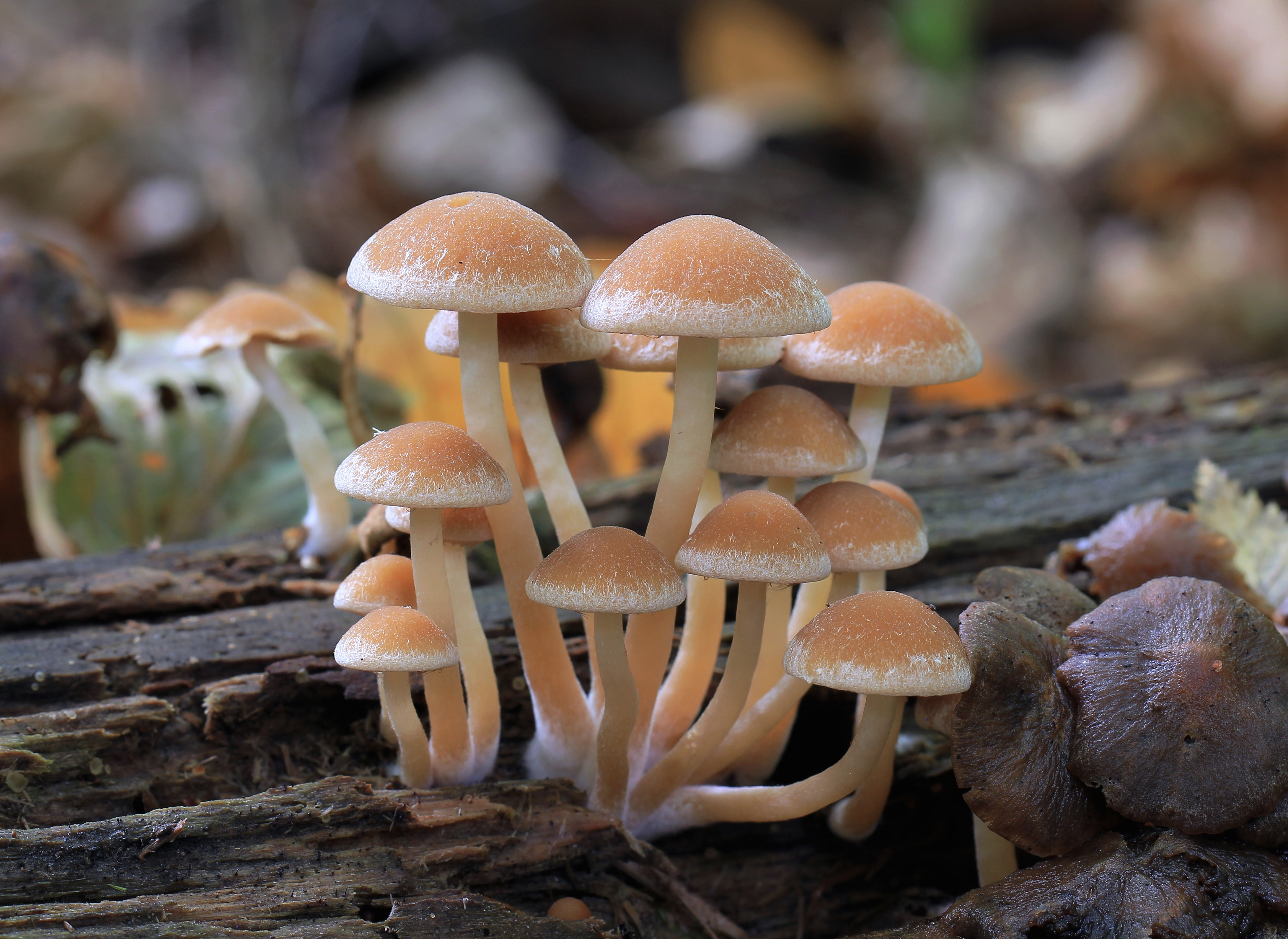
Psathyrella piluliformis, commonly known as the Clustered Brittlestem, is a widespread and common saprobic mushroom found growing in dense clusters on decaying hardwood. It is characterized by its reddish-brown to tawny cap, which often fades to a paler color, and its brittle, whitish stem. While not considered toxic, its edibility is generally regarded as poor due to its small size, fragile texture, and lack of distinctive flavor.
How to Identify
- Cap
- The cap is 2-7 cm in diameter, initially convex to campanulate, expanding to broadly convex or plano-convex, often with a low umbo. The margin is initially incurved, becoming straight, and often striate when moist. The color ranges from reddish-brown to tawny or cinnamon-brown when moist, fading to buff, tan, or yellowish-brown when dry (hygrophanous). The surface is smooth, sometimes finely pruinose when young, and often has veil remnants along the margin when immature.
- Gills
- The gills are adnate to adnexed, close to crowded, and narrow. They are initially whitish to pale grayish, becoming purplish-brown to dark brown with age due to spore maturation. There are numerous lamellulae (short gills).
- Stem
- The stem is 3-10 cm long and 0.3-1 cm thick, central, cylindrical, often slightly tapering upwards, and hollow. It is whitish to pale brownish, often pruinose at the apex, and can be finely fibrillose below. It is brittle and lacks a persistent ring, though a faint, evanescent fibrillose zone may be present from the partial veil.
- Flesh
- The flesh is thin, fragile, whitish to pale brownish, and lacks a distinctive odor or taste.
- Fruiting body
- The fruiting body is typically gregarious to densely caespitose (clustered), emerging from decaying wood.
- Habitat
- Saprobic, growing in dense clusters on decaying hardwood logs, stumps, and buried wood. Occasionally found on conifer wood. It is a common decomposer in deciduous and mixed forests.
Key Facts
- Cap surfaces: Smooth, sometimes finely pruinose, hygrophanous
- Growth Form: Caespitose (clustered)
- Spore Print: Dark purplish-brown
- Body color: Reddish-brown to tawny (moist), buff to tan (dry)
- Odor: Indistinct
- Flesh bruises: Does not bruise
- Height: 3-10 cm
- Cap Diameter: 2-7 cm
- Nutrient gathering: Saprobic
Safe
SafePsathyrella piluliformis is generally considered non-toxic, but its edibility is poor due to its small size, fragile texture, and lack of culinary value. It is not recommended for consumption. There are no known specific toxins, but consumption of any wild mushroom without positive identification by an expert carries inherent risks.
Quick Check
- Odor: Indistinct
- Fruiting: Late spring to autumn
- Substrate: Decaying hardwood
Where to Find
North America
Widespread across temperate regions, particularly in eastern North America.
Europe
Common throughout Europe.
Asia
Reported in parts of Asia, though less extensively documented than in North America and Europe.
Finding Tips
Look for Decaying Hardwood
Focus your search on fallen logs, stumps, and buried wood in deciduous or mixed forests. It rarely grows directly on soil.
Observe Clustering Growth
Psathyrella piluliformis almost always grows in dense clusters, making it easier to spot. Solitary specimens are rare.
Check for Hygrophanous Caps
The cap color changes significantly with moisture. Look for the reddish-brown color when wet and the paler, buff color when dry.
Seasonal Timing
This species fruits primarily from late spring through autumn, with peak abundance in late summer and fall.
Similar Species
Sulphur Tuft
fungus
Also known as: Hypholoma fasciculare
Brick Cap
fungus
Also known as: Hypholoma lateritium
Candolle's Psathyrella
fungus
Also known as: Psathyrella candolleana
Scientific Classification
- Phylum
- Basidiomycota
- Class
- Agaricomycetes
- Order
- Agaricales
- Family
- Psathyrellaceae
- Genus
- Psathyrella
Storage Information
- Max Temperature: 4°C
- Freezing duration: Not recommended for freezing due to fragile texture.
- Min Temperature: 1°C
- Refrigeration: 1-2 days (for identification purposes only, not culinary storage)
How to Clean
Due to its small size and fragile nature, cleaning is often impractical. If collected for identification, gently brush off any debris with a soft brush. It is not typically collected for culinary purposes.
Explore Clustered Brittlestem
Identify mushrooms anywhere
Free on iOS, Android, and Web. Photo identification, full database, and your personal collection.