
Got a photo? Identify mushrooms instantly with the Mushby app
Open the appDescription
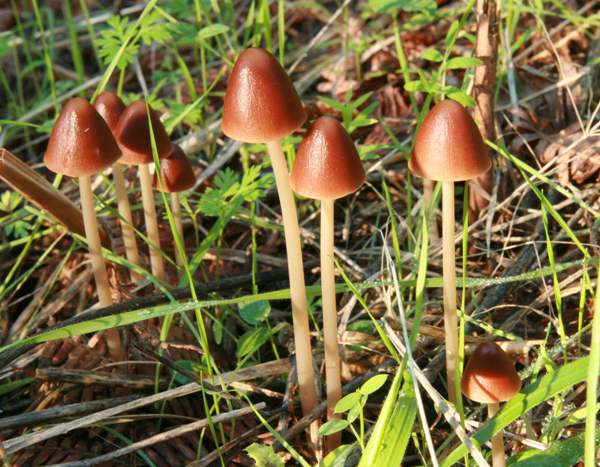
Psathyrella conopilea, commonly known as the Conical Brittlestem, is a widespread and common saprobic mushroom belonging to the family Psathyrellaceae. It is characterized by its distinctive conical to bell-shaped cap, which often retains a pointed umbo, and its fragile, brittle nature. This species is typically found growing on disturbed ground, lawns, gardens, and wood debris, often in troops or scattered groups. While not considered toxic, its small size and fragile texture make it of no culinary interest.
How to Identify
- Cap
- The cap is typically 1-4 cm in diameter, initially acutely conical to bell-shaped, often retaining a distinct pointed umbo even as it expands. The color varies from dark brown to reddish-brown when moist, fading to pale buff or grayish-brown when dry (hygrophanous). The margin is often striate when moist and may become slightly uplifted with age. The surface is smooth, sometimes finely pruinose when young.
- Gills
- The gills are adnate to adnexed, crowded, and narrow. They are initially pale grayish-brown, becoming dark purplish-brown to blackish with age due to the maturing spores. The gill edges are often paler and fimbriate.
- Stem
- The stem is 4-12 cm long and 2-5 mm thick, slender, hollow, and very fragile. It is whitish to pale brownish, often pruinose at the apex, and smooth or finely striate. There is no ring or veil remnants.
- Flesh
- The flesh is very thin, fragile, and whitish to pale brownish. It has no distinctive odor or taste.
- Fruiting body
- The fruiting body is agaricoid, meaning it has a cap and stem with gills.
- Habitat
- Saprobic, growing on disturbed ground, lawns, gardens, wood chips, decaying wood, and rich soil. Often found in troops or scattered groups.
Key Facts
- Cap surfaces: Smooth, sometimes finely pruinose when young, hygrophanous.
- Growth Form: Scattered to gregarious, sometimes in troops.
- Spore Print: Dark purplish-brown to blackish-brown.
- Body color: Cap: Dark brown to reddish-brown (moist), fading to pale buff or grayish-brown (dry). Stem: Whitish to pale brownish.
- Odor: Indistinct.
- Flesh bruises: Does not bruise.
- Height: 4-12 cm
- Cap Diameter: 1-4 cm
- Nutrient gathering: Saprobic
Safe
SafePsathyrella conopilea is generally considered non-toxic, but it is not edible due to its small size, fragile texture, and lack of culinary value. There are no known reports of toxicity, but consumption is not recommended. Always exercise extreme caution and avoid consuming any wild mushroom unless positively identified by an expert.
Quick Check
- Odor: Indistinct
- Fruiting: Spring to autumn, sometimes into early winter in mild climates.
- Substrate: Soil, wood debris, lawns, gardens, disturbed ground.
Where to Find
Temperate Regions
Widely distributed across temperate regions of North America, Europe, and Asia.
Lawns and Gardens
Commonly found in urban and suburban settings, particularly on well-maintained lawns and garden beds.
Disturbed Ground
Frequently appears on recently disturbed soil, construction sites, and areas with wood debris.
Woodland Edges
Can be found at the edges of woodlands, especially where there is decaying wood or leaf litter.
Finding Tips
Look for disturbed areas
Focus your search on areas with recent soil disturbance, wood chips, or decaying organic matter.
Check lawns and gardens
This species is very common in grassy areas, especially after rain.
Observe hygrophanous caps
Note the color change of the cap as it dries, a key characteristic of Psathyrella species.
Examine gill color
The progression of gill color from pale to dark purplish-brown is a good indicator.
Similar Species
Fairy Inkcap
Coprinellus disseminatus
Also known as: None
Glistening Inkcap
Coprinellus micaceus
Also known as: Mica Cap
Common Brittlestem
Psathyrella candolleana
Also known as: Pale Brittlestem
Scientific Classification
- Phylum
- Basidiomycota
- Class
- Agaricomycetes
- Order
- Agaricales
- Family
- Psathyrellaceae
- Genus
- Psathyrella
Storage Information
- Max Temperature: Not applicable
- Freezing duration: Not applicable
- Min Temperature: Not applicable
- Refrigeration: Not applicable
How to Clean
Not applicable, as this mushroom is not consumed.
Explore Conical Brittlestem
Identify mushrooms anywhere
Free on iOS, Android, and Web. Photo identification, full database, and your personal collection.