
Got a photo? Identify mushrooms instantly with the Mushby app
Open the appDescription
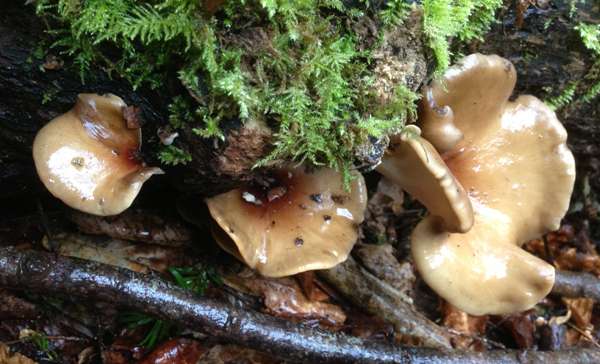
Polyporus durus, commonly known as the Bay Polypore, is a saprobic bracket fungus belonging to the order Polyporales. It is characterized by its dull to shiny brown, often bay-colored cap, and a distinct central to eccentric stem. Unlike many other polypores, P. durus is typically found growing from buried wood or tree roots, often appearing terrestrial, and is notable for its tough, leathery texture when mature. It plays a significant ecological role in the decomposition of hardwood. This species was formerly known as Macroporus durus and is sometimes confused with other Polyporus species.
How to Identify
- Cap
- The cap measures 5-20 cm (2-8 inches) in diameter, and is convex to depressed in the center, often irregular to wavy. The color ranges from dull brown to a rich bay-brown or reddish-brown, often paler towards the margin and sometimes with darker concentric zones. The surface is smooth, dry, and often becomes finely radially wrinkled with age. It can be somewhat shiny when fresh.
- Gills
- Instead of gills, Polyporus durus has a poroid hymenophore on the underside of the cap. The pores are small, 3-5 per millimeter, circular to angular, and whitish to cream-colored when young, aging to yellowish or brownish. The pore surface is often decurrent down the stem.
- Stem
- The stem (stipe) is central to eccentric, occasionally lateral, and measures 3-10 cm (1.2-4 inches) in length and 1-3 cm (0.4-1.2 inches) in thickness. It is typically tough to woody, cylindrical or slightly tapering towards the base, and often darker brown to blackish, especially at the base where it connects to the buried wood. The surface is often finely velvety or pruinose, becoming smoother with age. It can be deeply rooted in the substrate.
- Flesh
- The flesh is tough, leathery, and whitish to pale cream-colored, typically 0.5-2 cm thick. It does not change color when cut or bruised. It has a mild, indistinct odor and taste.
- Fruiting body
- The fruiting body is a centrally to eccentrically stipitate polypore, meaning it has a stem. It typically grows individually or in small clusters. When young, it can be somewhat fleshy, becoming tough and leathery to woody with age. It is poroid.
- Habitat
- Typically found on dead hardwood, often emerging from buried wood or roots, giving the appearance of growing terrestrially. Less commonly on conifer wood. It acts as a saprobe, decomposing lignin and cellulose.
Key Facts
- Cap surfaces: Smooth, dry, radially wrinkled with age, sometimes shiny when fresh
- Growth Form: Solitary to clustered, growing from buried wood
- Spore Print: White
- Body color: Cap: Dull brown to bay-brown; Pores: Whitish to cream, aging yellow-brown; Stem: Brown to blackish, especially at base
- Odor: Nondescript or mild
- Flesh bruises: Does not bruise or change color
- Height: Cap diameter 5-20 cm (2-8 inches); Stem length 3-10 cm (1.2-4 inches)
- Cap Diameter: 5-20 cm (2-8 inches)
- Nutrient gathering: Saprobic (decomposes dead wood)
Safe
SafePolyporus durus is considered non-toxic. However, its tough, leathery texture (especially when mature) makes it unpalatable for most. There are no known specific toxins. As with any wild mushroom, individual allergic reactions are possible. It is imperative to correctly identify any mushroom before consumption. Beginners should avoid consumption until confident in identification.
Quick Check
- Odor: Indistinct or mild
- Fruiting: Spring to early summer, occasionally into late summer
- Substrate: Dead hardwood, typically buried wood or roots
Where to Find
Deciduous Forests
Commonly found in deciduous woodlands, particularly under oak, beech, maple, and other hardwood trees, growing from buried wood or roots.
Riversides and Floodplains
Areas with ample deadwood, especially where decomposition is active, offer prime habitats.
Parks and Gardens
Can be found in urban and suburban settings if suitable host trees and buried wood are present.
Finding Tips
Look for Buried Wood
Although it appears terrestrial, P. durus almost always grows from buried wood. Look for areas where trees have fallen or stumps have rotted below ground.
Examine Hardwood Areas
Focus your search on areas dominant with hardwood trees. While rare, it can occur on conifers.
Check Seasonality
Primarily fruits in spring and early summer after periods of rain, but can sometimes be found later in the season.
Similar Species
Polyporus tuberaster
Fungus
Also known as: Tuberous Polypore
Polyporus squamosus
Fungus
Also known as: Dryad's Saddle, Pheasant's Back Mushroom
Polyporus badius
Fungus
Also known as: Black-footed Polypore
Scientific Classification
- Phylum
- Basidiomycota
- Class
- Agaricomycetes
- Order
- Polyporales
- Family
- Polyporaceae
- Genus
- Polyporus
Storage Information
- Max Temperature: 4°C
- Freezing duration: 6 months
- Min Temperature: 0°C
- Refrigeration: 3 days
How to Clean
Due to its tough nature, particularly when mature, the Bay Polypore is not typically consumed fresh. If collected for culinary purposes (e.g., young specimens for texture), brush off any debris. Washing is generally not recommended as it adds moisture. The tough texture often necessitates slicing thinly and prolonged cooking.
Explore Bay Polypore
Identify mushrooms anywhere
Free on iOS, Android, and Web. Photo identification, full database, and your personal collection.