
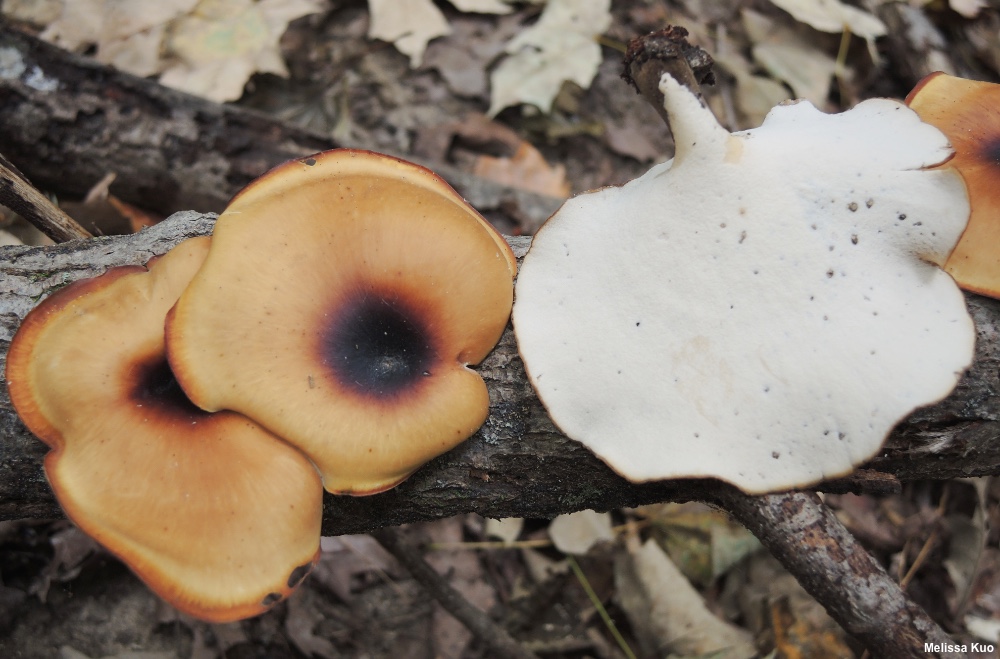
How to identify Black Foot Polypore
Polyporus badius
Got a photo? Identify mushrooms instantly with the Mushby app
Open the appTo correctly identify Black Foot Polypore (Polyporus badius), check each of these features in order. Misidentification is the most common cause of mushroom poisoning, so cross-reference multiple sources.
Step-by-step identification
- 1
Cap
Shape, color, surface texture, and diameter.
The cap is kidney-shaped to semicircular, with a smooth, dark brown to black surface. It can be slightly depressed in the center.
- 2
Gills
Attachment to stem, color, and spacing.
N/A (Pores instead of gills). The underside has small, round pores that are white to cream-colored.
- 3
Stem
Length, shape, surface, and any ring.
Absent. The fruiting body attaches directly to the substrate.
- 4
Flesh
Color, texture, and bruising reaction.
The flesh is thin and leathery, with a dark brown color.
- 5
Fruiting body
Overall growth pattern.
The fruiting body is a bracket-like structure that grows horizontally from the substrate.
- 6
Habitat
Where it grows and on what substrate.
Grows on decaying hardwood, particularly beech and birch.
Key Facts
- Cap surfaces
- Smooth
- Growth Form
- Bracket-like
- Spore Print
- White to cream
- Body color
- Dark brown to black
- Odor
- Mild, fungal
- Flesh bruises
- Does not typically bruise
- Height
- 1-3 cm thick
- Cap Diameter
- 5-20 cm
Fruit body characteristics
- Gill attachment: N/A (Pores instead of gills)
- Stem shape: N/A (Lacks a true stem)
- Stem surface: N/A (Lacks a true stem)
- Ring: Absent
- Stem cross-section: N/A (Lacks a true stem)
Explore Black Foot Polypore
Identify mushrooms anywhere
Free on iOS, Android, and Web. Photo identification, full database, and your personal collection.