
Got a photo? Identify mushrooms instantly with the Mushby app
Open the appDescription
The King Oyster Mushroom (Pleurotus eryngii) is a choice edible mushroom prized for its meaty texture and umami flavor. It is one of the largest species in the Pleurotus genus, which also includes oyster mushrooms. It is native to Mediterranean regions of Europe, North Africa, and the Middle East, but is now cultivated worldwide.
How to Identify
- Cap
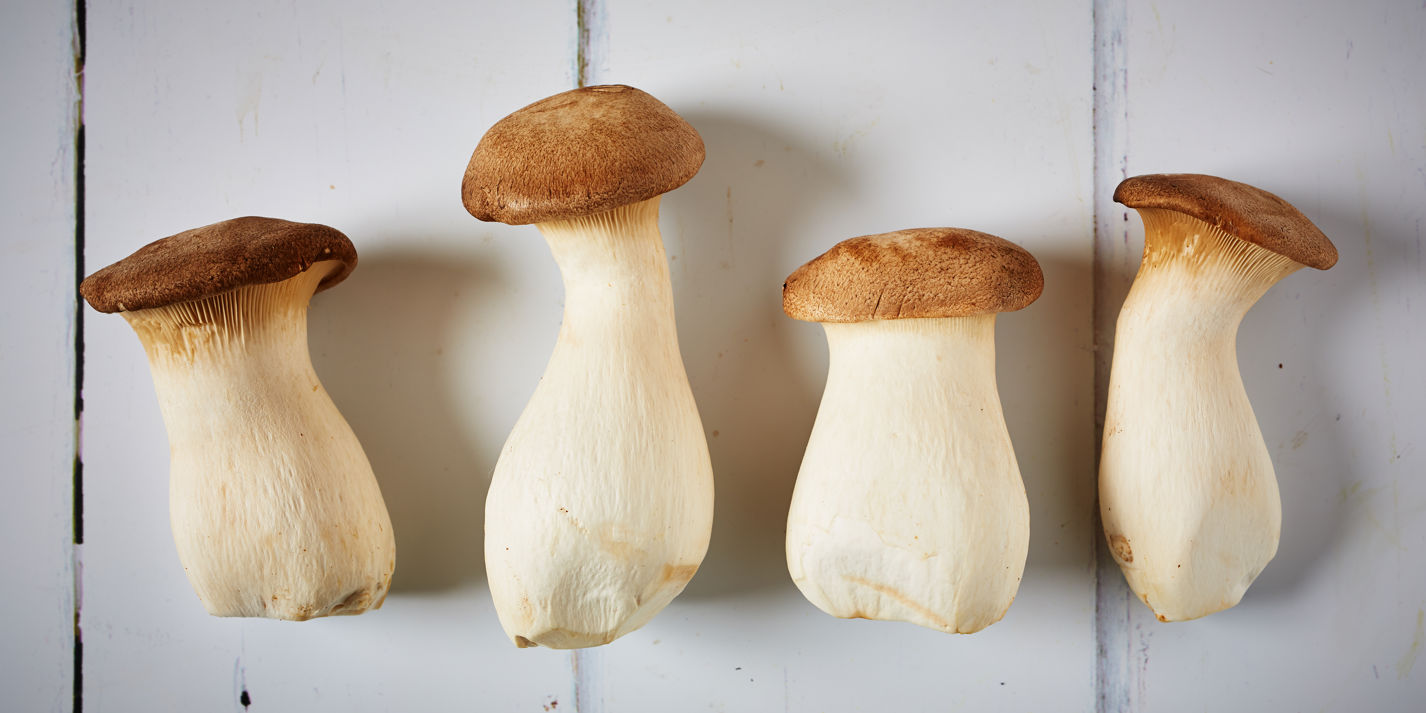
- The cap of the King Oyster Mushroom typically ranges from 5 to 20 cm in diameter. It is convex when young, becoming flattened with age. The color varies from light tan to dark brown, with a smooth, dry surface.
- Gills
- The gills are white to cream-colored, closely spaced, and decurrent, running down the stem.
- Stem
- The stem is thick, solid, and white, typically ranging from 5 to 15 cm in length and 2 to 5 cm in diameter. It is smooth and dry, with no ring or volva.
- Flesh
- The flesh is thick, firm, and white. It has a mild, slightly sweet aroma and flavor.
- Fruiting body
- The fruiting body is large and fleshy, consisting of a thick stem and a relatively small cap.
- Habitat
- King Oyster Mushrooms are found growing on decaying wood or in grasslands, often associated with the roots of herbaceous plants.
Key Facts
- Cap surfaces: Smooth, dry
- Growth Form: Solitary or in small clusters
- Spore Print: White to lilac-gray
- Body color: White stem, tan to brown cap
- Odor: Mild, slightly sweet
- Flesh bruises: Does not bruise
- Height: 5-15 cm
- Cap Diameter: 5-20 cm
- Nutrient gathering: Saprophytic or weakly parasitic
Safe
SafeThe King Oyster Mushroom is considered a safe and edible mushroom with no known toxins.
Quick Check
- Odor: Mild, slightly sweet
- Fruiting: Late autumn to early spring
- Substrate: Decaying wood, grasslands
Where to Find
Decaying Wood
Grows on decaying wood, particularly the roots of dead trees.
Grasslands and Fields
Found in grasslands and fields, often associated with the roots of herbaceous plants.
Season
Prefers cooler temperatures and can be found in late autumn and early spring.
Finding Tips
Appearance
Look for a large, thick white stem and a small to medium-sized tan or brown cap.
Habitat
Check areas where other oyster mushrooms have been found, as they often grow in similar habitats.
Texture and Aroma
The mushroom should have a firm texture and a pleasant, slightly sweet aroma.
Similar Species
Pleurotus ostreatus
mushroom
Also known as: Oyster Mushroom
Pleurotus populinus
mushroom
Also known as: Aspen Oysterling
Scientific Classification
- Phylum
- Basidiomycota
- Class
- Agaricomycetes
- Order
- Agaricales
- Family
- Pleurotaceae
- Genus
- Pleurotus
Storage Information
- Max Temperature: 10
- Freezing duration: 3 months
- Min Temperature: 2
- Refrigeration: 1 week
How to Clean
To clean King Oyster Mushrooms, gently brush off any dirt or debris with a soft brush or damp cloth. Avoid soaking them in water, as they can become waterlogged. If necessary, lightly rinse them under cold water and pat dry immediately.
Explore King Oyster Mushroom
Identify mushrooms anywhere
Free on iOS, Android, and Web. Photo identification, full database, and your personal collection.