
Got a photo? Identify mushrooms instantly with the Mushby app
Open the appDescription
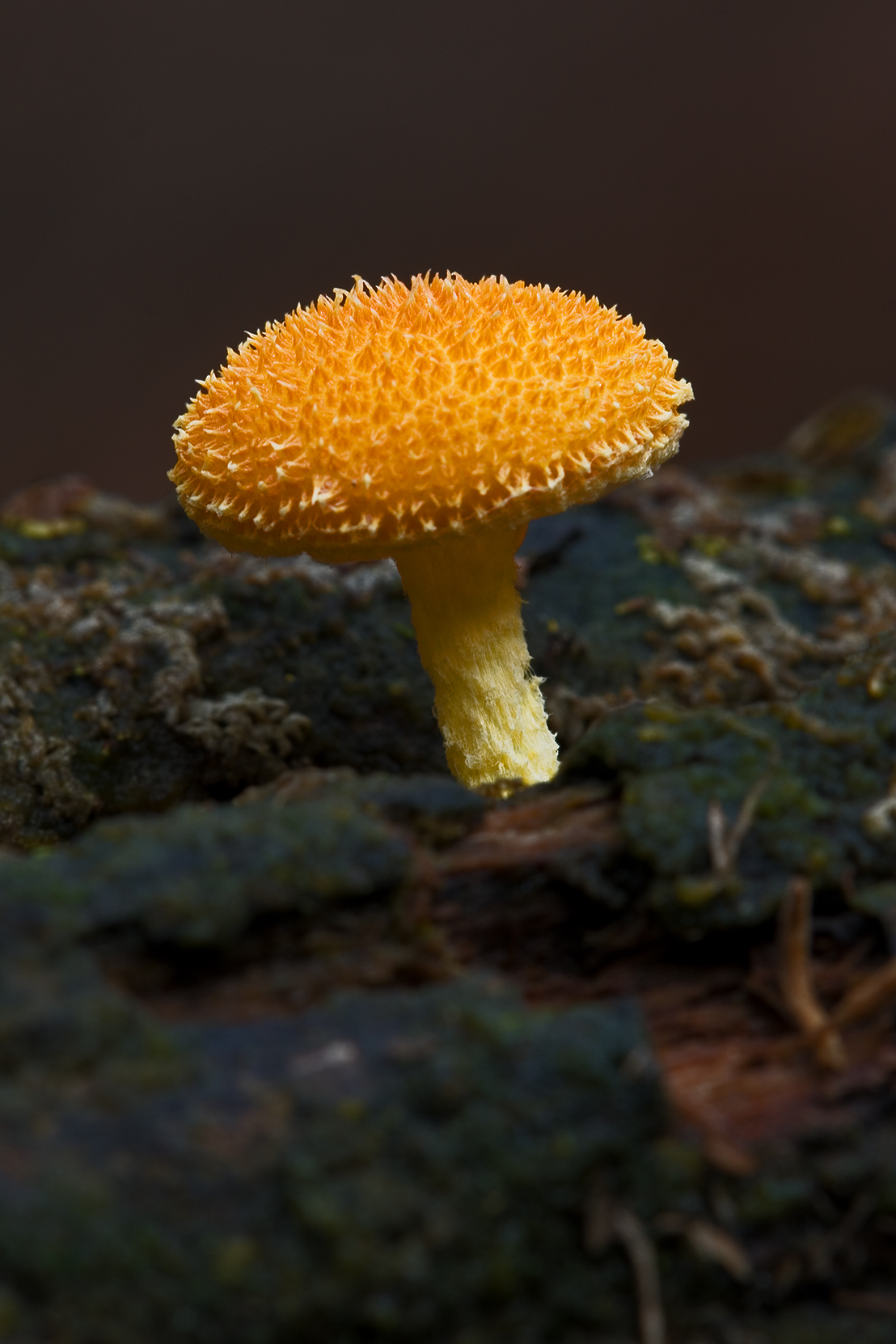
Phyllotopsis nidulans, commonly known as the Orange Mock Oysterling, is a saprobic fungus that grows on decaying wood. It is characterized by its bright orange color and oyster-like shape. While not considered poisonous, it is generally not recommended for consumption due to its unpleasant odor and taste.
How to Identify
- Cap
- The cap surface is dry and covered with fine hairs, giving it a velvety texture. The margin is often wavy or lobed.
- Gills
- The gills are closely spaced, radiating from the point of attachment to the substrate. They are typically a lighter shade of orange than the cap.
- Stem
- The stem is short or absent, with the cap directly attached to the substrate.
- Flesh
- The flesh is thin, tough, and orange. It has a distinctive, unpleasant odor, often described as skunk-like or cabbage-like.
- Fruiting body
- The fruiting body is typically 2-7 cm wide, fan-shaped or kidney-shaped, and bright orange in color.
- Habitat
- It grows on decaying wood, often in clusters. It can be found on a variety of hardwoods and occasionally on conifers.
Key Facts
- Cap surfaces: Velvety, covered with fine hairs
- Growth Form: Clustered
- Spore Print: Pinkish-orange
- Body color: Bright orange
- Odor: Unpleasant
- Flesh bruises: Does not typically bruise
- Height: Up to 3 cm
- Cap Diameter: 2-7 cm
- Nutrient gathering: Saprobic
Safe
SafeWhile not considered poisonous, it is generally not recommended for consumption due to its unpleasant odor and taste.
Quick Check
- Odor: Unpleasant, skunk-like or cabbage-like
- Fruiting: Fan-shaped or kidney-shaped
- Substrate: Decaying wood
Where to Find
North America
Common in eastern North America, but can be found in other regions as well.
Europe
Found in various parts of Europe, particularly in wooded areas.
Finding Tips
Look for Decaying Wood
Search for the Orange Mock Oysterling on fallen logs, branches, and stumps, especially those of hardwood trees.
Check in Damp Areas
These mushrooms tend to grow in moist environments, so focus your search in damp woodlands.
Similar Species
Oyster Mushroom
an edible mushroom
Also known as: Pleurotus ostreatus
Scientific Classification
- Phylum
- Basidiomycota
- Class
- Agaricomycetes
- Order
- Agaricales
- Family
- Tricholomataceae
- Genus
- Phyllotopsis
Storage Information
- Max Temperature: N/A
- Freezing duration: N/A
- Min Temperature: N/A
- Refrigeration: N/A
How to Clean
Not applicable, as this mushroom is not typically consumed.
Explore Orange Mock Oysterling
Identify mushrooms anywhere
Free on iOS, Android, and Web. Photo identification, full database, and your personal collection.