
Got a photo? Identify mushrooms instantly with the Mushby app
Open the appDescription
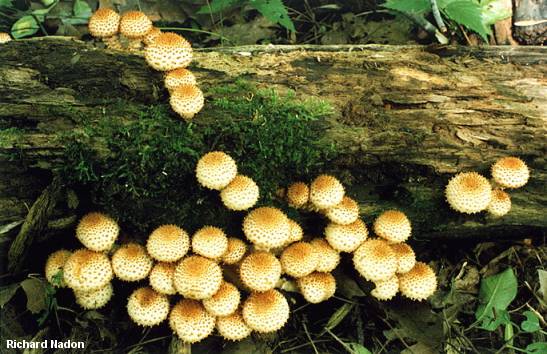
Pholiota squarrosoides, commonly known as the Shaggy Scalycap, is a distinctive wood-rotting mushroom characterized by its densely scaly cap and stem. It is a saprobic fungus, playing a role in the decomposition of dead hardwood, and occasionally conifers. This species is often found in clusters on logs, stumps, or at the base of dead or dying trees. Its appearance can vary slightly with age and environmental conditions, but the prominent, recurved scales are a consistent identifying feature.
How to Identify
- Cap
- The cap is typically 3-10 cm (1.2-4 inches) in diameter, convex to broadly convex, becoming flatter with age. The color ranges from yellowish-brown to tawny or cinnamon-brown, often paler towards the margin. It is densely covered with prominent, erect to recurved, pointed, dark brown to reddish-brown scales, which are more concentrated towards the center. The margin is often inrolled when young and may have remnants of the partial veil.
- Gills
- The gills are adnate to adnexed, sometimes with a slight decurrent tooth, crowded, and narrow. They are initially whitish to pale yellowish, becoming rusty brown to cinnamon-brown with age due to the maturing spores. There are numerous lamellulae (short gills).
- Stem
- The stem is 4-12 cm (1.6-4.7 inches) long and 0.5-1.5 cm (0.2-0.6 inches) thick, central or slightly eccentric, cylindrical or slightly tapering towards the base. It is concolorous with the cap or slightly paler, and densely covered with recurved, dark brown scales below the ring zone. Above the ring, it is often smooth or finely fibrillose. A persistent, membranous ring (annulus) is present, often stained rusty brown by spores. The stem is solid.
- Flesh
- The flesh is whitish to pale yellowish, firm, and does not change color when cut or bruised. It has a mild to slightly radish-like odor and a mild taste.
- Fruiting body
- The fruiting body is typically robust, growing in clusters or singly on wood. It is characterized by prominent, recurved scales on both the cap and stem.
- Habitat
- Saprobic, growing on dead or dying hardwood logs, stumps, and sometimes at the base of living trees, particularly deciduous species like oak, maple, and birch. Occasionally found on conifers. It typically grows in clusters or gregariously.
Key Facts
- Cap surfaces: Densely covered with prominent, recurved, dark brown scales
- Growth Form: Clustered or gregarious
- Spore Print: Rusty brown to cinnamon-brown
- Body color: Yellowish-brown to tawny or cinnamon-brown
- Odor: Mild to slightly radish-like
- Flesh bruises: No color change
- Height: 4-12 cm (1.6-4.7 inches)
- Cap Diameter: 3-10 cm (1.2-4 inches)
- Nutrient gathering: Saprobic
Safe
Mild ToxicityPholiota squarrosoides is generally considered edible, but it is not highly regarded due to its tough texture and sometimes bitter taste, especially in older specimens. Some sources report it as inedible due to bitterness or tough texture. There are also reports of gastrointestinal upset in some individuals, particularly if not thoroughly cooked or if consumed in large quantities. It is crucial to cook this mushroom thoroughly. Due to potential confusion with toxic look-alikes and variable edibility, it is not recommended for consumption by inexperienced foragers. Always exercise extreme caution and positively identify any wild mushroom before consumption.
Quick Check
- Odor: Mild to slightly radish-like
- Fruiting: Late summer to late autumn
- Substrate: Dead or dying hardwood (occasionally conifers)
Where to Find
North America
Widely distributed across temperate regions, particularly in eastern North America.
Europe
Common throughout Europe, especially in deciduous and mixed forests.
Asia
Reported in parts of Asia, though less extensively documented than in North America and Europe.
Finding Tips
Look for Hardwood
Focus your search on areas with fallen hardwood logs, stumps, or dead standing deciduous trees. It prefers oak, maple, birch, and beech.
Check for Clusters
Pholiota squarrosoides often grows in dense clusters, so if you find one, there are likely more nearby.
Seasonal Timing
This mushroom typically fruits from late summer through late autumn, especially after periods of rain.
Examine Scales
Pay close attention to the prominent, recurved scales on both the cap and stem, which are a key identifying feature.
Similar Species
Shaggy Pholiota
Pholiota
Also known as: Pholiota squarrosa
Honey Mushroom
Armillaria
Also known as: Armillaria mellea
Gymnopilus junonius
Gymnopilus
Also known as: Spectacular Rustgill
Scientific Classification
- Phylum
- Basidiomycota
- Class
- Agaricomycetes
- Order
- Agaricales
- Family
- Strophariaceae
- Genus
- Pholiota
Storage Information
- Max Temperature: 4°C
- Freezing duration: 6 months
- Min Temperature: 0°C
- Refrigeration: 5-7 days
How to Clean
Gently brush off any debris or soil with a soft brush or damp cloth. Avoid washing under running water, as mushrooms can absorb excess moisture. If necessary, a quick rinse and immediate drying are acceptable.
Explore Shaggy Scalycap
Identify mushrooms anywhere
Free on iOS, Android, and Web. Photo identification, full database, and your personal collection.