
Got a photo? Identify mushrooms instantly with the Mushby app
Open the appDescription
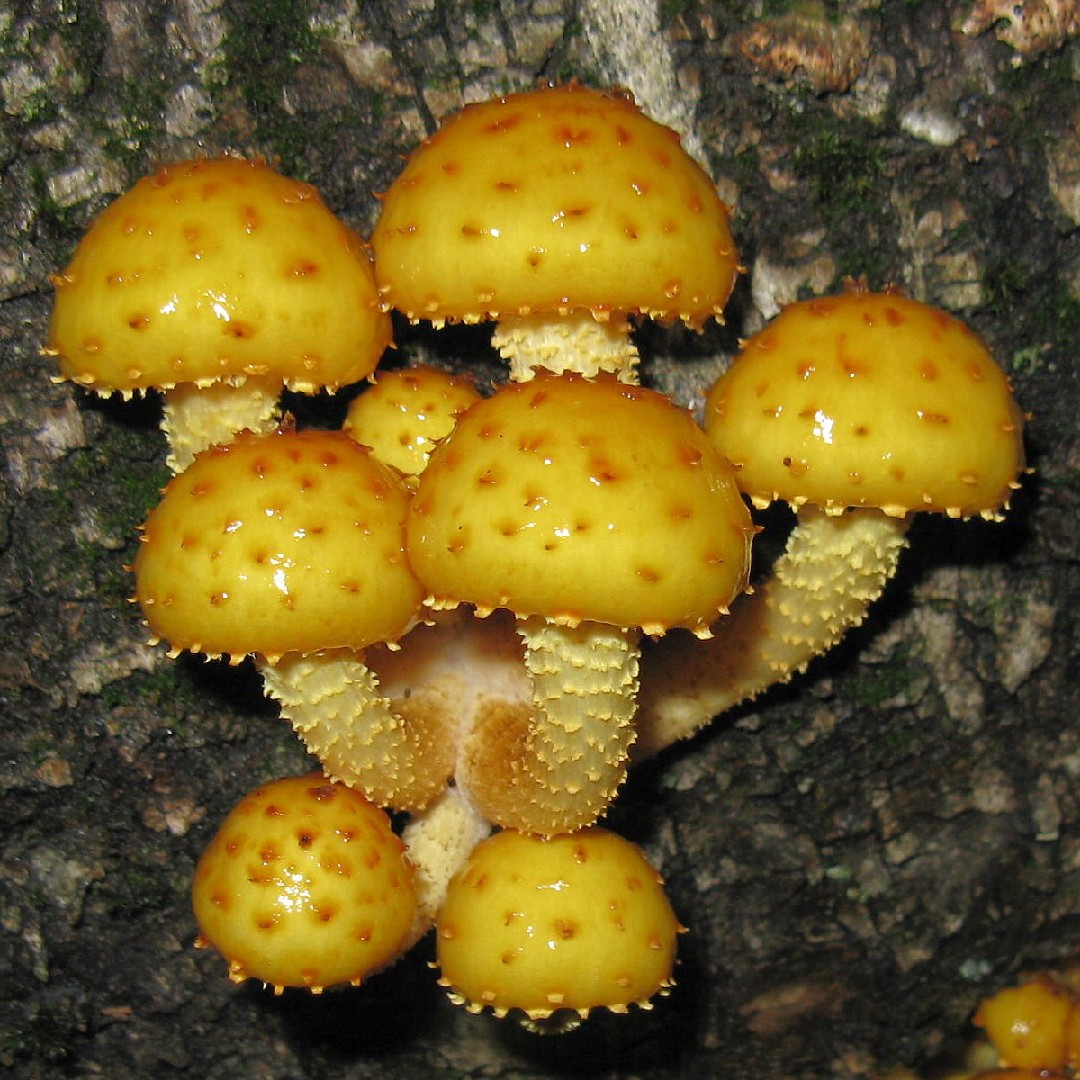
Phaeolepiota aurea, commonly known as the Cinnamon Cap, is a saprobic mushroom characterized by its bright cinnamon-brown to orange-brown cap and stem. It is often found in disturbed soil and wooded areas. While not considered deadly, its edibility is debated, and caution is advised due to potential gastrointestinal upset in some individuals.
How to Identify
- Cap
- The cap is typically 5-20 cm in diameter, convex to flattened, with a granular to scaly surface. The color ranges from cinnamon-brown to orange-brown, often fading with age.
- Gills
- The gills are crowded, free to adnexed, and yellowish to brownish in color. They may darken with age.
- Stem
- The stem is 5-15 cm long and 1-3 cm thick, cylindrical, and often curved. The surface is granular to fibrillose, with a ring that may be fragile and disappear with age.
- Flesh
- The flesh is yellowish to brownish, with a mild odor and taste.
- Fruiting body
- The overall appearance is a medium to large mushroom with a distinctive cinnamon-brown color and granular cap surface.
- Habitat
- Found in disturbed soil and wooded areas, often near decaying organic matter.
Key Facts
- Cap surfaces: Granular to scaly
- Growth Form: Solitary to scattered
- Spore Print: Rusty brown
- Body color: Cinnamon-brown to orange-brown
- Odor: Mild
- Flesh bruises: No significant bruising
- Height: 5-15 cm
- Cap Diameter: 5-20 cm
- Nutrient gathering: Saprobic
Safe
Mild ToxicityWhile not considered deadly, Phaeolepiota aurea can cause gastrointestinal upset in some individuals. It is not recommended for consumption.
Quick Check
- Odor: Mild, not distinctive
- Fruiting: Autumn
- Substrate: Disturbed soil, decaying organic matter
Where to Find
Disturbed Soil
Disturbed soil, such as gardens, roadsides, and construction sites.
Wooded Areas
Wooded areas, particularly near decaying organic matter.
Finding Tips
Color
Look for mushrooms with a bright cinnamon-brown to orange-brown color.
Cap Surface
Check for a granular to scaly cap surface.
Habitat
Search in areas with disturbed soil or decaying organic matter.
Similar Species
Amanita rubescens
mushroom
Also known as: The Blusher
Scientific Classification
- Phylum
- Basidiomycota
- Class
- Agaricomycetes
- Order
- Agaricales
- Family
- Incertae sedis
- Genus
- Phaeolepiota
Storage Information
- Max Temperature: 2
- Freezing duration: 3 months
- Min Temperature: -2
- Refrigeration: 3 days
How to Clean
Gently brush off any dirt or debris from the cap and stem. Avoid soaking in water, as this can make the mushroom soggy. A soft, damp cloth can be used to wipe the surface if needed.
Explore Cinnamon Cap
Identify mushrooms anywhere
Free on iOS, Android, and Web. Photo identification, full database, and your personal collection.