
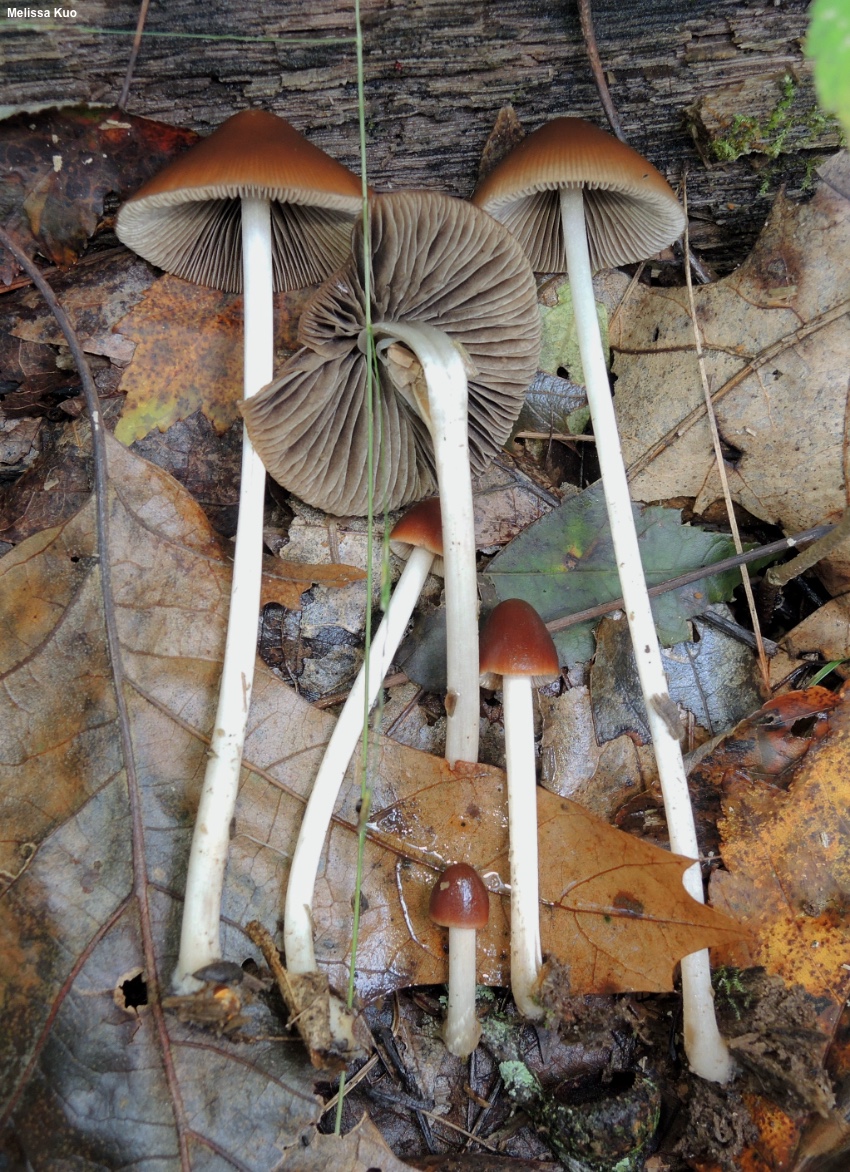
How to identify Conical Brittlestem
Parasola conopilea
Got a photo? Identify mushrooms instantly with the Mushby app
Open the appTo correctly identify Conical Brittlestem (Parasola conopilea), check each of these features in order. Misidentification is the most common cause of mushroom poisoning, so cross-reference multiple sources.
Step-by-step identification
- 1
Cap
Shape, color, surface texture, and diameter.
Initially acutely conical, becoming campanulate (bell-shaped) to broadly conical with age, but rarely flattening completely. The cap diameter ranges from 1 to 3 cm. The surface is radially grooved or striate from the margin almost to the center, reflecting the gills beneath. It is pale greyish-brown to ochraceous-brown, often darker at the apex, and becomes paler towards the margin. The cap is hygrophanous, meaning its color changes with moisture content, appearing darker when wet and lighter when dry. It lacks any veil remnants or scales.
- 2
Gills
Attachment to stem, color, and spacing.
Free, crowded, and narrow. Initially whitish, they become greyish-brown to blackish with age as the spores mature. They do not deliquesce (turn to black ink) as readily or completely as many other inkcap species, though some marginal deliquescence can occur.
- 3
Stem
Length, shape, surface, and any ring.
Slender, hollow, fragile, and cylindrical, often slightly tapering upwards. It measures 4 to 12 cm in length and 1 to 3 mm in diameter. The surface is smooth, whitish to translucent, and often pruinose (finely powdered) towards the apex. There is no ring or volva.
- 4
Flesh
Color, texture, and bruising reaction.
Very thin, fragile, and whitish to pale grey. It has no distinctive odor or taste.
- 5
Fruiting body
Overall growth pattern.
The fruiting body is slender and fragile, typical of the genus Parasola. It is not a robust mushroom and can be easily overlooked.
- 6
Habitat
Where it grows and on what substrate.
Saprobic, growing solitarily or in small scattered groups on rich, disturbed soil, lawns, gardens, wood chips, and grassy areas, often in nutrient-rich environments. It is particularly common in urban and suburban settings.
Key Facts
- Cap surfaces
- Radially grooved/striate, hygrophanous
- Growth Form
- Solitary to scattered
- Spore Print
- Black
- Body color
- Pale greyish-brown to ochraceous-brown cap, whitish stem
- Odor
- Indistinct
- Flesh bruises
- No
- Height
- 4-12 cm
- Cap Diameter
- 1-3 cm
Fruit body characteristics
- Gill attachment: Free
- Stem shape: Cylindrical, often tapering upwards
- Stem surface: Smooth, pruinose at apex
- Ring: Absent
- Stem cross-section: Hollow
Explore Conical Brittlestem
Identify mushrooms anywhere
Free on iOS, Android, and Web. Photo identification, full database, and your personal collection.