
Got a photo? Identify mushrooms instantly with the Mushby app
Open the appDescription
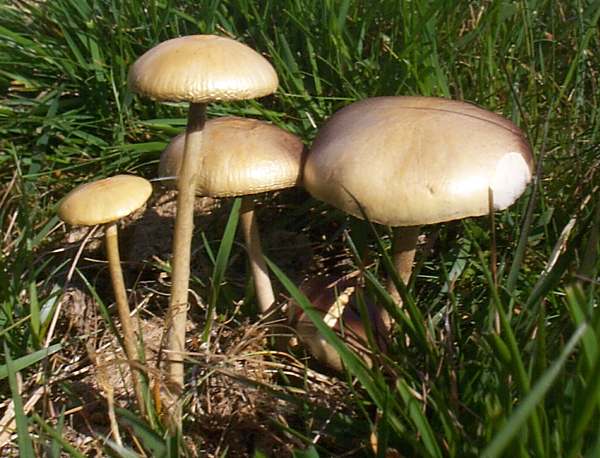
Panaeolus semiovatus, commonly known as the Banded Mottlegill, is a widely distributed but easily overlooked mushroom. It is known for its smooth, bell-shaped cap and habitat in dung-enriched areas. While not considered highly toxic, confusion with genuinely poisonous species requires extreme caution. It is often found growing on horse dung.
How to Identify
- Cap
- The cap is typically 1.5-5 cm in diameter, oval to bell-shaped (campanulate) when young, expanding to convex but retaining a slight umbo (a central bump). The surface is smooth, often sticky when moist, and ranges in color from whitish to grayish, or tan. It is hygrophanous, meaning it changes color with moisture content, often drying to a paler shade. A characteristic feature is the presence of a slight band or zone near the margin.
- Gills
- The gills are adnate to adnexed (attached to the stem but sometimes narrowly so), close to crowded, and initially grayish, maturing to mottled black as the spores develop. A key feature is the uneven maturation of spores, creating a mottled or banded appearance. The edges of the gills are often whitish and slightly fringed.
- Stem
- The stem is 4-12 cm long and 0.2-0.5 cm thick, cylindrical, equal in width or slightly enlarged at the base. It is smooth, fragile, and colored similarly to the cap or paler. A remnant of the partial veil may be present as a slight zone near the apex of the stem, but it is not a well-defined ring. The stem is typically hollow.
- Flesh
- The flesh is thin and fragile, colored similarly to the cap. It lacks a distinctive odor or taste.
- Fruiting body
- The fruiting body of Panaeolus semiovatus is generally medium-sized, with a distinct cap and stem. It is fragile and ephemeral, often disappearing quickly after maturation.
- Habitat
- Panaeolus semiovatus is a coprophilous fungus, meaning it grows on dung, especially that of horses and cattle. It is commonly found in pastures, fields, and other areas where livestock graze. It can also occur on enriched soil or compost.
Key Facts
- Cap surfaces: Smooth, sticky when moist, hygrophanous.
- Growth Form: Solitary or in small groups.
- Spore Print: Black
- Body color: Whitish, grayish, tan, or yellowish-brown.
- Odor: Not Distinctive
- Flesh bruises: Does not typically bruise.
- Height: 4-12 cm
- Cap Diameter: 1.5-5 cm
- Nutrient gathering: Saprophytic; grows on decaying organic matter (dung).
Safe
Mild ToxicityPanaeolus semiovatus is not considered highly toxic, but it can easily be mistaken for poisonous species. It contains trace amounts of psilocybin and psilocin, but not in significant quantities to cause strong psychoactive effects. However, misidentification can lead to ingestion of dangerous fungi. Edibility is generally not recommended due to the risk of confusion.
Quick Check
- Odor: Not Distinctive
- Fruiting: Spring through Autumn
- Substrate: Dung, especially horse and cow manure
Where to Find
Pastures
Common in pastures with grazing livestock, especially where horse or cow dung is present.
Fields
Frequently found in fields where animals have been grazing or where manure has been spread.
Compost piles
Can occasionally occur on compost piles or in gardens where manure is used as fertilizer.
Finding Tips
Look for Dung
Focus your search in areas with abundant animal dung, particularly horse or cow manure.
Check After Rain
These mushrooms often appear after periods of rain, which stimulates their growth.
Examine Closely
The small size and unassuming appearance can make them easy to miss, so examine the dung closely.
Similar Species
Panaeolus foenisecii
Mushroom
Also known as: Haymaker Mushroom, Lawn Mower's Mushroom
Panaeolus cinctulus
Mushroom
Also known as: Red Edge Panaeolus, Banded Mottlegill
Deconica coprophila
Mushroom
Also known as: Dung-loving Psilocybe
Scientific Classification
- Phylum
- Basidiomycota
- Class
- Agaricomycetes
- Order
- Agaricales
- Family
- Bolbitiaceae
- Genus
- Panaeolus
Storage Information
- Max Temperature: N/A
- Freezing duration: Freezing is not recommended due to their fragile structure.
- Min Temperature: 2-4°C (35-40°F)
- Refrigeration: 1-2 days, but best consumed as soon as possible.
How to Clean
Cleaning Panaeolus semiovatus involves gently brushing off any adhering debris, such as pieces of dung or soil. Because of their delicate nature, avoid washing them vigorously, as this can damage the mushroom. A soft brush or a slightly damp cloth is best.
Explore Banded Mottlegill
Identify mushrooms anywhere
Free on iOS, Android, and Web. Photo identification, full database, and your personal collection.