
Got a photo? Identify mushrooms instantly with the Mushby app
Open the appDescription
Panaeolus cinctulus, also known as the Banded Mottlegill, is a widely distributed, but often unacknowledged, psychoactive mushroom. This mushroom contains psilocybin, psilocin and baeocystin.
How to Identify
- Cap
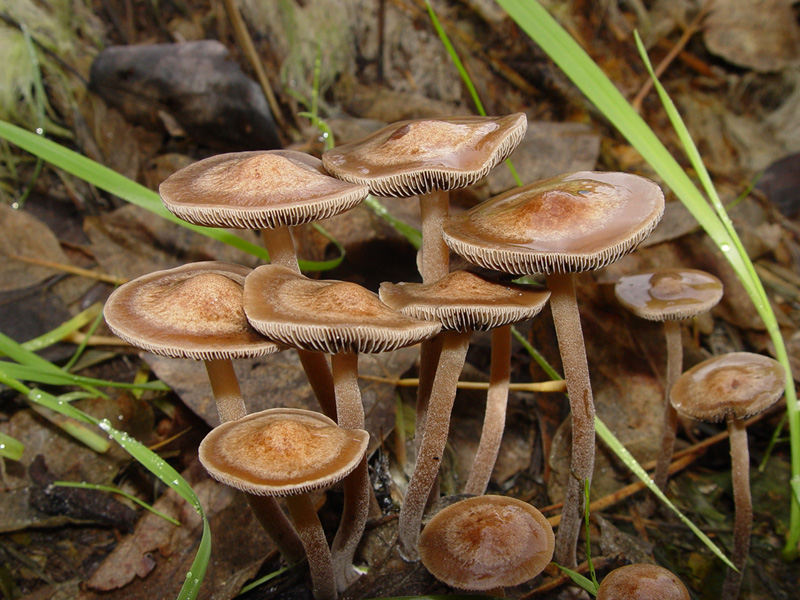
- The cap is typically 1 to 3 cm in diameter, conic to convex, and expands to become broadly convex with age. It is smooth, hygrophanous, and reddish-brown when moist, fading to tan or straw-colored as it dries. Often has a darker band around the margin.
- Gills
- The gills are closely spaced, adnate to adnexed, and initially light brown, becoming mottled with black as the spores mature. They often have a grayish tint.
- Stem
- The stem is slender, 4 to 7 cm long and 2 to 4 mm thick, equal in width, and brittle. It is smooth, reddish-brown, and lacks a ring.
- Flesh
- Thin and fragile, brownish in color.
- Fruiting body
- Small to medium-sized mushroom with a conic to convex cap and a slender stem.
- Habitat
- Grows in lawns, gardens, and disturbed ground, often in areas enriched with compost or manure. It can be found in both urban and rural settings.
Key Facts
- Cap surfaces: Smooth, hygrophanous
- Growth Form: Solitary to scattered
- Spore Print: Black
- Body color: Reddish-brown when moist, fading to tan or straw-colored when dry
- Odor: Farinaceous (like flour) or indistinct
- Flesh bruises: Does not typically bruise
- Height: 4-7 cm
- Cap Diameter: 1-3 cm
- Nutrient gathering: Saprophytic
Toxic
DeadlyContains psilocybin and psilocin, which are psychoactive compounds. Ingestion can cause altered perception, hallucinations, and other neurological effects.
Quick Check
- Odor: Farinaceous or indistinct
- Fruiting: Lawns, gardens, disturbed ground
- Substrate: Grass, compost, manure
Where to Find
North America
Lawns, gardens, and disturbed ground
Europe
Composted areas and grassy fields
Australia
Pastures and cultivated lands
Finding Tips
After Rain
Look for them after rain or in moist conditions.
Rich Soil
Check areas with rich, organic matter.
Group Growth
They often grow in clusters or small groups.
Similar Species
Panaeolus foenisecii
mushroom
Also known as: None
Psilocybe semilanceata
mushroom
Also known as: None
Scientific Classification
- Phylum
- Basidiomycota
- Class
- Agaricomycetes
- Order
- Agaricales
- Family
- Bolbitiaceae
- Genus
- Panaeolus
Explore Panaeolus cinctulus
Identify mushrooms anywhere
Free on iOS, Android, and Web. Photo identification, full database, and your personal collection.