
Got a photo? Identify mushrooms instantly with the Mushby app
Open the appDescription
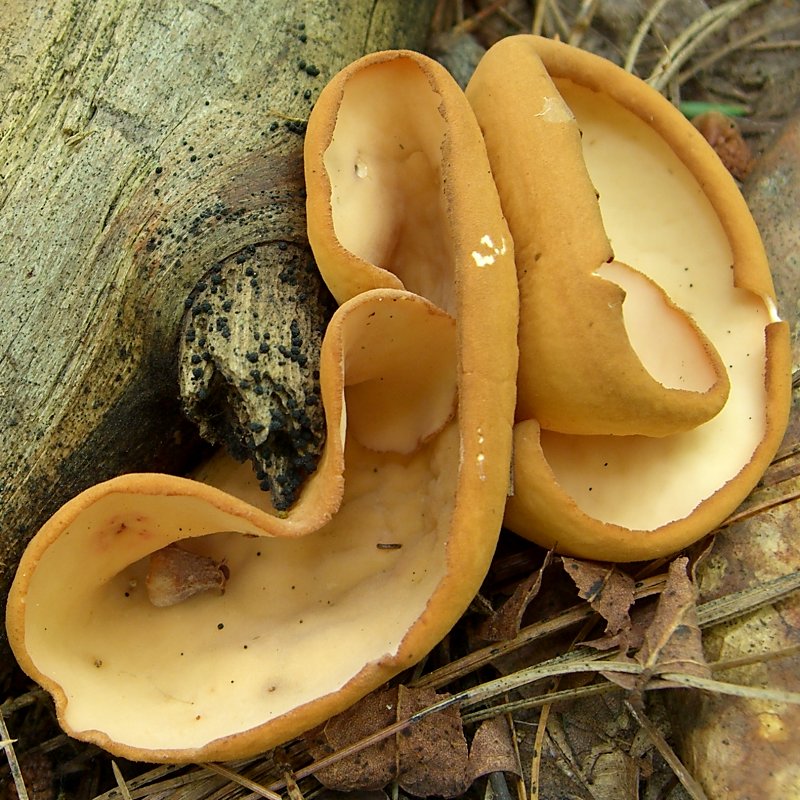
Otidea alutacea, commonly known as Brown Ear-Rot, is an ascomycetous fungus belonging to the family Otideaceae. It is characterized by its ear-shaped or cup-shaped fruiting bodies, typically varying in shades of tan, brown, or ochraceous. These fungi are saprobic, primarily found growing terrestrially on decaying organic matter, often among leaf litter or moss in woodland environments.
How to Identify
- Cap
- Not applicable as it is an ascomycete with cup-shaped fruiting bodies, not a traditional cap-and-stem mushroom.
- Gills
- Not applicable as Otidea alutacea is an ascomycete and does not produce gills. Spores are produced on the inner surface of the cup.
- Stem
- A true stem is absent; however, the fruiting body often narrows to a short, sometimes wrinkled, stem-like base that is buried in the substrate and usually paler than the cup itself.
- Flesh
- The flesh is thin, brittle, and concolorous with the fruiting body's surface, often a pale tan or whitish. It is not generally consumed.
- Fruiting body
- The fruiting body is typically ear-shaped, cup-shaped, or sometimes rabbit-ear shaped, splitting on one side. It can be irregular, often convoluted, and measures 2-8 cm in height and 2-6 cm across. The inner surface (hymenial surface) is smooth, becoming finely granular with age, and varies from pale ochre to tan, dull brown, or cinnamon. The outer surface is often paler, pruinose (finely powdered), and may have minute hairs or a velvety texture, sometimes with a whitish base extending into a short, rudimentary stem-like structure.
- Habitat
- Typically found growing gregariously or in scattered clusters on the ground, often on decaying wood (though appearing terrestrial), mossy soil, or leaf litter, particularly under deciduous and coniferous trees.
Key Facts
- Cap surfaces: Inner surface (hymenium) smooth, outer surface pruinose or finely pubescent.
- Growth Form: Cup or ear-shaped, frequently splitting on one side.
- Spore Print: White.
- Body color: Pale ochre to tan, dull brown, or cinnamon.
- Odor: Indistinct or slightly earthy.
- Flesh bruises: Does not bruise.
- Height: 2-8 cm
- Cap Diameter: 2-6 cm across (referring to the width of the cup-like body)
- Nutrient gathering: Saprobic, decomposing organic matter.
Safe
SafeOtidea alutacea is generally considered non-toxic but inedible due to its tough, thin flesh and lack of culinary value. There are no known toxins reported for this species. However, consumption is not recommended.
Quick Check
- Odor: Indistinct or slightly earthy.
- Fruiting: Ear-shaped, cupulate, or split-eared ascomycete.
- Substrate: Terrestrial on decaying wood, leaf litter, or moss.
Where to Find
Deciduous and Coniferous Forests
Common in woodlands across temperate regions of the Northern Hemisphere, often found in mixed forests.
Mossy Areas
Especially prevalent in areas with deep moss beds where organic matter accumulates.
Well-drained Soil
Prefers somewhat moist but well-drained soil rich in decaying woody debris or leaf litter.
Finding Tips
Seasonality
Look for Otidea alutacea primarily during late summer and autumn, extending into early winter in milder climates.
Habitat Search
Focus your search in mature woodlands with plenty of decaying leaf litter or mossy ground, particularly near decaying stumps or logs.
Gregarious Growth
Since they often grow in scattered groups, if you find one, continue to search the immediate vicinity for more specimens.
Similar Species
Yellow Ear
Otidea leporina
Also known as: Hare's Ear
Brown Cup
Peziza badia
Also known as: Bay Cup
Fluted Ear
Otidea bufonia
Also known as: Toad's Ear
Scientific Classification
- Phylum
- Ascomycota
- Class
- Pezizomycetes
- Order
- Pezizales
- Family
- Otideaceae
- Genus
- Otidea
Storage Information
- Max Temperature: Not applicable; not stored for consumption.
- Freezing duration: Not applicable.
- Min Temperature: Not applicable; not stored for consumption.
- Refrigeration: Not applicable.
How to Clean
Not typically collected for consumption. If handled, brushing off loose debris is sufficient as it is not eaten.
Explore Brown Ear-Rot
Identify mushrooms anywhere
Free on iOS, Android, and Web. Photo identification, full database, and your personal collection.