
Got a photo? Identify mushrooms instantly with the Mushby app
Open the appDescription
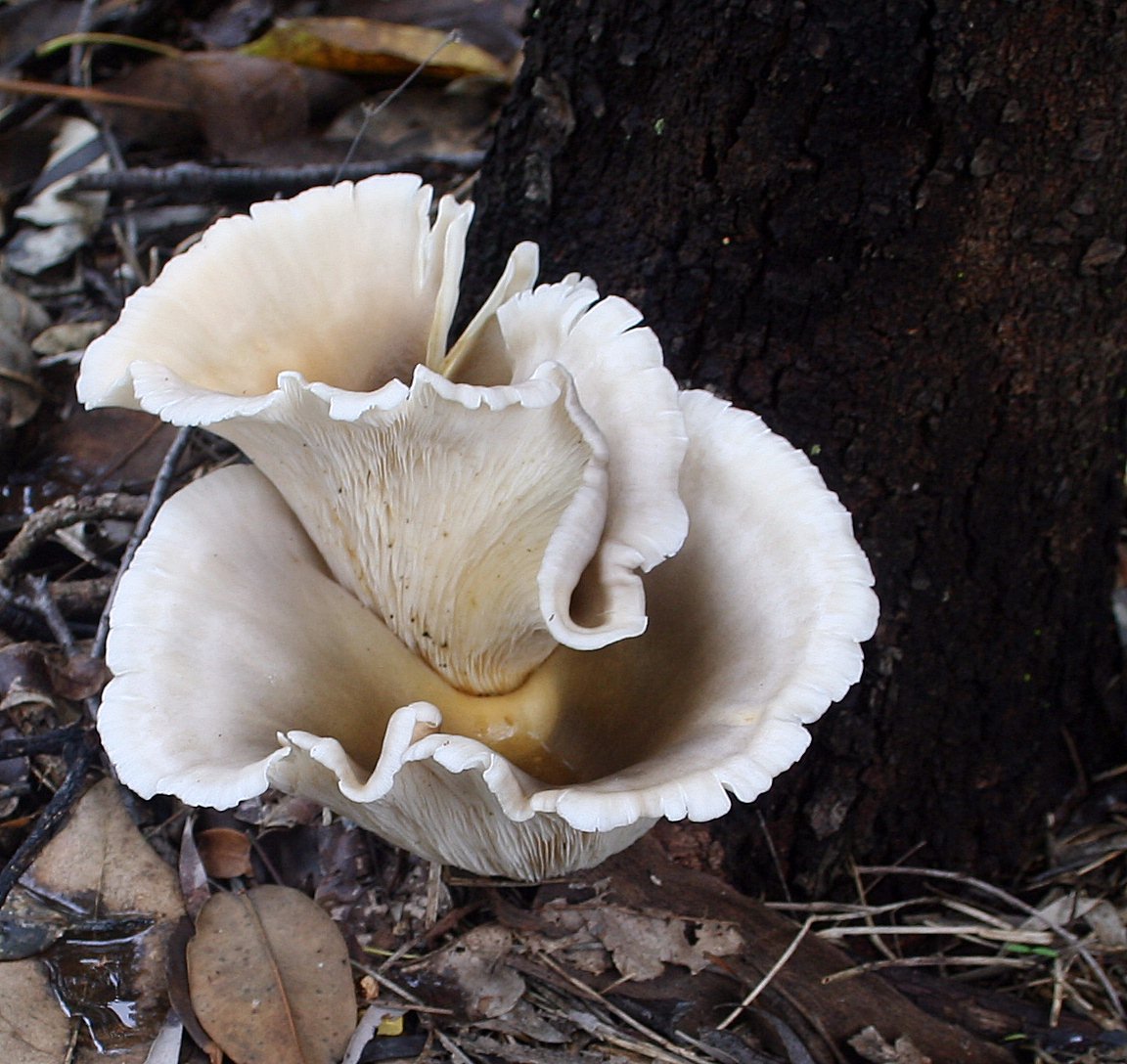
Omphalotus nidiformis is a bioluminescent mushroom, meaning it produces its own light, often visible at night, giving it the common name 'Ghost Fungus'. It is a large, gilled mushroom that typically grows in striking, overlapping clusters on dead or decaying wood.
How to Identify
- Cap
- Initially convex, flattening with age, often developing a central depression or funnel-like shape. Margins are usually inrolled when young, becoming wavy or lobed. Color ranges from creamy white to pale grey, brownish, or purplish-black, often with darker shades at the center, 3-30 cm (1.2-12 inches) in diameter.
- Gills
- Decurrent (running down the stem), numerous, narrow, and crowded. Whitish to cream or pale yellow, often with a faint greenish tint, and are the primary source of the mushroom's bioluminescence.
- Stem
- Short, stout, often eccentric (off-center) or lateral, narrowing towards the base. Color is similar to the cap, whitish to pale cream or brownish, 2-8 cm (0.8-3.1 inches) long and 1-3 cm (0.4-1.2 inches) thick. Often tough and fibrous.
- Flesh
- Thick, firm, whitish, sometimes bruising purplish-brown when damaged. Does not change color significantly when cut.
- Fruiting body
- Large, often overlapping clusters of fan-shaped or funnel-shaped caps. Bioluminescent, emitting a greenish glow in the dark, particularly from the gills.
- Habitat
- Saprobic, growing in dense, overlapping clusters on dead or decaying wood, particularly eucalyptus, casuarina, and other hardwoods. Can also be found on buried wood or at the base of living trees, appearing to grow from the ground.
Key Facts
- Cap surfaces: Smooth to slightly fibrillose, often sticky when moist.
- Growth Form: Cespitose (clumped), sessile or with short, thick stalks.
- Spore Print: White to creamy white.
- Body color: Creamy white to pale grey, brownish, or purplish-black.
- Odor: Mushroomy or slightly unpleasant.
- Flesh bruises: May bruise purplish-brown, but not a significant distinguishing feature.
- Height: Variable, stem 2-8 cm (0.8-3.1 inches)
- Cap Diameter: 3-30 cm (1.2-12 inches)
- Nutrient gathering: Saprobic (decomposes dead organic matter).
Toxic
Severe ToxicityOmphalotus nidiformis is a toxic mushroom. Ingestion causes severe gastrointestinal distress, including nausea, vomiting, abdominal pain, and diarrhea. While not typically lethal, the symptoms can be extremely unpleasant and debilitating.
Quick Check
- Odor: Faintly mushroomy, sometimes described as earthy or slightly unpleasant.
- Fruiting: In large, dense, overlapping clusters.
- Substrate: Dead or decaying wood (saprobic).
Where to Find
Australia
Widely distributed across southern and eastern Australia, including New South Wales, Victoria, Queensland, South Australia, and Western Australia. Common in wooded areas, forests, and suburban gardens where suitable host trees are present.
Tasmania
Also found in Tasmania, inhabiting similar woodland environments.
New Zealand
Recorded in New Zealand, though less common than in Australia.
Finding Tips
Time of Year
Typically fruits during autumn and winter months, but can appear year-round in suitable moist conditions. Peak season is generally after significant rainfall.
Bioluminescence
To observe the bioluminescence, visit a known patch at night, especially after rain, and allow your eyes to adjust to the darkness for at least 15-20 minutes. The glow is subtle but distinct.
Host Trees
Look for dead eucalyptus logs, stumps, or fallen branches. It can also appear at the base of seemingly healthy trees where there is buried decaying wood.
Cluster Growth
Favors growing in large, conspicuous clusters, so once one fruiting body is found, more are likely nearby.
Similar Species
Jack O'Lantern Mushroom
Fungus
Also known as: Omphalotus illudens, Omphalotus olearius
Oyster Mushroom
Fungus
Also known as: Pleurotus ostreatus
Scientific Classification
- Phylum
- Basidiomycota
- Class
- Agaricomycetes
- Order
- Agaricales
- Family
- Omphalotaceae
- Genus
- Omphalotus
Explore Ghost Fungus
Identify mushrooms anywhere
Free on iOS, Android, and Web. Photo identification, full database, and your personal collection.