
Got a photo? Identify mushrooms instantly with the Mushby app
Open the appDescription
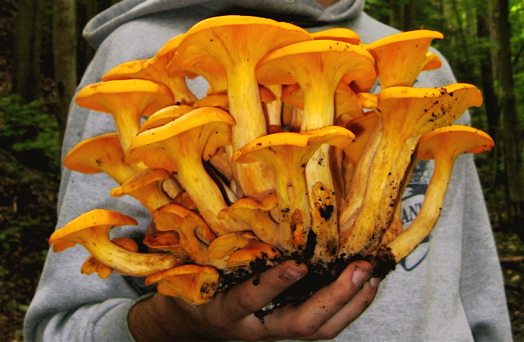
The Jack O'Lantern mushroom is a toxic, bioluminescent fungus known for its vibrant orange color and its tendency to grow in large, dense clusters on wood. It is often mistaken for edible chanterelles, leading to poisonings. Its most distinctive feature is its bioluminescence, which is visible in complete darkness, though it can be faint.
How to Identify
- Cap
- 3-20 cm (1.2-8 inches) in diameter, convex to broadly convex, becoming flat or centrally depressed with age, often with a wavy or irregular margin. Color is bright orange to orange-yellow, sometimes with brownish tints, smooth, and dry.
- Gills
- Deeply decurrent (running down the stem), closely spaced, narrow, and often forked, bright orange to orange-yellow, bioluminescent in the dark.
- Stem
- 5-20 cm (2-8 inches) long, 1-3 cm (0.4-1.2 inches) thick, tapering towards the base, often curved, solid, concolorous with the cap or slightly paler, smooth, and lacking a ring.
- Flesh
- Thick, firm, yellowish-orange, not changing color when cut or bruised.
- Fruiting body
- Large, fleshy, and typically orange to orange-yellow, growing in dense clusters on wood.
- Habitat
- Saprobic, growing in dense clusters on decaying hardwood (especially oak) or buried wood, often appearing to grow terrestrially from buried roots.
Key Facts
- Cap surfaces: Smooth, dry
- Growth Form: Clustered, often in large groups
- Spore Print: Creamy white to pale yellow
- Body color: Bright orange to orange-yellow
- Odor: Mild, not distinctive
- Flesh bruises: No significant bruising or color change
- Height: 5-20 cm (2-8 inches)
- Cap Diameter: 3-20 cm (1.2-8 inches)
- Nutrient gathering: Saprobic
Toxic
Severe ToxicityOmphalotus illudens is a poisonous mushroom. Consumption leads to severe gastrointestinal distress, including nausea, vomiting, diarrhea, and abdominal cramps. Symptoms typically appear within 30 minutes to 3 hours after ingestion and can last for several hours. While generally not fatal, the symptoms are highly unpleasant and can lead to dehydration.
Quick Check
- Odor: Mild, sometimes described as faintly mushroomy or unpleasant.
- Fruiting: Late summer to fall.
- Substrate: Decaying hardwood, especially oak.
Where to Find
Eastern North America
Common throughout the eastern United States and Canada, particularly in deciduous forests.
Hardwood Forests
Primarily found in forests dominated by hardwood trees, especially oaks, but also maples and other deciduous species.
Decaying Wood
Grows on stumps, logs, buried roots, and at the base of living trees, always associated with wood.
Finding Tips
Look for Clusters
Jack O'Lantern mushrooms almost always grow in large, dense clusters, often at the base of trees or on stumps.
Check for Decurrent Gills
The gills run down the stem, a key feature that helps distinguish it from many look-alikes, especially chanterelles which have false gills or ridges.
Observe Bioluminescence
In complete darkness, the gills of fresh specimens may emit a faint greenish glow. This is a definitive identification feature, though it can be difficult to observe.
Habitat is Key
Always found growing on wood, either visible or buried. Chanterelles typically grow terrestrially from the soil.
Seasonal Timing
Typically fruits from late summer through fall, especially after periods of rain.
Similar Species
Chanterelle
Cantharellus
Also known as: Golden Chanterelle, Yellow Chanterelle
Omphalotus olivascens
Omphalotus
Also known as: Western Jack O'Lantern Mushroom
Omphalotus olearius
Omphalotus
Also known as: European Jack O'Lantern Mushroom
Scientific Classification
- Phylum
- Basidiomycota
- Class
- Agaricomycetes
- Order
- Agaricales
- Family
- Omphalotaceae
- Genus
- Omphalotus
Explore Jack O'Lantern Mushroom
Identify mushrooms anywhere
Free on iOS, Android, and Web. Photo identification, full database, and your personal collection.