
Got a photo? Identify mushrooms instantly with the Mushby app
Open the appDescription
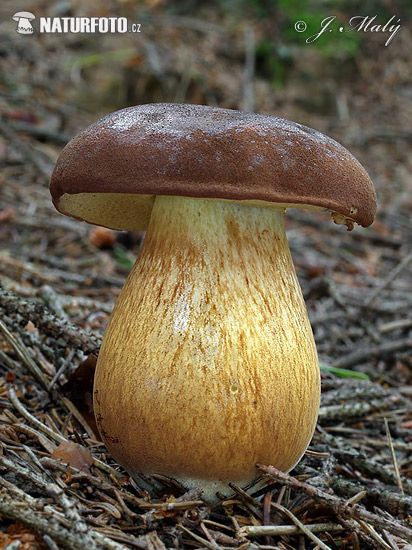
The Bay Bolete is a popular edible mushroom found across Europe and North America. It is characterized by its distinctive bay-brown cap, yellowish pores that bruise blue, and a robust stem. It is a mycorrhizal fungus, forming symbiotic relationships with various trees, particularly conifers and oaks.
How to Identify
- Cap
- The cap is typically 5-15 cm (2-6 inches) in diameter, convex to broadly convex, becoming flatter with age. The color ranges from bay-brown to chestnut-brown, sometimes with reddish or olive tints. The surface is finely velvety or felted when young, becoming smoother with age, and often slightly sticky in wet weather. The margin is usually incurved when young.
- Gills
- Instead of gills, the Bay Bolete has a pore surface. The pores are small, angular, and initially pale yellow, becoming greenish-yellow to olive-yellow with age. They bruise blue-green when touched or damaged. The tubes are adnate to depressed around the stem, 1-2 cm deep.
- Stem
- The stem is 5-12 cm (2-5 inches) long and 1-3 cm (0.4-1.2 inches) thick, typically cylindrical or slightly club-shaped, often tapering towards the base. The color is yellowish to brownish, often paler than the cap, and can have fine reddish-brown fibrils or reticulation (net-like pattern) near the apex, though this is often faint or absent. It does not have a prominent net-like pattern (reticulation) like some other boletes.
- Flesh
- The flesh is whitish to pale yellow, firm when young, becoming softer with age. It stains blue when cut or bruised, particularly above the tubes, though the bluing can be subtle or absent in some specimens.
- Fruiting body
- The fruiting body is a typical bolete shape, consisting of a cap, pores, and a stem.
- Habitat
- Mycorrhizal, forming associations with various trees, primarily conifers (especially pine, spruce, and fir) and sometimes deciduous trees (like oak and beech). It grows solitarily or scattered on the ground in coniferous, mixed, and deciduous forests.
Key Facts
- Cap surfaces: Velvety to smooth, sometimes slightly sticky
- Growth Form: Solitary or scattered
- Spore Print: Olive-brown
- Body color: Bay-brown cap, yellowish pores, yellowish-brown stem
- Odor: Mild, pleasant
- Flesh bruises: Whitish to pale yellow, stains blue when cut or bruised (especially above pores)
- Height: 5-12 cm (2-5 inches)
- Cap Diameter: 5-15 cm (2-6 inches)
- Nutrient gathering: Mycorrhizal
Safe
SafeThe Bay Bolete is considered a good edible mushroom. However, it is crucial to correctly identify it, as some toxic boletes exist. Always cook thoroughly before consumption. Raw consumption can lead to gastrointestinal upset. Some individuals may experience mild digestive issues if consumed in large quantities or if not properly cooked.
Quick Check
- Odor: Mild, pleasant, mushroomy
- Fruiting: Late summer to late autumn
- Substrate: Ground, mycorrhizal with conifers and deciduous trees
Where to Find
Europe
Widespread across temperate Europe, particularly common in coniferous and mixed forests.
North America
Found in eastern and western North America, often in association with conifers.
Asia
Reported in parts of Asia, though less extensively documented than in Europe and North America.
Finding Tips
Preferred Trees
Look under pine, spruce, fir, oak, and beech trees. It often grows near the base of these trees or in areas with their root systems.
Moisture Conditions
Favors moist, but not waterlogged, forest floors. After periods of rain, it is more likely to appear.
Seasonal Availability
Typically fruits from late summer through autumn (August to November in many regions), with peak season often in September and October.
Forest Type
Common in both coniferous and mixed woodlands. It can also be found in deciduous forests, especially those with oak.
Similar Species
Boletus subtomentosus
Boletus
Also known as: Yellow-cracked Bolete
Boletus ferrugineus
Boletus
Also known as: Brown-capped Bolete
Tylopilus felleus
Tylopilus
Also known as: Bitter Bolete
Scientific Classification
- Phylum
- Basidiomycota
- Class
- Agaricomycetes
- Order
- Boletales
- Family
- Boletaceae
- Genus
- Neoboletus
Storage Information
- Max Temperature: 4°C
- Freezing duration: 6 months
- Min Temperature: 0°C
- Refrigeration: 5 days
How to Clean
Gently brush off any dirt or debris with a soft brush or damp cloth. Avoid washing under running water, as boletes can absorb a lot of moisture and become soggy. Trim off any insect-damaged or soft parts of the stem and cap.
Explore Bay Bolete
Identify mushrooms anywhere
Free on iOS, Android, and Web. Photo identification, full database, and your personal collection.