
Got a photo? Identify mushrooms instantly with the Mushby app
Open the appDescription
The Bay Bolete is a medium to large-sized bolete mushroom, highly regarded for its edibility. It is characterized by its distinctive bay-brown cap, yellowish pores that bruise blue, and a robust stem. It is a common and widespread species, particularly in coniferous and mixed woodlands across the Northern Hemisphere.
How to Identify
- Cap
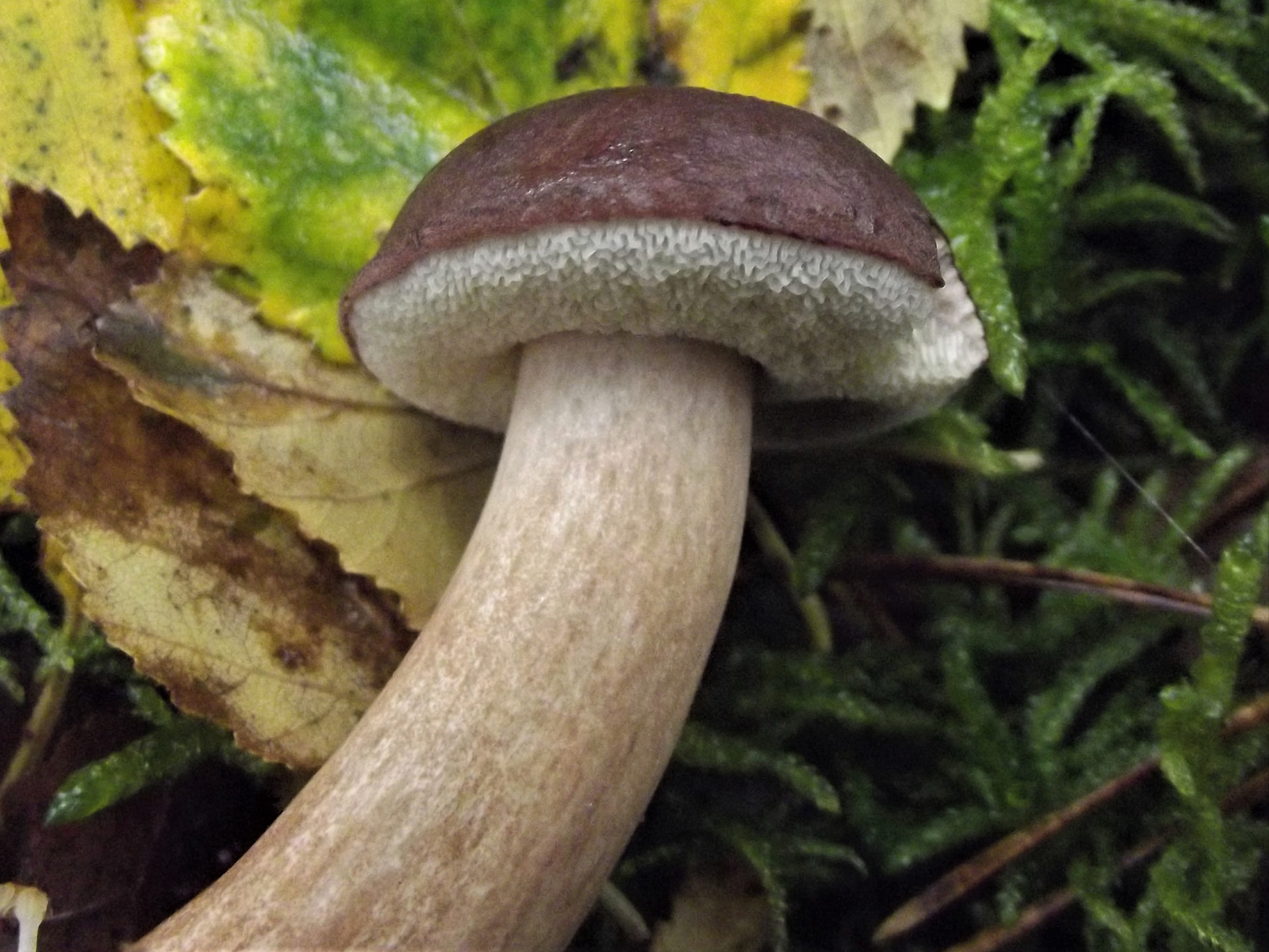
- 5-15 cm (2-6 inches) in diameter, convex to broadly convex or nearly flat with age. The color is typically bay-brown, chestnut-brown, or reddish-brown, often with a velvety or finely tomentose (hairy) surface when young, becoming smooth and somewhat sticky or greasy when wet. The margin is usually incurved when young, expanding with age.
- Gills
- Pore surface is adnate to depressed around the stem, initially pale yellow, becoming greenish-yellow to olive-yellow with age. Pores are small and angular. They bruise blue to greenish-blue when touched, a key identifying feature.
- Stem
- 5-15 cm (2-6 inches) long and 1-4 cm (0.4-1.6 inches) thick, central or slightly eccentric. It is typically cylindrical or club-shaped, often tapering towards the base. The color is yellowish to brownish, often paler than the cap, and can have fine reddish-brown fibrils or reticulation (net-like pattern) near the apex, though this is often absent or very faint. It does not have a prominent net-like pattern (reticulation) like some other boletes.
- Flesh
- Thick, firm, and whitish to pale yellow, sometimes with a faint pinkish tinge. It bruises blue when cut or damaged, especially above the tubes, though the bluing can be slow and not always intense.
- Fruiting body
- Cap and stem with a porous underside (hymenium).
- Habitat
- Mycorrhizal, forming symbiotic relationships with various trees. Commonly found in coniferous forests (especially with pine, spruce, and fir) and mixed woodlands, often under oak and beech. It can grow solitarily or in scattered groups.
Key Facts
- Cap surfaces: Velvety to smooth, sometimes sticky when wet
- Growth Form: Solitary to scattered
- Spore Print: Olive-brown
- Body color: Bay-brown cap, yellowish pores, yellowish-brown stem
- Odor: Mild, pleasant
- Flesh bruises: Blue, especially above the tubes
- Height: 5-15 cm
- Cap Diameter: 5-15 cm
- Nutrient gathering: Mycorrhizal
Safe
SafeNeoboletus badius is considered a good edible mushroom. However, like all wild mushrooms, it should be cooked thoroughly before consumption. Raw consumption can lead to gastrointestinal upset. There are no known toxins in cooked Bay Boletes. Always be 100% certain of your identification before consuming any wild mushroom. Misidentification with toxic species is the primary risk.
Quick Check
- Odor: Mild, pleasant, mushroomy
- Fruiting: Late summer to late autumn
- Substrate: Soil, often near conifers or mixed hardwoods
Where to Find
Europe
Widespread and common across most of Europe, particularly in coniferous and mixed forests.
North America
Found in eastern and western North America, often associated with conifers.
Asia
Reported in parts of Asia, including China and Japan.
Finding Tips
Look for Conifers
Focus your search in coniferous forests or mixed woodlands where conifers are present, as it frequently forms mycorrhizal associations with these trees.
Check Under Leaves and Moss
Bay Boletes can often be partially hidden under leaf litter or moss, so gently clear away debris.
Seasonal Timing
Prime fruiting season is late summer to late autumn, depending on local climate and rainfall.
Examine Pore Color and Bruising
Always check the color of the pores and observe if they bruise blue when gently pressed. This is a crucial identification step.
Similar Species
Boletus edulis
fungus
Also known as: Porcino, Penny Bun
Xerocomellus chrysenteron
fungus
Also known as: Red-cracked Bolete
Tylopilus felleus
fungus
Also known as: Bitter Bolete
Boletus subtomentosus
fungus
Also known as: Yellow-cracked Bolete
Scientific Classification
- Phylum
- Basidiomycota
- Class
- Agaricomycetes
- Order
- Boletales
- Family
- Boletaceae
- Genus
- Neoboletus
Storage Information
- Max Temperature: 4°C
- Freezing duration: 6 months
- Min Temperature: 0°C
- Refrigeration: 5 days
How to Clean
Gently brush off any dirt or debris with a soft brush or damp cloth. Avoid washing under running water, as boletes can absorb a lot of moisture and become soggy. Trim off any insect-damaged or soft parts of the stem and cap.
Explore Bay Bolete
Identify mushrooms anywhere
Free on iOS, Android, and Web. Photo identification, full database, and your personal collection.