
Got a photo? Identify mushrooms instantly with the Mushby app
Open the appDescription
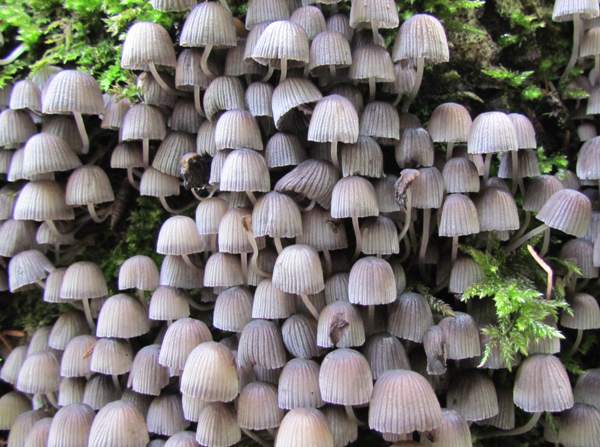
Mycena tenerrima is a tiny, delicate saprobic mushroom characterized by its white, bell-shaped cap, often covered in fine white powder or granules, and a translucent, fragile stem. It is typically found growing on decaying wood, particularly twigs and small branches, in damp environments.
How to Identify
- Cap
- Typically 2-8 mm in diameter, initially conical or bell-shaped, expanding to convex or plano-convex with age, often with a small central papilla. The surface is dry, pruinose (covered in fine white powder or granules), and translucent-striate when moist, revealing the gills beneath. Color is pure white to grayish-white.
- Gills
- Adnate to adnexed, sometimes nearly free, distant, and narrow. White to cream-colored. There are typically 8-14 gills that reach the stem, with shorter lamellulae in between.
- Stem
- 2-15 mm long and 0.5-1 mm thick, cylindrical, hollow, and very fragile. It is white, translucent, and often covered in fine white hairs or pruina, especially towards the base. The base is typically slightly enlarged and covered with radiating white mycelial hairs (rhizoids) that anchor it to the substrate.
- Flesh
- Extremely thin, fragile, and white. Odor and taste are indistinct.
- Fruiting body
- Small, delicate, and entirely white to off-white.
- Habitat
- Saprobic, growing on decaying wood, particularly small twigs, branches, and woody debris of deciduous and coniferous trees. Often found in damp, shaded areas.
Key Facts
- Cap surfaces: Pruinose, translucent-striate when moist
- Growth Form: Solitary to scattered
- Spore Print: White
- Body color: White to grayish-white
- Odor: Indistinct
- Flesh bruises: Does not bruise
- Height: 2-15 mm
- Cap Diameter: 2-8 mm
- Nutrient gathering: Saprobic
Safe
SafeMycena tenerrima is considered inedible due to its minuscule size and fragile nature. While not known to be toxic, it offers no culinary value. There are no reported toxins for this specific species, but many Mycena species contain various compounds, some of which can be mildly toxic or cause gastrointestinal upset if consumed in larger quantities (which is impractical for this species).
Quick Check
- Odor: Indistinct
- Fruiting: Solitary to scattered
- Substrate: Decaying wood (twigs, small branches)
Where to Find
Deciduous and Coniferous Forests
Commonly found in forests across temperate regions of North America, Europe, and Asia.
Damp, Shaded Areas
Prefers moist environments, often near streams or in shaded undergrowth.
On Decaying Wood
Look for it on small fallen branches, twigs, and woody debris, rather than large logs.
Finding Tips
Look Closely
Due to its small size, Mycena tenerrima is easily overlooked. A hand lens can be very helpful for identification.
Check Undersides of Twigs
Often grows on the underside of decaying twigs, protected from direct rain.
Moist Conditions
Thrives in humid conditions, so look after rain or in consistently damp areas.
Similar Species
Snowy Bonnet
Mycena
Also known as: Mycena adscendens
White Bonnet
Mycena
Also known as: Mycena alba
Pear-shaped Puffball
Lycoperdon
Also known as: Lycoperdon pyriforme
Scientific Classification
- Phylum
- Basidiomycota
- Class
- Agaricomycetes
- Order
- Agaricales
- Family
- Mycenaceae
- Genus
- Mycena
Storage Information
- Max Temperature: Not applicable
- Freezing duration: Not applicable
- Min Temperature: Not applicable
- Refrigeration: Not applicable
How to Clean
Not applicable due to its minute size and inedibility.
Explore Bonnet Bell
Identify mushrooms anywhere
Free on iOS, Android, and Web. Photo identification, full database, and your personal collection.