
Got a photo? Identify mushrooms instantly with the Mushby app
Open the appDescription
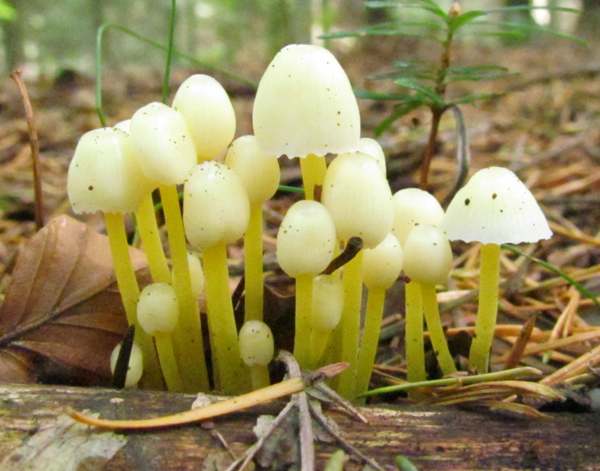
Mycena epipterygia, commonly known as the Shiny-capped Mushroom or Yellowleg Bonnet, is a widespread and common species of small, delicate agaric in the family Mycenaceae. It is characterized by its viscid (slimy) cap and stem, often yellowish coloration, and preference for growing on decaying wood or plant debris in damp, mossy environments. The species exhibits considerable variability in cap and stem color, leading to several recognized varieties.
How to Identify
- Cap
- Typically 0.5-2.5 cm (0.2-1.0 in) in diameter, initially conical or bell-shaped, expanding to convex or broadly umbonate with age. The surface is distinctly viscid (slimy or greasy) when moist, often appearing shiny when dry. Color is highly variable, ranging from yellowish-brown, olive-brown, grayish-brown, to pale yellow or even whitish, often darker at the center. The margin is striate (grooved) and translucent when moist.
- Gills
- Adnate to adnexed, sometimes with a decurrent tooth, moderately crowded, narrow. Color is whitish to pale grayish, sometimes with a yellowish tint. There are often lamellulae (short gills) present.
- Stem
- 2-8 cm (0.8-3.1 in) long and 1-3 mm (0.04-0.12 in) thick, slender, cylindrical, and hollow. The surface is notably viscid, especially when young and moist, often covered in a gelatinous sheath. Color is typically yellowish, sometimes whitish, grayish, or brownish, often paler towards the apex. The base may be slightly swollen and covered with fine, whitish hairs (tomentum).
- Flesh
- Thin, fragile, and watery, concolorous with the cap or paler.
- Fruiting body
- Small, delicate, and often gregarious, sometimes appearing in clusters.
- Habitat
- Saprobic, growing on decaying wood (coniferous and deciduous), moss, leaf litter, and other plant debris. Often found in damp, shaded areas in forests, woodlands, and sometimes gardens.
Key Facts
- Cap surfaces: Viscid, shiny when dry, striate margin.
- Growth Form: Gregarious, sometimes clustered.
- Spore Print: White.
- Body color: Variable, often yellowish, olive-brown, or grayish-brown.
- Odor: Mild, sometimes slightly farinaceous.
- Flesh bruises: Does not bruise.
- Height: 2-8 cm (0.8-3.1 in)
- Cap Diameter: 0.5-2.5 cm (0.2-1.0 in)
- Nutrient gathering: Saprobic
Safe
SafeMycena epipterygia is generally considered non-toxic, but its edibility is listed as unknown or insignificant due to its small size, fragile texture, and lack of culinary appeal. It is not recommended for consumption. There are no known toxins associated with this species, but consumption of wild mushrooms without expert identification carries inherent risks.
Quick Check
- Odor: Mild, sometimes slightly farinaceous (mealy) or indistinct.
- Fruiting: Late summer to late autumn.
- Substrate: Decaying wood (coniferous and deciduous), moss, leaf litter.
Where to Find
Temperate Forests
Common in coniferous and mixed forests across North America, Europe, and parts of Asia.
Mossy Woodlands
Prefers damp, shaded environments with abundant moss and decaying wood.
Gardens and Parks
Can occasionally be found in cultivated areas with suitable decaying organic matter.
Finding Tips
Look for Damp, Shaded Areas
Mycena epipterygia thrives in moist conditions, so focus your search in areas with high humidity, such as near streams, in ravines, or under dense canopy.
Inspect Decaying Wood and Moss
These mushrooms are saprobic, meaning they feed on dead organic matter. Carefully examine fallen logs, stumps, branches, and thick moss beds.
Seasonal Timing
While they can appear throughout the growing season, they are most prevalent from late summer through autumn, especially after periods of rain.
Observe the Slimy Texture
The viscid cap and stem are key identifying features. Touch the cap and stem gently to confirm the slimy or greasy feel, especially when moist.
Similar Species
Mycena vulgaris
Mycena
Also known as: Common Bonnet
Mycena flavoalba
Mycena
Also known as: Whiteleg Bonnet
Mycena viscosa
Mycena
Also known as: Sticky Mycena
Scientific Classification
- Phylum
- Basidiomycota
- Class
- Agaricomycetes
- Order
- Agaricales
- Family
- Mycenaceae
- Genus
- Mycena
Storage Information
- Max Temperature: 4°C
- Freezing duration: Not recommended
- Min Temperature: 1°C
- Refrigeration: 1-2 days
How to Clean
Due to their small size and delicate nature, Mycena epipterygia are not typically collected for culinary purposes. If handled, they should be gently brushed clean of debris, avoiding water which can make them even more fragile and slimy.
Explore Shiny-capped Mushroom
Identify mushrooms anywhere
Free on iOS, Android, and Web. Photo identification, full database, and your personal collection.