
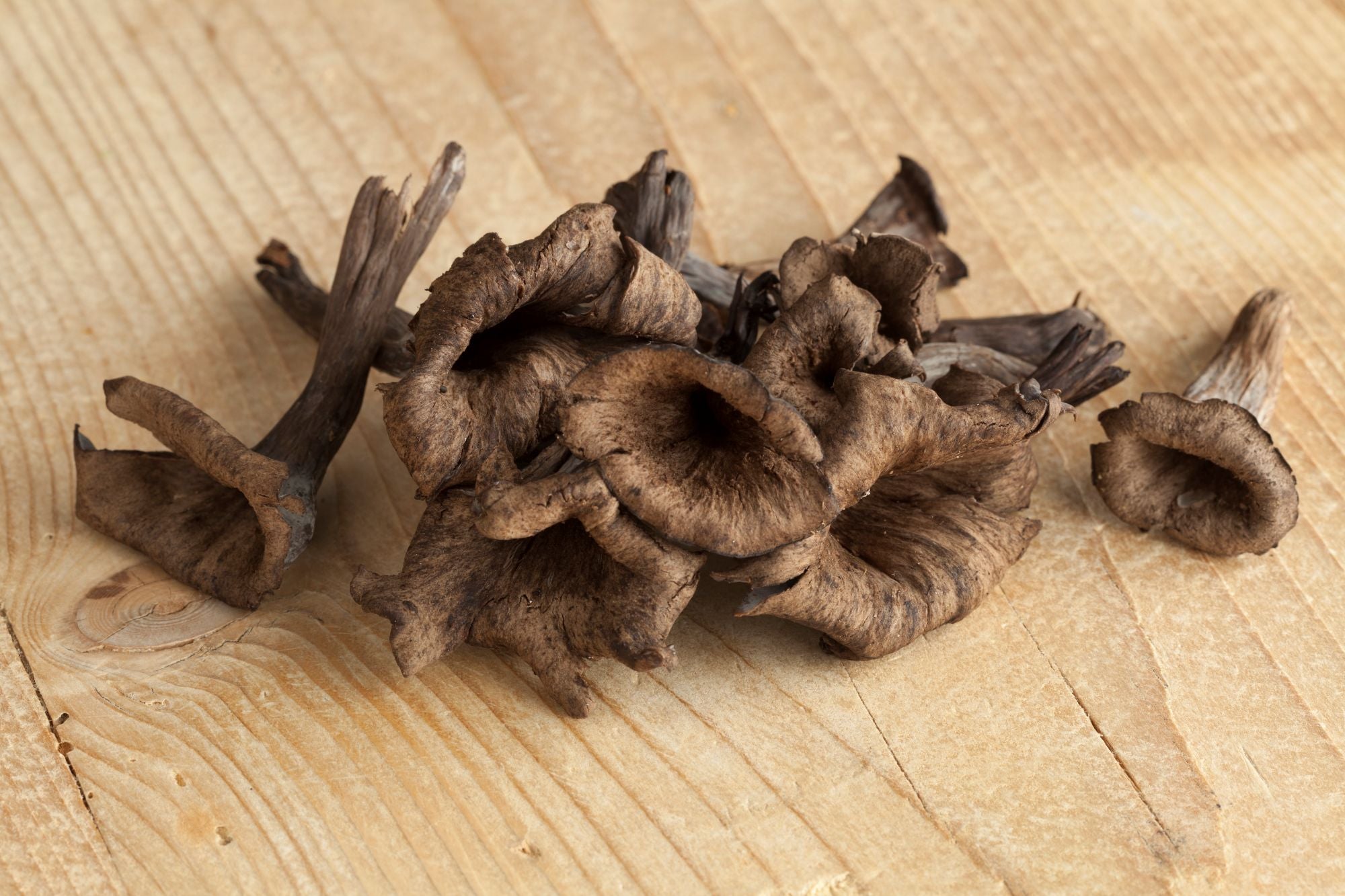
How to identify Black-staining Polypore
Meripilus sumstinei
Got a photo? Identify mushrooms instantly with the Mushby app
Open the appTo correctly identify Black-staining Polypore (Meripilus sumstinei), check each of these features in order. Misidentification is the most common cause of mushroom poisoning, so cross-reference multiple sources.
Step-by-step identification
- 1
Cap
Shape, color, surface texture, and diameter.
Individual caps are typically 10-30 cm wide, fan-shaped or spatulate, with a wavy or lobed margin. The surface is initially pale tan to yellowish-brown, becoming darker brown to grayish-brown with age. It is often finely velvety or scaly, especially when young. The most crucial identifying feature is that the cap surface, especially the pore surface, will stain black when bruised or handled.
- 2
Gills
Attachment to stem, color, and spacing.
Absent. Instead, it has a pore surface on the underside of the caps. The pores are very small (3-5 per millimeter), angular to round, and initially white or cream, turning yellowish with age. They stain black almost immediately upon bruising.
- 3
Stem
Length, shape, surface, and any ring.
Typically absent or very rudimentary, appearing as a thick, central stalk-like base from which the individual caps arise. This base is usually buried or partially buried in the substrate (wood or soil).
- 4
Flesh
Color, texture, and bruising reaction.
Thick, tough, and fibrous, especially in mature specimens. It is whitish to pale cream, but quickly stains black when cut or bruised. This black-staining reaction is a key diagnostic feature.
- 5
Fruiting body
Overall growth pattern.
Large, fan-shaped to spatulate caps arranged in overlapping, rosette-like clusters, often reaching impressive sizes (up to 50-100 cm or more across). The entire cluster can weigh several kilograms.
- 6
Habitat
Where it grows and on what substrate.
Grows at the base of living or dead hardwood trees (especially oak, maple, beech) or from buried roots. It is both parasitic, causing a white rot in living trees, and saprobic, decomposing dead wood.
Key Facts
- Cap surfaces
- Finely velvety to scaly, becoming smoother with age; pale tan to brown, staining black when bruised.
- Growth Form
- Large, overlapping, rosette-like clusters.
- Spore Print
- White.
- Body color
- Whitish to pale cream flesh, staining black; pore surface white to yellowish, staining black.
- Odor
- Mild, pleasant, mushroomy.
- Flesh bruises
- Stains black almost immediately upon cutting or bruising.
- Height
- Individual caps 10-30 cm wide; entire cluster can be 50-100 cm or more across.
- Cap Diameter
- 10-30 cm for individual caps.
Fruit body characteristics
- Gill attachment: N/A (polypore, has pores instead of gills)
- Stem shape: Rudimentary or absent, forming a thick, central base.
- Stem surface: Often rough or fibrous, typically buried.
- Ring: Absent.
- Stem cross-section: N/A (stem is rudimentary or absent)
Explore Black-staining Polypore
Identify mushrooms anywhere
Free on iOS, Android, and Web. Photo identification, full database, and your personal collection.