
Got a photo? Identify mushrooms instantly with the Mushby app
Open the appDescription
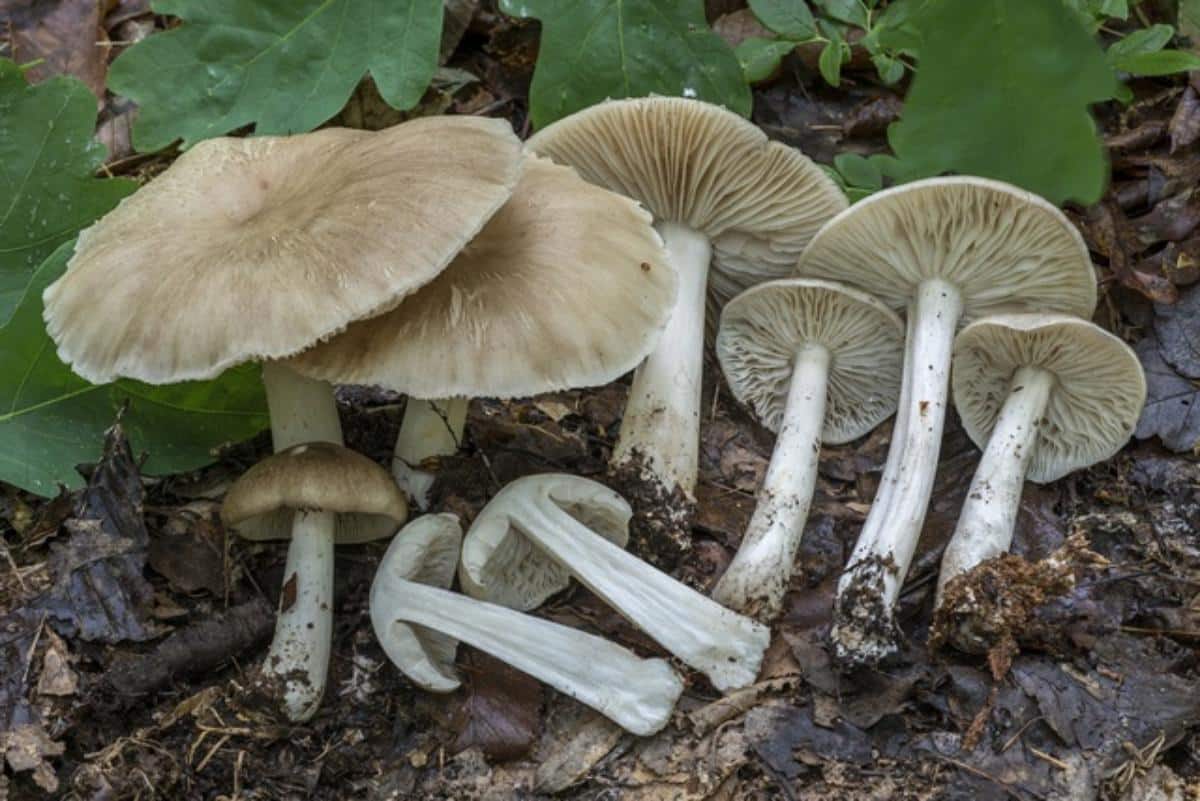
Megacollybia platyphylla, commonly known as the Platterful Mushroom or Broadgill, is a large, distinctive saprobic mushroom found in woodlands. It is characterized by its broad, widely spaced gills and a cap that often splits radially at the margin. It plays an important ecological role as a decomposer of woody debris.
How to Identify
- Cap
- 3-15 cm (1.2-6 inches) in diameter, initially convex, expanding to broadly convex or flat, often with a central depression. The margin frequently splits radially, especially in mature specimens, giving it a ragged appearance. The surface is dry, fibrillose to scaly, and typically grayish-brown, dark brown, or sometimes paler, especially towards the margin. It can be somewhat hygrophanous, appearing darker when wet.
- Gills
- Broad, very widely spaced (hence 'broadgill'), adnexed to notched, sometimes nearly free. They are white to cream-colored, often with a slightly serrated or eroded edge in older specimens. The broad spacing is a key identifying feature.
- Stem
- 5-15 cm (2-6 inches) long and 1-2.5 cm (0.4-1 inch) thick, central, cylindrical, often tapering slightly towards the apex or base. It is firm, fibrous, and white to grayish, often with longitudinal striations or fibrils. The base is typically somewhat rooting, extending into the substrate, though not as deeply as some other rooting species.
- Flesh
- White, thick, and firm, not changing color when cut or bruised. It has a mild taste and a slightly earthy or indistinct odor.
- Fruiting body
- Large, robust, and typically solitary to scattered. The overall appearance is somewhat coarse.
- Habitat
- Saprobic, growing on decaying hardwood or conifer logs, stumps, buried wood, or woody debris. It can also appear terrestrial, but is always associated with buried wood. Found in deciduous, coniferous, and mixed forests.
Key Facts
- Cap surfaces: Dry, fibrillose to scaly, often radially splitting at margin
- Growth Form: Solitary to scattered
- Spore Print: White
- Body color: Grayish-brown to dark brown cap, white to grayish stem
- Odor: Mild, earthy, or indistinct
- Flesh bruises: No color change
- Height: 5-15 cm (2-6 inches)
- Cap Diameter: 3-15 cm (1.2-6 inches)
- Nutrient gathering: Saprobic
Safe
SafeMegacollybia platyphylla is generally considered edible, but not highly prized. Some sources report it as having a bland taste and a somewhat tough texture, especially the stem. It is not known to be toxic, but as with all wild mushrooms, proper identification is crucial, and it should be cooked thoroughly. Individual sensitivities can occur.
Quick Check
- Odor: Mild, earthy, or indistinct
- Fruiting: Late spring to autumn
- Substrate: Decaying hardwood or conifer logs, stumps, buried wood
Where to Find
North America
Widespread across temperate regions, particularly common in eastern North America.
Europe
Also found throughout Europe.
Asia
Reported in parts of Asia.
Finding Tips
Look for Decaying Wood
Always search near or on decaying logs, stumps, or buried wood, as it is a saprobic species.
Observe Gill Spacing
The very broad and widely spaced gills are a crucial identification feature. If the gills are crowded, it's likely not Megacollybia platyphylla.
Check for Radial Splits
Mature caps often show characteristic radial splitting at the margin.
Seasonal Availability
Typically fruits from late spring through autumn, with peak fruiting in summer and early fall.
Similar Species
Rooting Shank
Hymenopellis radicata (formerly Xerula radicata)
Also known as: Deep Root Mushroom
Giant Tricholoma
Tricholoma colossus
Also known as: Colossus Tricholoma
Scientific Classification
- Phylum
- Basidiomycota
- Class
- Agaricomycetes
- Order
- Agaricales
- Family
- Marasmiaceae
- Genus
- Megacollybia
Storage Information
- Max Temperature: 4°C
- Freezing duration: 6 months
- Min Temperature: 0°C
- Refrigeration: 5-7 days
How to Clean
Gently brush off any debris with a soft brush or damp cloth. Avoid washing under running water, as mushrooms can absorb excess moisture. If necessary, a quick rinse and immediate drying are acceptable.
Explore Platterful Mushroom
Identify mushrooms anywhere
Free on iOS, Android, and Web. Photo identification, full database, and your personal collection.