
Got a photo? Identify mushrooms instantly with the Mushby app
Open the appDescription
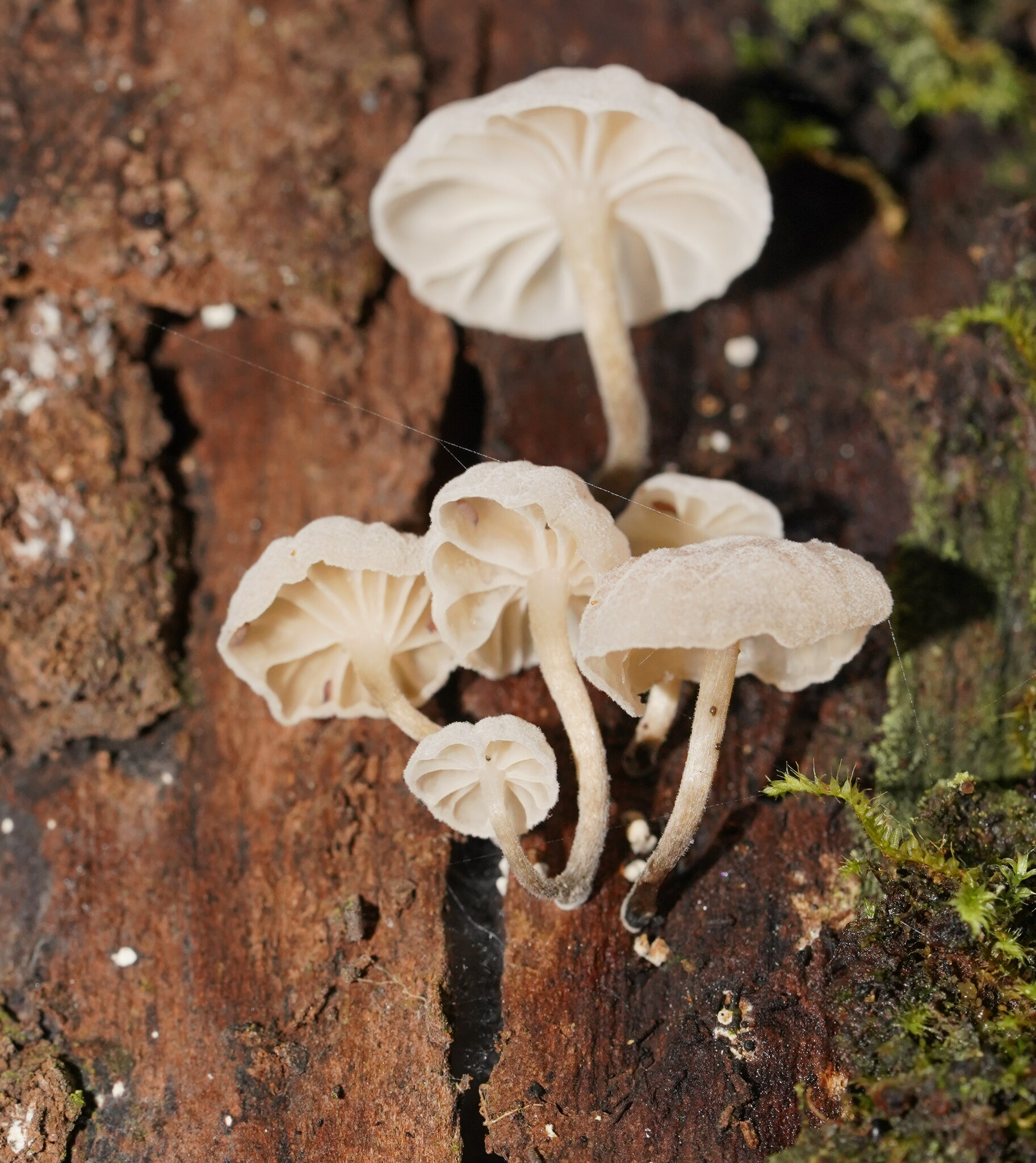
Marasmiellus candidus, commonly known as the Fairy Parachute or White Pinwheel, is a small, delicate, and entirely white mushroom. It is characterized by its tiny, often translucent cap, widely spaced gills, and a very thin, wiry stem. This saprobic species plays an important ecological role in breaking down decaying plant material, particularly small twigs, leaves, and herbaceous stems in damp, shaded environments. Its diminutive size and ephemeral nature make it a charming, though often overlooked, component of forest ecosystems.
How to Identify
- Cap
- The cap is typically 0.5-2 cm (0.2-0.8 inches) in diameter, convex to plano-convex, often becoming depressed in the center with age. It is pure white, sometimes translucent, especially when wet, and can be slightly striate (grooved) near the margin. The surface is smooth and dry.
- Gills
- The gills are adnate to adnexed, sometimes appearing almost free, and are widely spaced. They are white, relatively broad for the size of the mushroom, and often have a somewhat collariate (collar-like) attachment to the stem. They are typically few in number.
- Stem
- The stem is 1-4 cm (0.4-1.6 inches) long and 0.5-1.5 mm (0.02-0.06 inches) thick, very slender, wiry, and tough. It is white, often translucent, and can be slightly pruinose (powdery) near the apex. It is typically central, cylindrical, and often arises from a small, disc-like base attached to the substrate.
- Flesh
- The flesh is very thin, white, and fragile, with no distinctive odor or taste.
- Fruiting body
- The fruiting body is small, entirely white, and delicate, resembling a miniature parachute or pinwheel.
- Habitat
- Saprobic, growing on decaying plant material such as small twigs, leaves, herbaceous stems, and sometimes on mosses or bark. It prefers damp, shaded environments in deciduous and mixed forests.
Key Facts
- Cap surfaces: Smooth, dry, sometimes translucent and striate when wet
- Growth Form: Scattered to gregarious
- Spore Print: White
- Body color: Pure white throughout
- Odor: Indistinct
- Flesh bruises: Does not bruise
- Height: 1-4 cm (0.4-1.6 inches)
- Cap Diameter: 0.5-2 cm (0.2-0.8 inches)
- Nutrient gathering: Saprobic
Safe
SafeMarasmiellus candidus is generally considered non-toxic, but its edibility is unknown due to its minuscule size and lack of culinary interest. It is not known to contain any harmful compounds. However, due to its small size and potential for confusion with other small white fungi, it is not recommended for consumption.
Quick Check
- Odor: Indistinct or mild
- Fruiting: Late spring to autumn
- Substrate: Decaying plant material (twigs, leaves, herbaceous stems)
Where to Find
Deciduous and Mixed Forests
Commonly found in the leaf litter and on small woody debris in broadleaf and mixed woodlands across temperate regions.
Damp, Shaded Areas
Prefers moist, shaded microclimates, often near streams or in dense undergrowth, where humidity is consistently high.
Finding Tips
Look Low
Due to its small size, one must look closely at the forest floor, examining decaying twigs, leaves, and other small plant debris.
Check After Rain
Fruiting is most prolific after periods of rain, when moisture levels are high, making the delicate fruiting bodies more apparent.
Seasonal Availability
Typically found from late spring through autumn, with peak abundance during the summer months in many regions.
Similar Species
Garlic Marasmius
Mycetinis scorodonius
Also known as: Garlic Parachute
Pinwheel Marasmius
Marasmius rotula
Also known as: Collared Parachute
White Mycena
Mycena pura
Also known as: Lilac Bonnet
Scientific Classification
- Phylum
- Basidiomycota
- Class
- Agaricomycetes
- Order
- Agaricales
- Family
- Omphalotaceae
- Genus
- Marasmiellus
Storage Information
- Max Temperature: Not applicable for culinary storage.
- Freezing duration: Not applicable for culinary storage.
- Min Temperature: Not applicable for culinary storage.
- Refrigeration: Not applicable for culinary storage.
How to Clean
Due to its extremely small size and delicate nature, Marasmiellus candidus is not typically collected for culinary purposes. If one were to attempt to clean it for microscopic study or photography, a soft brush or small artist's brush would be used to gently remove debris, avoiding water which could damage the fragile structure.
Explore Fairy Parachute
Identify mushrooms anywhere
Free on iOS, Android, and Web. Photo identification, full database, and your personal collection.