
Got a photo? Identify mushrooms instantly with the Mushby app
Open the appDescription
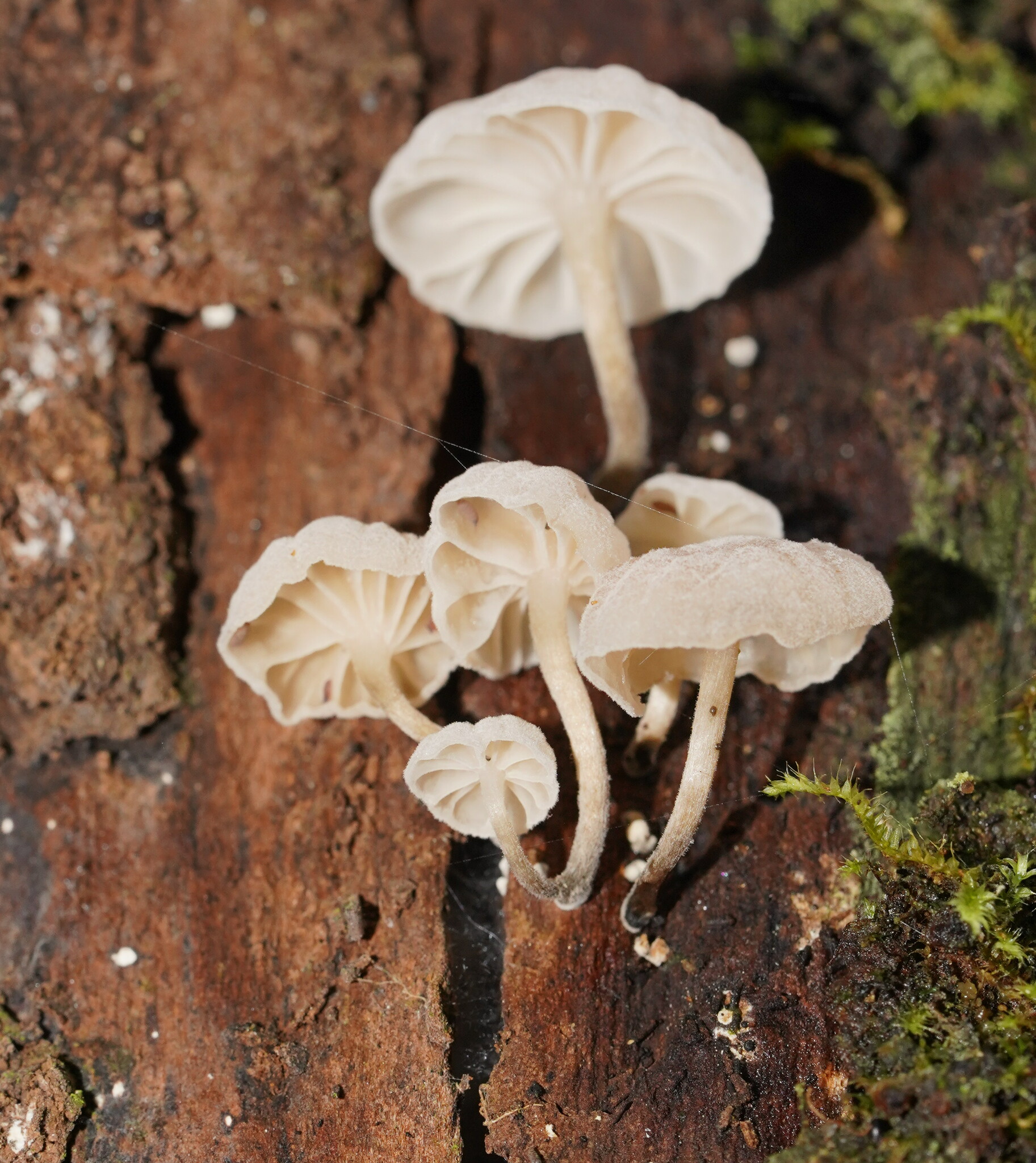
Marasmiellus candidipes, commonly known as the Fairy Parachute or White-stemmed Parachute, is a small, delicate saprobic mushroom belonging to the family Omphalotaceae. It is characterized by its tiny, often translucent white cap, widely spaced gills, and a slender, tough, white stem. This species plays an important ecological role as a decomposer of woody debris in various forest ecosystems.
How to Identify
- Cap
- The cap is 0.5-2 cm in diameter, convex to plano-convex, often with a central depression or umbilicus. It is typically white to off-white, sometimes translucent, and can become slightly yellowish with age. The surface is smooth, often striate or grooved when moist, and can be somewhat hygrophanous, appearing more opaque when dry.
- Gills
- The gills are adnate to subdecurrent, widely spaced, and relatively broad. They are white to cream-colored, sometimes with a slightly yellowish tint, and often have a somewhat waxy appearance.
- Stem
- The stem is 1-4 cm long and 0.5-2 mm thick, very slender, tough, and cartilaginous. It is typically white to translucent white, sometimes with a slightly darker base where it attaches to the substrate. The surface is smooth and often appears somewhat shiny. It is centrally attached to the cap.
- Flesh
- The flesh is very thin, white, and fragile.
- Fruiting body
- The fruiting body is small and delicate, typically appearing as a tiny umbrella-shaped mushroom.
- Habitat
- Saprobic, growing on decaying wood, bark, twigs, and other woody debris, often in moist, shaded areas of forests. It can be found on both hardwoods and conifers.
Key Facts
- Cap surfaces: Smooth, often striate or grooved when moist, sometimes translucent.
- Growth Form: Solitary to gregarious.
- Spore Print: White.
- Body color: White to off-white, sometimes yellowish with age.
- Odor: Indistinct or mild.
- Flesh bruises: Does not bruise.
- Height: 1-4 cm
- Cap Diameter: 0.5-2 cm
- Nutrient gathering: Saprobic (decomposer of woody debris).
Safe
SafeMarasmiellus candidipes is generally considered non-toxic, but its edibility is unknown or considered insignificant due to its minute size and lack of substantial flesh. It is not recommended for consumption.
Quick Check
- Odor: Indistinct or mild, sometimes slightly fungoid.
- Fruiting: Solitary to scattered or gregarious on woody debris.
- Substrate: Decaying wood (hardwood and conifer), bark, twigs.
Where to Find
Deciduous Forests
Commonly found in deciduous forests, growing on fallen branches, logs, and leaf litter.
Coniferous Forests
Also present in coniferous forests, particularly on decaying conifer wood.
Mixed Woodlands
Thrives in mixed woodlands where both hardwood and conifer debris are abundant.
Finding Tips
Look for Woody Debris
Focus your search on areas with abundant decaying wood, such as fallen logs, branches, and stumps.
Check Moist, Shaded Areas
These mushrooms prefer moist and shaded environments, so check under dense canopy or in damp ravines.
Examine Closely
Due to their small size, a careful and close examination of the substrate is necessary to spot them.
Seasonal Timing
While they can appear throughout the growing season, they are often more prevalent during periods of high humidity and after rainfall.
Similar Species
Pinwheel Marasmius
fungus
Also known as: Marasmius rotula
Garlic Marasmius
fungus
Also known as: Marasmius scorodonius
Horsehair Fungus
fungus
Also known as: Marasmius androsaceus
Scientific Classification
- Phylum
- Basidiomycota
- Class
- Agaricomycetes
- Order
- Agaricales
- Family
- Omphalotaceae
- Genus
- Marasmiellus
Storage Information
- Max Temperature: 4°C
- Freezing duration: Not recommended for freezing due to delicate structure.
- Min Temperature: 1°C
- Refrigeration: 1-2 days (for scientific study, not culinary)
How to Clean
Due to their small size and delicate nature, Fairy Parachutes are not typically collected for culinary purposes. If one were to clean them for scientific study, a soft brush or small artist's brush would be used to gently remove any debris. Avoid washing with water as they are very fragile.
Explore Fairy Parachute
Identify mushrooms anywhere
Free on iOS, Android, and Web. Photo identification, full database, and your personal collection.