
Got a photo? Identify mushrooms instantly with the Mushby app
Open the appDescription
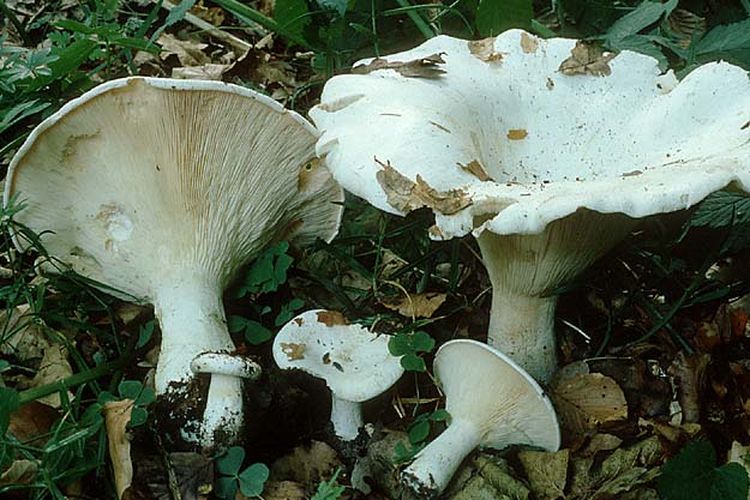
Leucopaxillus giganteus, commonly known as the Giant Funnel, is a large, white to cream-colored mushroom characterized by its deeply funnel-shaped cap, crowded gills, and robust stature. It is saprobic, growing on decaying organic matter, often in rings or arcs in grasslands, pastures, and open woodlands. This species is notable for its impressive size and distinctive funnel shape, which becomes more pronounced with age. It is also known for producing clitocybin, a compound with antibiotic properties.
How to Identify
- Cap
- Initially convex with an inrolled margin, quickly becoming broadly infundibuliform (funnel-shaped) with a depressed center and often wavy or lobed margins. Color ranges from white to cream, buff, or pale tan, often becoming yellowish or brownish with age or in the center. The surface is smooth, dry, and sometimes slightly felty when young. Size can be immense, ranging from 10 to 50 cm (4 to 20 inches) in diameter, occasionally larger.
- Gills
- Adnate to slightly decurrent, very crowded, narrow, and often forking. Color is white to cream, becoming slightly yellowish with age. They are easily separable from the cap flesh.
- Stem
- Stout and solid, typically central but can be eccentric. It is cylindrical or slightly tapering towards the base, often short in relation to the cap diameter. Color is white to cream, smooth or finely fibrillose, and lacks a ring or volva. Dimensions are usually 3-10 cm (1.2-4 inches) long and 2-5 cm (0.8-2 inches) thick.
- Flesh
- Thick, firm, white, and unchanging when cut. It has a mild, sometimes slightly mealy or indistinct odor and taste.
- Fruiting body
- Large, robust, and fleshy, typically growing in rings or arcs.
- Habitat
- Saprobic, growing terrestrially on decaying organic matter, often in nutrient-rich soils. Found in grasslands, pastures, meadows, open woodlands (especially deciduous or mixed forests), and along forest edges. It frequently forms large fairy rings or arcs.
Key Facts
- Cap surfaces: Smooth, dry, sometimes slightly felty.
- Growth Form: Solitary, scattered, or in large fairy rings/arcs.
- Spore Print: White to cream.
- Body color: White, cream, buff, pale tan.
- Odor: Mild, sometimes slightly mealy.
- Flesh bruises: Does not bruise.
- Height: 3-10 cm (stem length)
- Cap Diameter: 10-50 cm (occasionally larger)
- Nutrient gathering: Saprobic
Safe
SafeLeucopaxillus giganteus is generally considered edible when cooked, but it is not universally recommended due to its strong flavor and potential for gastrointestinal upset in some individuals. It must be thoroughly cooked; raw consumption can cause digestive issues. Some people report a slightly bitter or unpleasant taste. It is known to contain clitocybin, an antibiotic compound, which might contribute to digestive discomfort in sensitive individuals. Always cook thoroughly. Exercise caution and try a small amount first if consuming for the first time. There are several toxic white funnel-shaped mushrooms that can be confused with L. giganteus, making identification critical.
Quick Check
- Odor: Mild, sometimes slightly mealy or indistinct.
- Fruiting: Late summer to autumn.
- Substrate: Terrestrial, on decaying organic matter in soil.
Where to Find
Europe
Widespread across temperate regions of Europe, particularly common in the UK, France, Germany, and Scandinavia.
North America
Found in various regions of North America, though less common than in Europe. It occurs in the Pacific Northwest, parts of the Midwest, and the Northeast.
Asia
Reported from parts of Asia, including Japan and China.
Finding Tips
Habitat Preference
Look for it in open areas like pastures, meadows, and lawns, especially where grass is kept short. It also appears in open deciduous or mixed woodlands.
Growth Pattern
Often grows in large fairy rings or arcs, which can be quite extensive. Once you find one, look for others nearby.
Seasonality
Typically fruits from late summer through autumn (August to November), depending on local climate and rainfall.
Size and Color
Its large size and pale, funnel-shaped cap are key identifiers. Younger specimens may be less funnel-shaped but will still be robust and pale.
Similar Species
Clouded Funnel
Clitocybe nebularis
Also known as: Clouded Agaric
Ivory Funnel
Clitocybe dealbata
Also known as: Sweating Mushroom
White Dapperling
Leucocoprinus cepistipes
Also known as: Onion-stalked Parasol
Scientific Classification
- Phylum
- Basidiomycota
- Class
- Agaricomycetes
- Order
- Agaricales
- Family
- Tricholomataceae
- Genus
- Leucopaxillus
Storage Information
- Max Temperature: 4°C
- Freezing duration: 6 months
- Min Temperature: 0°C
- Refrigeration: 5 days
How to Clean
Brush off any debris or soil with a soft brush or damp cloth. Avoid washing under running water as the gills can absorb a lot of moisture, making them soggy. If necessary, a quick rinse and immediate drying are acceptable. Trim off any damaged or insect-ridden parts.
Explore Giant Funnel
Identify mushrooms anywhere
Free on iOS, Android, and Web. Photo identification, full database, and your personal collection.