
Got a photo? Identify mushrooms instantly with the Mushby app
Open the appDescription
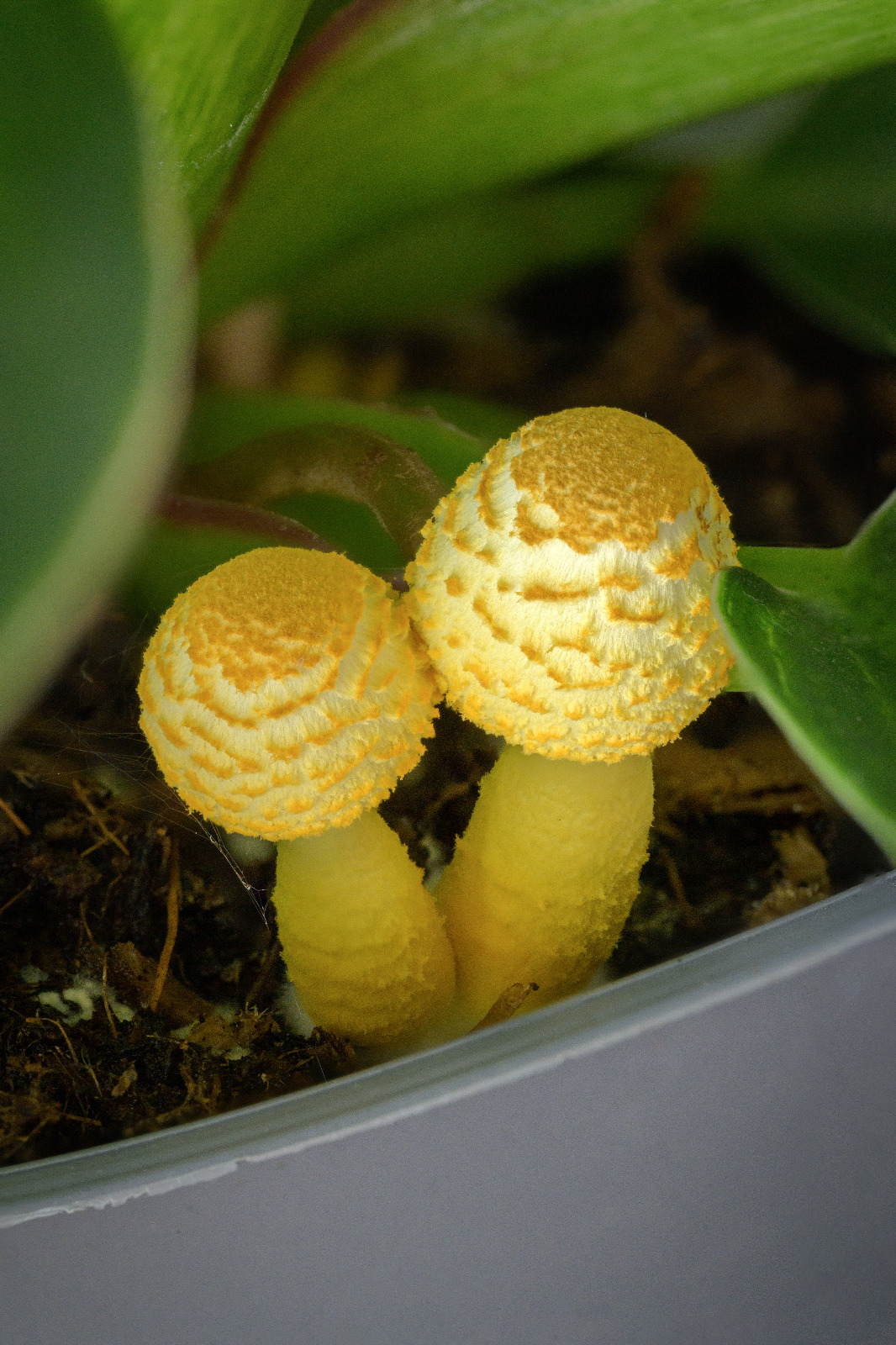
Leucocoprinus birnbaumii, commonly known as the Lemon Parasol, is a small, vibrant yellow mushroom often found in greenhouses and flowerpots. It is a saprophytic fungus, meaning it obtains nutrients from decaying organic matter. While not considered deadly poisonous, it can cause gastrointestinal upset in some individuals.
How to Identify
- Cap
- The cap is initially oval or bell-shaped, expanding to become convex with age. It is typically 2-5 cm in diameter and covered in powdery or granular scales, giving it a textured appearance. The color is a vibrant yellow, which may fade to pale yellow or whitish with age.
- Gills
- The gills are free, meaning they do not attach to the stem. They are closely spaced and white to pale yellow in color.
- Stem
- The stem is slender and cylindrical, typically 5-10 cm long and 0.5-1 cm thick. It is hollow and brittle, with a smooth or slightly powdery surface. The color is pale yellow, often with a slightly darker base. A fragile, yellowish ring may be present on the upper part of the stem, but it often disappears with age.
- Flesh
- The flesh is thin and fragile, with a pale yellow color. It does not have a distinctive odor or taste.
- Fruiting body
- The fruiting body is small to medium-sized, typically reaching a height of 5-10 cm. It is characterized by its bright yellow color, which can fade with age.
- Habitat
- Leucocoprinus birnbaumii is commonly found in greenhouses, flowerpots, and other indoor environments with warm, humid conditions. It grows in soil or compost rich in organic matter. It is a cosmopolitan species, found worldwide in tropical and subtropical regions, and occasionally in temperate areas.
Key Facts
- Cap surfaces: Powdery or granular scales
- Growth Form: Saprophytic
- Spore Print: White
- Body color: Bright Yellow
- Odor: Not Distinctive
- Flesh bruises: Does not typically bruise
- Height: 5-10 cm
- Cap Diameter: 2-5 cm
- Nutrient gathering: Decomposing organic matter
Toxic
Mild ToxicityWhile not considered deadly, Leucocoprinus birnbaumii can cause gastrointestinal upset in some individuals. It is generally not recommended for consumption.
Quick Check
- Odor: Not Distinctive
- Fruiting: Solitary or in small groups
- Substrate: Soil or compost rich in organic matter
Where to Find
Greenhouses
Commonly found in the warm, humid environment of greenhouses.
Flowerpots
Frequently appears in flowerpots, especially those with rich soil or compost.
Indoor Plantings
Can occur in indoor plantings where conditions are favorable.
Finding Tips
Check Soil
Inspect the surface of the soil in flowerpots and greenhouses for small, yellow mushrooms.
Look for Humidity
These mushrooms thrive in humid conditions, so check areas with high moisture levels.
Observe After Watering
They often appear after watering, as the increased moisture promotes growth.
Similar Species
Leucoagaricus species
Mushroom
Also known as: White Dapperlings
Scientific Classification
- Phylum
- Basidiomycota
- Class
- Agaricomycetes
- Order
- Agaricales
- Family
- Agaricaceae
- Genus
- Leucocoprinus
Explore Lemon Parasol
Identify mushrooms anywhere
Free on iOS, Android, and Web. Photo identification, full database, and your personal collection.