
Got a photo? Identify mushrooms instantly with the Mushby app
Open the appDescription
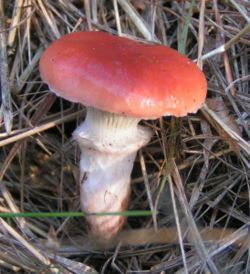
The Bleeding Milk Cap (Lactarius rubrilacteus) is a fascinating mushroom known for the reddish-orange latex it exudes when cut or broken. This feature, along with its distinctive coloration, makes it relatively easy to identify. It is an ectomycorrhizal fungus, forming symbiotic relationships with tree roots, particularly conifers.
How to Identify
- Cap
- The cap is typically 5-15 cm in diameter, depressed or funnel-shaped, and has a reddish-brown to orange-brown color. It may have concentric zones of color and a slightly sticky surface when moist.
- Gills
- The gills are closely spaced, slightly decurrent (running down the stem), and have a pale orange to cream color. They may stain reddish-brown where damaged.
- Stem
- The stem is typically 4-8 cm long and 1-2 cm thick, cylindrical, and smooth. It is usually the same color as the cap or slightly paler. The stem may also exude latex when cut.
- Flesh
- The flesh is firm and whitish to pale orange. When cut, it exudes a reddish-orange latex.
- Fruiting body
- Medium to large size mushroom with a depressed cap and reddish-orange latex.
- Habitat
- Found in coniferous forests, particularly under pine and fir trees. It is an ectomycorrhizal fungus.
Key Facts
- Cap surfaces: Slightly sticky when moist
- Growth Form: Solitary to scattered
- Spore Print: Cream to pale yellow
- Body color: Reddish-brown to orange-brown
- Odor: Mild and nondescript
- Flesh bruises: Exudes reddish-orange latex
- Height: 4-8 cm
- Cap Diameter: 5-15 cm
- Nutrient gathering: Ectomycorrhizal
Safe
SafeLactarius rubrilacteus is generally considered edible, but like all wild mushrooms, it should be properly identified before consumption. Some individuals may experience gastrointestinal upset. It is important to cook it thoroughly, as some Lactarius species can cause stomach upset if eaten raw.
Quick Check
- Odor: Mild
- Fruiting: Late summer to fall
- Substrate: Coniferous forests
Where to Find
Coniferous Forests
Under coniferous trees, especially pine and fir.
Moist Soil
Prefers moist soil conditions.
North America
Found in North America, particularly the Pacific Northwest.
Finding Tips
Check for Latex
Look for mushrooms with a depressed cap and reddish-orange latex.
Search Seasonally
Search near pine and fir trees in late summer and fall.
Examine Gills
Examine the gills for close spacing and a slightly decurrent attachment.
Similar Species
Lactarius camphoratus
mushroom
Also known as: Candy Cap
Lactarius torminosus
mushroom
Also known as: Woolly Milk Cap
Scientific Classification
- Phylum
- Basidiomycota
- Class
- Agaricomycetes
- Order
- Russulales
- Family
- Russulaceae
- Genus
- Lactarius
Storage Information
- Max Temperature: 4
- Freezing duration: 3 months
- Min Temperature: 2
- Refrigeration: 1 week
How to Clean
Gently brush off any dirt or debris. Avoid soaking in water to prevent the mushroom from becoming waterlogged. A soft brush or damp cloth can be used to clean the cap and stem.
Explore Bleeding Milk Cap
Identify mushrooms anywhere
Free on iOS, Android, and Web. Photo identification, full database, and your personal collection.