
Got a photo? Identify mushrooms instantly with the Mushby app
Open the appDescription
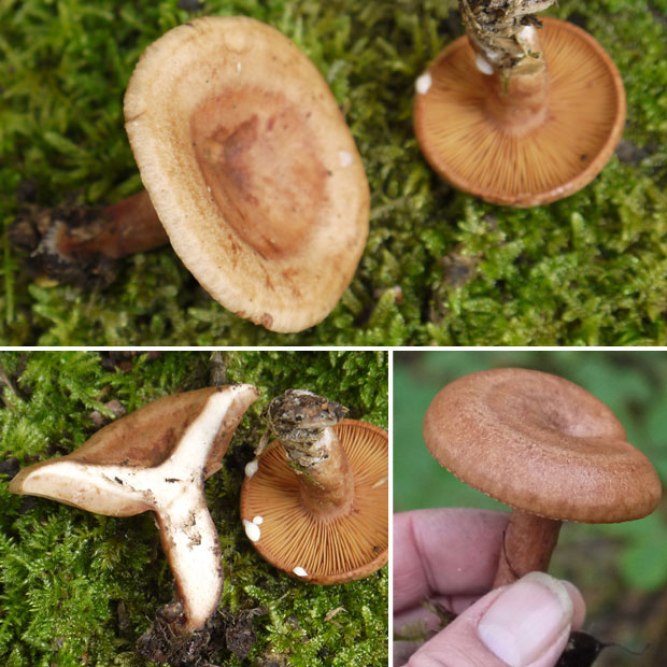
Lactarius quietus, commonly known as the Oak Milkcap, is a medium-sized mushroom characterized by its dull, reddish-brown cap, often with concentric zones, and its pale, watery milk (latex) that does not change color upon exposure to air. It is a mycorrhizal fungus, forming a symbiotic relationship primarily with oak trees.
How to Identify
- Cap
- The cap is typically 4-10 cm in diameter, convex to plano-convex, becoming depressed in the center with age. The color ranges from dull reddish-brown to cinnamon-brown, often with faint concentric zones (zonate) or spots, especially when young. The surface is dry and smooth, sometimes slightly velvety when young.
- Gills
- The gills are adnate to slightly decurrent, crowded, and rather narrow. They are initially pale cream to yellowish-buff, becoming ochraceous with age, sometimes with reddish-brown spots.
- Stem
- The stem is 3-8 cm long and 1-2 cm thick, cylindrical or slightly tapering towards the base. It is concolorous with the cap or slightly paler, often with a pruinose (powdery) surface, especially when young. It is solid when young, becoming hollow with age.
- Flesh
- The flesh is firm, whitish to pale brownish, and does not change color when cut. It exudes a white to watery-white latex that is mild to slightly acrid in taste and does not change color.
- Fruiting body
- The fruiting body is a typical agaric (gilled mushroom) with a cap, gills, and a central stem. It exudes a milky latex when cut or bruised.
- Habitat
- Lactarius quietus is exclusively mycorrhizal with oak trees (Quercus species). It is found growing on the ground, often scattered or in groups, in deciduous woodlands, parks, and gardens where oaks are present.
Key Facts
- Cap surfaces: Dry, smooth, sometimes faintly zonate.
- Growth Form: Scattered or gregarious.
- Spore Print: Cream to pale ochre.
- Body color: Reddish-brown to cinnamon-brown cap, paler stem.
- Odor: Faint, sometimes 'buggy' or 'geranium-like'.
- Flesh bruises: Does not bruise significantly; latex is unchanging white/watery-white.
- Height: 3-8 cm
- Cap Diameter: 4-10 cm
- Nutrient gathering: Mycorrhizal with oak trees.
Safe
SafeLactarius quietus is generally considered edible, though not highly prized. Some sources describe its taste as mild, while others note a slightly acrid or bitter aftertaste, especially in older specimens or if not properly cooked. It is crucial to cook this mushroom thoroughly. Raw consumption of any Lactarius species is not recommended due to potential gastrointestinal upset. Always ensure positive identification before consumption, as some similar-looking milkcaps can be acrid and cause digestive distress.
Quick Check
- Odor: Faint, sometimes described as 'buggy' or 'geranium-like', but often indistinct.
- Fruiting: Late summer to autumn (August to November).
- Substrate: Terrestrial, exclusively under oak trees.
Where to Find
Deciduous Woodlands
Commonly found in deciduous forests, particularly those dominated by oak trees.
Parks and Gardens
Can be found in urban and suburban areas with mature oak trees.
Under Oak Trees
Always found in association with oak roots, as it forms a mycorrhizal relationship.
Finding Tips
Look for Oaks
Focus your search in areas with mature oak trees, as this mushroom has a strict mycorrhizal association with them.
Check the Ground
Lactarius quietus grows terrestrially, often scattered or in small groups on the forest floor.
Seasonal Timing
Prime fruiting season is late summer to autumn, typically from August to November in temperate regions.
Examine Latex
When identifying, always break a piece of the cap or gills to observe the color and consistency of the latex. For L. quietus, it will be white to watery-white and unchanging.
Similar Species
Rufous Milkcap
Lactarius rufus
Also known as: Red Milkcap
Tawny Milkcap
Lactarius tabidus
Also known as: Birch Milkcap
Fleecy Milkcap
Lactarius vellereus
Also known as: Woolly Milkcap
Scientific Classification
- Phylum
- Basidiomycota
- Class
- Agaricomycetes
- Order
- Russulales
- Family
- Russulaceae
- Genus
- Lactarius
Storage Information
- Max Temperature: 4°C
- Freezing duration: 6 months
- Min Temperature: 1°C
- Refrigeration: 5 days
How to Clean
Gently brush off any dirt or debris with a soft brush or damp cloth. Avoid washing under running water, as mushrooms can absorb excess moisture. If necessary, a quick rinse and immediate drying are acceptable.
Explore Oak Milkcap
Identify mushrooms anywhere
Free on iOS, Android, and Web. Photo identification, full database, and your personal collection.