
Got a photo? Identify mushrooms instantly with the Mushby app
Open the appDescription
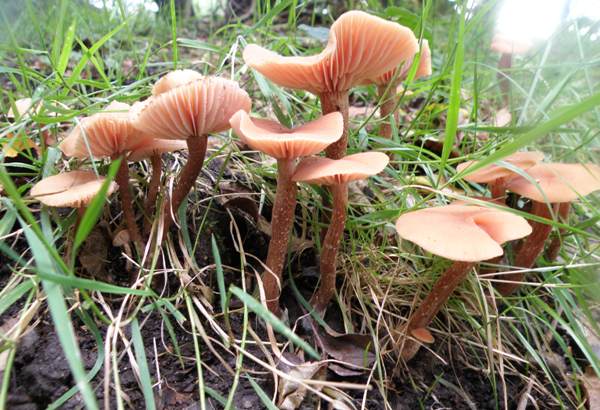
Laccaria proxima, commonly known as the Brown Laccaria or Scurfy Laccaria, is a widespread mycorrhizal mushroom found in temperate regions. It is characterized by its reddish-brown to orange-brown cap, often scurfy or scaly, and its relatively distant, pinkish-buff gills. The stem is typically fibrous and concolorous with the cap, often with a whitish mycelial base. It is a common inhabitant of damp, acidic soils, particularly in coniferous and mixed woodlands.
How to Identify
- Cap
- The cap of Laccaria proxima ranges from 2 to 8 cm in diameter, initially convex, becoming broadly convex to flattened, often with a central depression or umbo. The margin is often wavy or irregular and can be striate when moist. The color varies from reddish-brown, orange-brown, to brick-red, often fading with age or dryness. The surface is typically finely scurfy to scaly, especially towards the center, and can be somewhat hygrophanous, appearing paler when dry.
- Gills
- The gills are adnate to slightly decurrent, widely spaced (distant), and relatively thick. Their color is typically pinkish-buff to flesh-colored, sometimes with a purplish tint, especially when young. They often become powdered with white spores at maturity.
- Stem
- The stem is 3 to 10 cm long and 0.5 to 1.5 cm thick, cylindrical, often twisted or irregular, and fibrous. It is typically concolorous with the cap or slightly paler, often with fine longitudinal striations or fibrils. The base is often covered with whitish mycelial hairs. It is solid to stuffed, becoming hollow with age.
- Flesh
- The flesh is thin, pale reddish-brown to buff, and does not change color when cut or bruised. It has a mild, indistinct odor and taste.
- Fruiting body
- The fruiting body is a typical agaric (gilled mushroom) with a cap, gills, and a central stem.
- Habitat
- Laccaria proxima is a mycorrhizal fungus, forming symbiotic relationships with various trees, primarily conifers (e.g., pine, spruce, fir) but also occasionally hardwoods (e.g., birch, oak). It prefers damp, acidic, and often sandy or peaty soils. It can be found growing solitarily, scattered, or in small groups.
Key Facts
- Cap surfaces: Scurfy to finely scaly, often hygrophanous
- Growth Form: Solitary, scattered, or in small groups
- Spore Print: White
- Body color: Reddish-brown to orange-brown (cap and stem), pinkish-buff (gills)
- Odor: Mild
- Flesh bruises: No significant bruising reaction
- Height: 3-10 cm
- Cap Diameter: 2-8 cm
- Nutrient gathering: Mycorrhizal
Safe
SafeLaccaria proxima is generally considered edible, but it is not highly regarded for its culinary qualities. It has a mild flavor and somewhat tough texture. However, caution is advised due to potential confusion with other species. Always be 100% certain of identification before consumption. Some individuals may experience mild gastrointestinal upset if consumed raw or in large quantities. It is crucial to cook all wild mushrooms thoroughly.
Quick Check
- Odor: Mild, indistinct
- Fruiting: Late summer to late autumn
- Substrate: Soil, typically acidic and damp, under conifers or mixed woods
Where to Find
Coniferous Forests
Commonly found in pine, spruce, and fir forests, especially in areas with damp, acidic soil.
Mixed Woodlands
Can also occur in mixed forests where conifers are present, often near birch or oak.
Peaty and Sandy Soils
Favors well-drained but moist, acidic soils, often rich in organic matter.
Finding Tips
Seasonal Availability
Typically fruits from late summer through autumn, sometimes extending into early winter in milder climates.
Geographic Distribution
Widespread in temperate regions across North America, Europe, and Asia.
Look for Mycorrhizal Associations
Always search near the base of trees, particularly conifers, as it forms mycorrhizal associations.
Similar Species
Deceiver
Laccaria
Also known as: Laccaria laccata
Amethyst Deceiver
Laccaria
Also known as: Laccaria amethystina
Bicoloured Deceiver
Laccaria
Also known as: Laccaria bicolor
Scientific Classification
- Phylum
- Basidiomycota
- Class
- Agaricomycetes
- Order
- Agaricales
- Family
- Hydnangiaceae
- Genus
- Laccaria
Storage Information
- Max Temperature: 4°C
- Freezing duration: 6 months
- Min Temperature: 1°C
- Refrigeration: 5 days
How to Clean
Gently brush off any debris or soil with a soft brush or damp cloth. Avoid washing under running water as the mushroom can absorb excess moisture, affecting its texture and flavor. Trim off any tough or damaged parts of the stem.
Explore Brown Laccaria
Identify mushrooms anywhere
Free on iOS, Android, and Web. Photo identification, full database, and your personal collection.