
Got a photo? Identify mushrooms instantly with the Mushby app
Open the appDescription
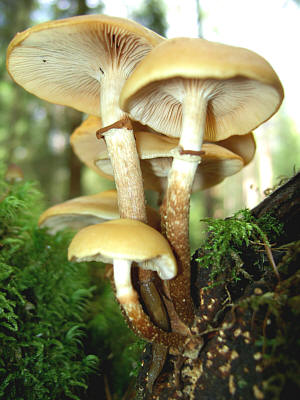
Sheathed Woodtuft (Kuehneromyces mutabilis) is a saprobic mushroom that typically grows in dense clusters on decaying wood, especially on stumps and fallen logs of deciduous trees. It is characterized by its hygrophanous cap, which changes color depending on its moisture content, and its distinctive ring on the stem.
How to Identify
- Cap
- The cap is 2-6 cm in diameter, initially convex, then flattening with age. It is hygrophanous, meaning it changes color depending on its moisture content. When wet, it is typically reddish-brown to ochre, and when dry, it becomes paler, often yellowish-brown. The surface is smooth and slightly sticky when moist.
- Gills
- The gills are adnate to slightly decurrent, crowded, and initially pale yellowish, becoming rusty brown as the spores mature.
- Stem
- The stem is 4-8 cm long and 0.5-1 cm thick, cylindrical, and often curved. It is smooth above the ring and scaly below. The color is typically brownish, darker below the ring.
- Flesh
- The flesh is thin and brownish in color.
- Fruiting body
- The fruiting body of Kuehneromyces mutabilis typically grows in dense clusters on decaying wood.
- Habitat
- It grows on decaying wood, especially on stumps and fallen logs of deciduous trees.
Key Facts
- Cap surfaces: Smooth, slightly sticky when moist
- Growth Form: Caespitose (growing in clusters)
- Spore Print: Rusty brown
- Body color: Brownish to ochre
- Odor: Mild, mushroomy
- Flesh bruises: No bruising reaction
- Height: 4-8 cm
- Cap Diameter: 2-6 cm
- Nutrient gathering: Saprobic
Safe
Mild ToxicityWhile Kuehneromyces mutabilis is considered edible, it can be easily confused with the deadly poisonous Galerina marginata. It is crucial to positively identify this mushroom before consumption.
Quick Check
- Odor: Mild, mushroomy
- Fruiting: Grows in clusters on decaying wood
- Substrate: Decaying wood of deciduous trees
Where to Find
Europe and North America
Sheathed Woodtuft is commonly found in Europe and North America.
Damp, wooded areas
It prefers damp, wooded areas with plenty of decaying wood.
Finding Tips
Check Decaying Wood
Look for clusters of mushrooms on decaying wood, especially on stumps and fallen logs.
Search in the Fall
The mushroom is most commonly found in the fall.
Identify the Ring
Check for the distinctive ring on the stem, which is a key identifying feature.
Similar Species
Sulphur Tuft
Hypholoma
Also known as: Sulphur Tuft
Scientific Classification
- Phylum
- Basidiomycota
- Class
- Agaricomycetes
- Order
- Agaricales
- Family
- Strophariaceae
- Genus
- Kuehneromyces
Storage Information
- Max Temperature: 5
- Freezing duration: 3
- Min Temperature: 2
- Refrigeration: 2
How to Clean
To clean Sheathed Woodtuft mushrooms, gently brush off any dirt or debris. If necessary, lightly rinse them under cold water and pat dry with a paper towel.
Explore Sheathed Woodtuft
Identify mushrooms anywhere
Free on iOS, Android, and Web. Photo identification, full database, and your personal collection.