
Got a photo? Identify mushrooms instantly with the Mushby app
Open the appDescription
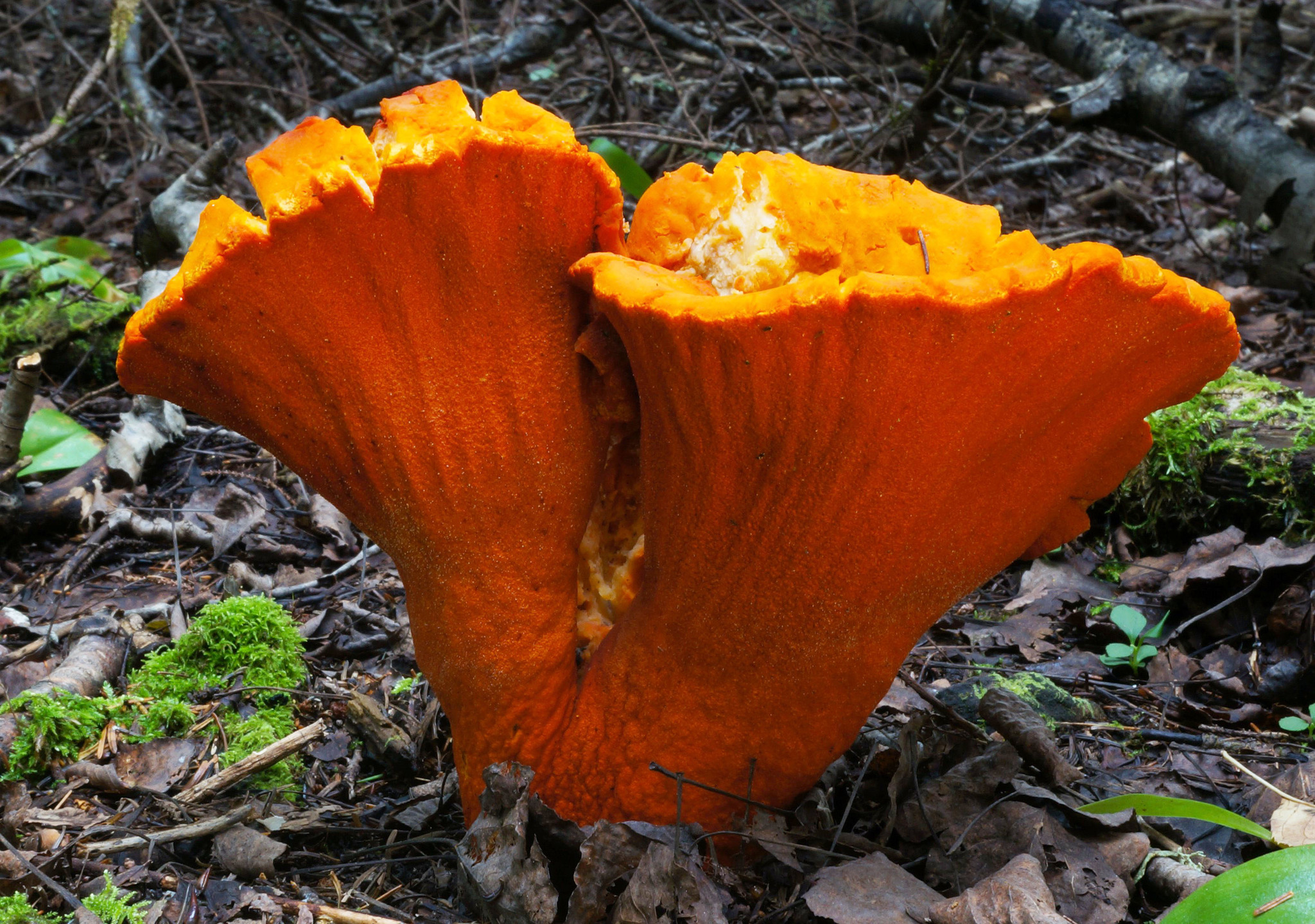
The Lobster Mushroom is not a true mushroom but a parasitic ascomycete fungus that grows on certain host mushrooms, typically species of Russula or Lactarius. The fungus deforms the host, making it unidentifiable, and gives it a reddish-orange color, resembling a cooked lobster. It is edible and prized by some for its seafood-like flavor.
How to Identify
- Cap
- The cap is usually unrecognizable due to the parasitic deformation. It lacks typical mushroom features.
- Gills
- Gills are absent due to the parasitic deformation. The host mushroom's gills are replaced by the fungal growth.
- Stem
- The stem is also deformed and may be difficult to distinguish from the rest of the fruiting body.
- Flesh
- The flesh is firm and white, often with a dense texture.
- Fruiting body
- The fruiting body is a deformed mushroom, typically reddish-orange, hard, and dense.
- Habitat
- Found in coniferous and mixed forests, parasitizing Russula or Lactarius species.
Key Facts
- Cap surfaces: Deformed, hard, and dense
- Growth Form: Parasitic
- Spore Print: White to pale yellow (on the host mushroom)
- Body color: Reddish-orange
- Odor: Seafood-like
- Flesh bruises: Does not typically bruise
- Height: Variable, depending on the host mushroom
- Cap Diameter: Variable, depending on the host mushroom
- Nutrient gathering: Parasitic
Safe
Mild ToxicityThe Lobster Mushroom is generally considered edible, but it can cause gastrointestinal upset in some individuals. It is important to ensure that the host mushroom is not toxic.
Quick Check
- Odor: Seafood-like or slightly fishy
- Fruiting: Summer to fall
- Substrate: Parasitic on Russula or Lactarius species
Where to Find
North America
Common in eastern North America, particularly in coniferous forests.
Europe
Occasionally found in Europe, though less common than in North America.
Finding Tips
Look for host mushrooms
Search in areas where Russula and Lactarius species are common.
Check coniferous forests
These mushrooms are often found in coniferous or mixed forests.
Similar Species
None
N/A
Also known as: N/A
Scientific Classification
- Phylum
- Ascomycota
- Class
- Sordariomycetes
- Order
- Hypocreales
- Family
- Hypocreaceae
- Genus
- Hypomyces
Storage Information
- Max Temperature: N/A
- Freezing duration: N/A
- Min Temperature: 2-4°C
- Refrigeration: 3-5 days
How to Clean
Clean the Lobster Mushroom by brushing off any dirt or debris. Trim any damaged or overly tough parts.
Explore Lobster Mushroom
Identify mushrooms anywhere
Free on iOS, Android, and Web. Photo identification, full database, and your personal collection.