
Got a photo? Identify mushrooms instantly with the Mushby app
Open the appDescription
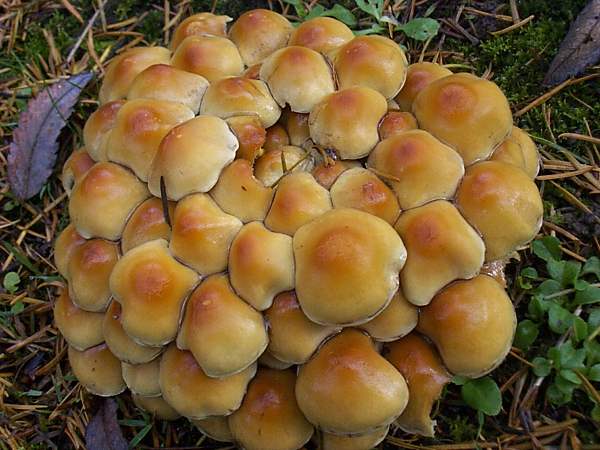
Hypholoma fasciculare, commonly known as the Sulphur Tuft or Clustered Woodlover, is a widespread saprophytic mushroom, typically found growing on decaying wood. It is known for its bright yellow to orange-brown cap and densely clustered growth habit. This mushroom is considered poisonous and can cause gastrointestinal upset if ingested.
How to Identify
- Cap
- The cap is typically 2-6 cm in diameter, initially convex, becoming more flattened with age. The color ranges from sulphur-yellow to orange-brown, often with a darker center. The cap surface is smooth and may have remnants of the partial veil along the margin.
- Gills
- The gills are crowded, adnate to adnexed, and initially sulphur-yellow, turning greenish-yellow to olive-brown as the spores mature.
- Stem
- The stem is slender, 4-10 cm long and 0.3-0.8 cm thick, yellowish, and often fibrous. It lacks a true ring, but may have a fibrillose zone near the apex. The stem base is often darker and may be slightly curved.
- Flesh
- The flesh is thin and yellowish, with a bitter taste.
- Fruiting body
- The fruiting body of Hypholoma fasciculare is characterized by a clustered arrangement of mushrooms growing from the same point on decaying wood.
- Habitat
- Hypholoma fasciculare grows on decaying wood, such as logs, stumps, and branches of deciduous and coniferous trees. It is commonly found in forests and wooded areas.
Key Facts
- Cap surfaces: Smooth
- Growth Form: Clustered
- Spore Print: Olive-brown
- Body color: Yellow to orange-brown
- Odor: Unpleasant
- Flesh bruises: No significant bruising
- Height: 4-10 cm
- Cap Diameter: 2-6 cm
- Nutrient gathering: Saprophytic
Toxic
Severe ToxicityHypholoma fasciculare is poisonous and contains compounds that can cause gastrointestinal distress if ingested. Symptoms may include nausea, vomiting, diarrhea, and abdominal cramps.
Quick Check
- Odor: Unpleasant or fungal
- Fruiting: Clustered on wood
- Substrate: Decaying wood
Where to Find
Forests
Common in deciduous and coniferous forests.
Wooded Areas
Grows on decaying wood in parks and gardens.
Finding Tips
Look for Decaying Wood
Search for clusters of mushrooms on logs, stumps, and fallen branches.
Check in Autumn
The Sulphur Tuft is most commonly found during the autumn months.
Similar Species
Brick Tuft
an edible mushroom
Also known as: Red Woodlover
Scientific Classification
- Phylum
- Basidiomycota
- Class
- Agaricomycetes
- Order
- Agaricales
- Family
- Strophariaceae
- Genus
- Hypholoma
Explore Sulphur Tuft
Identify mushrooms anywhere
Free on iOS, Android, and Web. Photo identification, full database, and your personal collection.