
Got a photo? Identify mushrooms instantly with the Mushby app
Open the appDescription
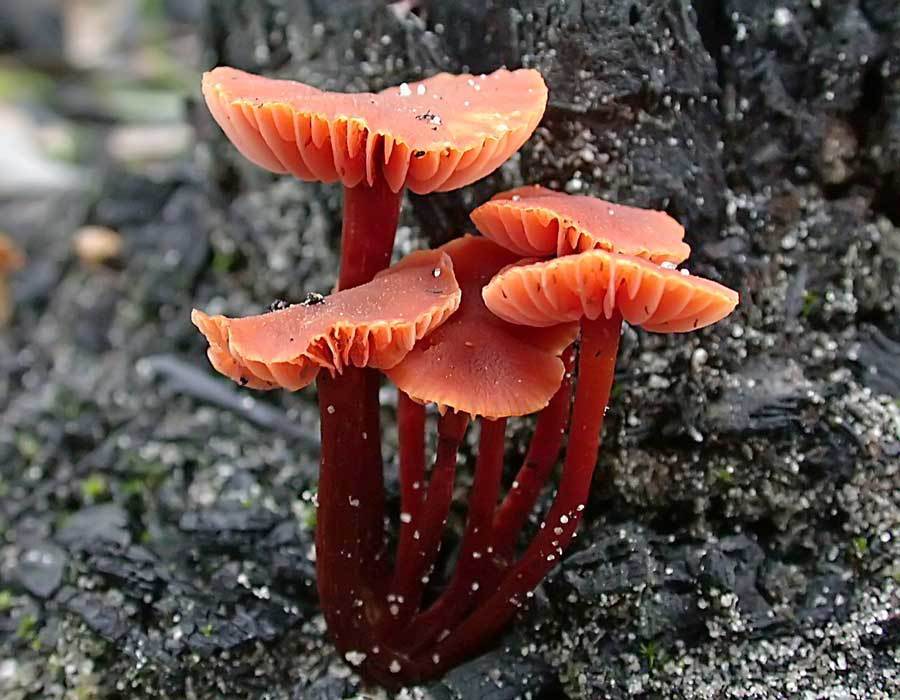
Hygrocybe conica, commonly known as the Blackening Waxcap, is a distinctive mushroom known for its conical cap shape and the characteristic blackening that occurs as it ages or when handled. It is found in grasslands and woodlands and is widely distributed. While not considered highly toxic, consumption is generally not recommended.
How to Identify
- Cap
- The cap is conical or bell-shaped, often with a pointed apex. It is typically orange to red when young, gradually darkening to black with age or bruising. The surface is smooth and dry, and it can be somewhat fibrous.
- Gills
- The gills are adnate to adnexed (narrowly attached to the stem), widely spaced, and waxy in texture. They are typically yellow to orange, darkening with age.
- Stem
- The stem is cylindrical, slender, and often brittle. It is typically the same color as the cap or slightly lighter, and it also blackens with age or handling. The surface is smooth to slightly fibrous.
- Flesh
- The flesh is thin and fragile, with a color similar to the cap. It blackens when bruised or cut.
- Fruiting body
- The fruiting body of Hygrocybe conica is typically small to medium-sized. The entire mushroom tends to blacken with age or upon handling.
- Habitat
- Hygrocybe conica is found in grasslands, meadows, and woodlands. It is often associated with disturbed soil and can be found in both coniferous and deciduous forests. It is widely distributed and can be found in many regions.
Key Facts
- Cap surfaces: Smooth, dry
- Growth Form: Solitary or scattered
- Spore Print: White
- Body color: Orange, red, blackening
- Odor: Mild
- Flesh bruises: Blackening
- Height: 3-8 cm
- Cap Diameter: 2-5 cm
- Nutrient gathering: Saprotrophic
Safe
Mild ToxicityWhile not considered highly toxic, consumption of Hygrocybe conica is generally not recommended as it can cause gastrointestinal upset in some individuals.
Quick Check
- Odor: Mild or indistinct
- Fruiting: Autumn
- Substrate: Grassland, woodland
Where to Find
Grasslands
Look for Hygrocybe conica in open grasslands and meadows, especially in areas with disturbed soil.
Woodlands
Search in woodlands, particularly along edges and in clearings where there is sufficient light.
Finding Tips
Check After Rain
Waxcaps often fruit after periods of rain, so it's a good time to search for them.
Look for Blackening
The blackening of the cap and stem is a key identifying feature, especially in older specimens.
Similar Species
Dune Waxcap
mushroom
Also known as: Hygrocybe conicoides
Scientific Classification
- Phylum
- Basidiomycota
- Class
- Agaricomycetes
- Order
- Agaricales
- Family
- Hygrophoraceae
- Genus
- Hygrocybe
Storage Information
- Max Temperature: N/A
- Freezing duration: N/A
- Min Temperature: N/A
- Refrigeration: N/A
How to Clean
Cleaning is not typically necessary as these mushrooms are not usually consumed. If desired, gently brush off any debris.
Explore Blackening Waxcap
Identify mushrooms anywhere
Free on iOS, Android, and Web. Photo identification, full database, and your personal collection.