
Got a photo? Identify mushrooms instantly with the Mushby app
Open the appDescription
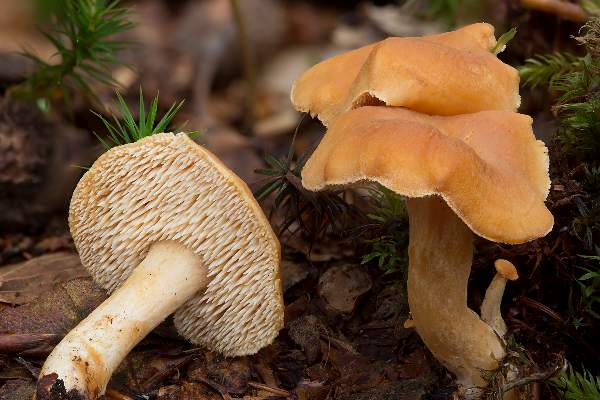
Hydnum rufescens, commonly known as the Terracotta Hedgehog or Rufous Hedgehog, is a widely distributed edible mushroom characterized by its distinctive tooth-like hymenium (underside of the cap) and its reddish-orange to terracotta coloration. It is closely related to the more common Wood Hedgehog (Hydnum repandum) but typically smaller and more uniformly colored.
How to Identify
- Cap
- The cap of Hydnum rufescens ranges from 2 to 10 cm (0.8 to 4 inches) in diameter, though usually 3-7 cm. It is typically convex when young, becoming plano-convex to somewhat depressed or irregular with age. The margin is often wavy or lobed, and sometimes slightly inrolled when young. The surface is dry, finely velvety or felted, becoming smoother with age, and typically lacks scales. The color is a key distinguishing feature, ranging from reddish-orange, terracotta, rufous, to apricot-orange, often with a slightly paler margin. It does not typically stain or bruise significantly.
- Gills
- Instead of gills, Hydnum rufescens possesses soft, brittle, downward-pointing spines or 'teeth' on the underside of the cap. These spines are typically 2-6 mm long, concolorous with the cap or slightly paler, and detach easily. They are decurrent, extending down the stem.
- Stem
- The stem is 2-7 cm (0.8 to 2.8 inches) long and 0.5-2 cm (0.2 to 0.8 inches) thick, often central but can be eccentric. It is solid, firm, and cylindrical or slightly tapering towards the base. The surface is smooth or finely pruinose, and its color is usually concolorous with the cap or slightly paler, often whitish towards the base. It does not have a ring or volva.
- Flesh
- The flesh is firm, brittle, and whitish to pale yellowish or orangish, especially under the cap cuticle. It does not change color significantly when cut or bruised. The odor is mild and pleasant, sometimes described as slightly fruity or mushroomy. The taste is mild, not bitter.
- Fruiting body
- The fruiting body is typically solitary to scattered, sometimes gregarious, but rarely truly clustered. It consists of a cap, a central or eccentric stem, and a distinctive toothed hymenium.
- Habitat
- Hydnum rufescens is a mycorrhizal fungus, forming symbiotic relationships with various tree species, primarily conifers (e.g., pine, spruce, fir) and broadleaf trees (e.g., oak, beech). It grows terrestrially, often scattered or in small groups, in mossy areas, leaf litter, or directly on soil in coniferous, deciduous, or mixed woodlands. It prefers well-drained, often acidic soils.
Key Facts
- Cap surfaces: Dry, finely velvety to felted, becoming smoother
- Growth Form: Solitary to scattered or gregarious
- Spore Print: White to pale cream
- Body color: Reddish-orange, terracotta, rufous, apricot-orange
- Odor: Mild, pleasant
- Flesh bruises: No significant bruising or color change
- Height: 2-7 cm
- Cap Diameter: 2-10 cm
- Nutrient gathering: Mycorrhizal
Safe
SafeHydnum rufescens is considered an excellent edible mushroom. There are no known toxic look-alikes with spines, making it a relatively safe mushroom for beginners to identify. However, as with all wild mushrooms, it should be cooked thoroughly. Some individuals may experience mild gastrointestinal upset if consumed raw or in large quantities, or if they have a specific sensitivity. Always try a small amount first when consuming any wild mushroom for the first time.
Quick Check
- Odor: Mild, pleasant, mushroomy
- Fruiting: Late summer to autumn
- Substrate: Terrestrial, mycorrhizal with conifers and broadleaf trees
Where to Find
Europe
Widespread across temperate Europe, particularly common in Scandinavia, the British Isles, and Central Europe.
North America
Found throughout temperate regions of North America, from the East Coast to the West Coast, and into parts of Mexico.
Asia
Reported from parts of Asia, including Japan and China, though its distribution may be less well-documented or differentiated from similar species.
Finding Tips
Preferred Habitat
Look in coniferous, deciduous, or mixed forests, often under pine, spruce, oak, or beech trees. They prefer mossy areas or leaf litter on well-drained soil.
Seasonality
Typically fruits from late summer through autumn, often peaking after periods of rain. In some milder climates, it can be found into early winter.
Distinguishing from H. repandum
H. rufescens is generally smaller, more uniformly reddish-orange, and has a more central stem compared to H. repandum, which is often larger, paler (buff to cream), and has a more irregular, often off-center cap and stem.
Spine Check
Always confirm the presence of easily detachable, soft spines on the underside of the cap, a key characteristic of the Hydnum genus.
Similar Species
Wood Hedgehog
Hydnum
Also known as: Sweet Tooth, Dentinum repandum
Giant Hedgehog
Hydnum
Also known as: Hydnum albidum (white form of H. repandum)
Scientific Classification
- Phylum
- Basidiomycota
- Class
- Agaricomycetes
- Order
- Cantharellales
- Family
- Hydnaceae
- Genus
- Hydnum
Storage Information
- Max Temperature: 4°C
- Freezing duration: 6 months
- Min Temperature: 0°C
- Refrigeration: 5 days
How to Clean
Gently brush off any debris, soil, or pine needles with a soft brush or damp cloth. The spines can sometimes trap dirt, so pay attention to the underside. Avoid washing under running water if possible, as they can absorb water and become soggy. If necessary, a quick rinse and immediate drying are acceptable.
Explore Terracotta Hedgehog
Identify mushrooms anywhere
Free on iOS, Android, and Web. Photo identification, full database, and your personal collection.