
Got a photo? Identify mushrooms instantly with the Mushby app
Open the appDescription
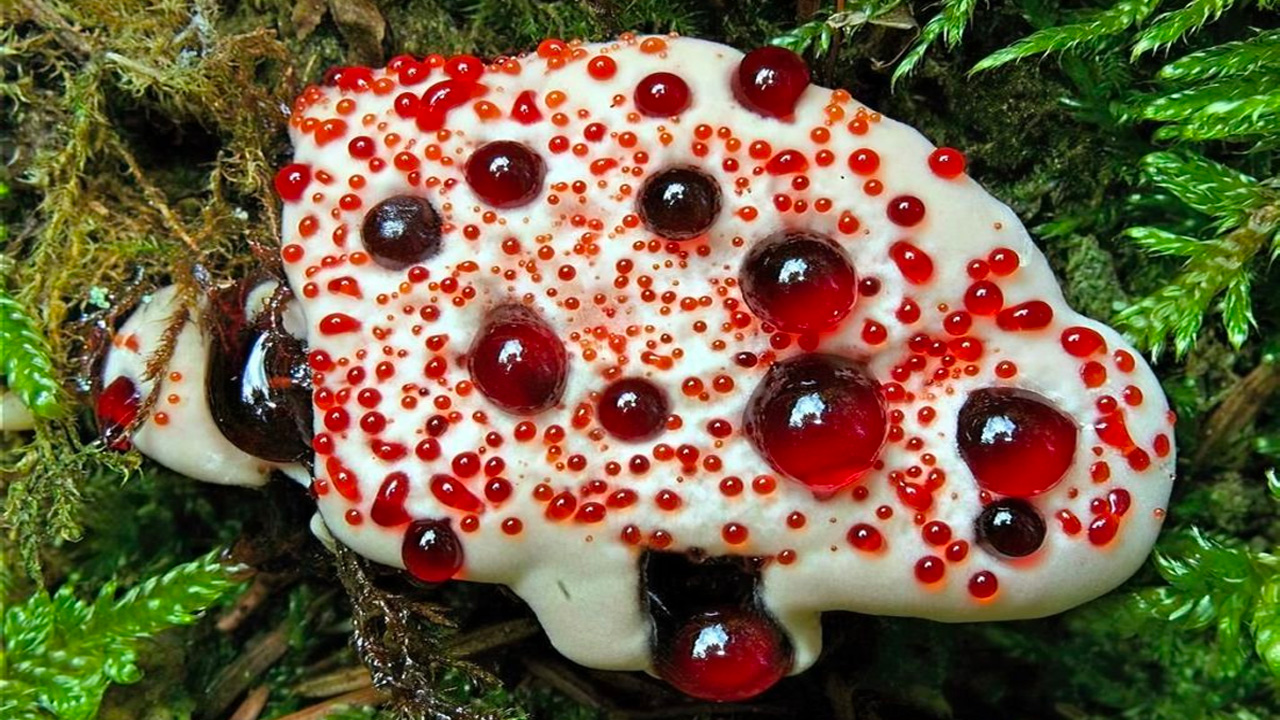
Hydnellum peckii, commonly known as the bleeding tooth fungus, is a fungus in the Hydnellum genus of the family Bankeraceae. It is easily recognizable for its red 'bleeding' liquid and the tooth-like spines on the underside of the cap. Although it is not poisonous, it has an extremely bitter taste and is inedible.
How to Identify
- Cap
- The cap is convex to depressed, with a velvety surface when young, becoming more rough and bumpy with age. The color ranges from whitish to brownish, often with reddish or pinkish areas.
- Gills
- This fungus does not have gills. Instead, it has small, tooth-like spines on the underside of the cap, from which the red liquid exudes.
- Stem
- The stem is short, thick, and often deformed, with a similar color to the cap.
- Flesh
- The flesh is pale pinkish-brown, tough, and fibrous.
- Fruiting body
- The fruit body of Hydnellum peckii is irregularly shaped and can grow up to 10 cm (4 in) tall and 7 cm (3 in) wide. Young specimens often 'bleed' a bright red juice.
- Habitat
- Hydnellum peckii is a mycorrhizal fungus, forming symbiotic relationships with various coniferous trees. It is typically found in coniferous forests in North America, Europe, and parts of Asia.
Key Facts
- Cap surfaces: Velvety when young, becoming rough and bumpy
- Growth Form: Terrestrial
- Spore Print: Brown
- Body color: Whitish to brownish, often with reddish or pinkish areas
- Odor: Earthy or fungal
- Flesh bruises: No significant bruising
- Height: Up to 10 cm
- Cap Diameter: Up to 7 cm
- Nutrient gathering: Mycorrhizal
Safe
SafeHydnellum peckii is not poisonous, but it is considered inedible due to its extremely bitter taste.
Quick Check
- Odor: Earthy or fungal
- Fruiting: Irregularly shaped fruit body with tooth-like spines
- Substrate: Grows on the ground in coniferous forests
Where to Find
North America
Common in coniferous forests, especially in the Pacific Northwest and Appalachian regions.
Europe
Found in various European countries, including Scotland, Germany, and Italy.
Asia
Reported in some parts of Asia, including Korea and Iran.
Finding Tips
Look for Coniferous Forests
Search in areas with pine, fir, and spruce trees, as Hydnellum peckii forms mycorrhizal associations with these trees.
Check Damp Areas
These fungi prefer moist environments, so look in areas with good moisture retention.
Observe the Ground
They often grow among leaf litter and moss, so pay attention to the forest floor.
Similar Species
Hydnellum caeruleum
Hydnellum
Also known as: Blue spine fungus
Hydnellum ferrugineum
Hydnellum
Also known as: Rusty spine fungus
Scientific Classification
- Phylum
- Basidiomycota
- Class
- Agaricomycetes
- Order
- Thelephorales
- Family
- Bankeraceae
- Genus
- Hydnellum
Storage Information
- Max Temperature: 25°C
- Freezing duration: N/A (Not typically stored)
- Min Temperature: 2°C
- Refrigeration: 1-2 days (for study purposes only)
How to Clean
Hydnellum peckii is not typically cleaned for consumption due to its inedible nature. However, if you were to clean it for study, gently brush off any dirt or debris with a soft brush.
Explore Bleeding Tooth Fungus
Identify mushrooms anywhere
Free on iOS, Android, and Web. Photo identification, full database, and your personal collection.